

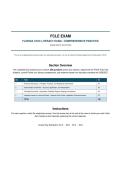
FCLE EXAM
FLORIDA CIVIC LITERACY EXAM - COMPREHENSIVE PRACTICE
2026/2027 EDITION
This is an independent practice exam for educational study; it is not an official Florida Department of Education FCLE.
Section Overview
This comprehensive practice exam contains 200 questions across four sections, aligned with the FDOE FCLE test
blueprint, current Florida civic literacy competencies, and evidence-based civic education standards for 2026/2027.
Sec Topic Qs
1 American Democracy - Principles, Practices, and Republican Government 50
2 United States Constitution - Structure, Application, and Interpretation 50
3 Founding Documents - Declaration, Federalist Papers, Shaping of Institutions 50
4 Landmark Impact on Law and Society - Supreme Court Cases, Legislation, Executive Actions 50
TOTAL 200
Instructions
For each question, select the single best answer. Use the answer key at the end of the exam to check your work. Each
item includes a brief rationale explaining the correct response.
Answer Key Distribution: 50 A · 50 B · 50 C · 50 D
, Section 1: American Democracy - Basic Principles and Practices of American Democracy and
Their Application in Our Republican Form of Government
Q1: The principle that government authority comes from the consent of the people is known as:
A. Monarchy
B. Divine right
C. Oligarchy
D. Popular sovereignty [CORRECT]
Correct Answer: D
Rationale: Popular sovereignty holds that government power derives from the people. The other options are different forms of
government or principles.
Q2: The United States has which form of government?
A. A constitutional republic [CORRECT]
B. A direct democracy
C. An absolute monarchy
D. A theocracy
Correct Answer: A
Rationale: The U.S. is a constitutional republic, not a direct democracy. The other options are different forms.
Q3: The 'rule of law' means that:
A. Everyone, including government officials, is subject to the law [CORRECT]
B. Only citizens must follow the law
C. The government is above the law
D. Laws do not apply to elected leaders
Correct Answer: A
Rationale: The rule of law means all persons, including officials, are subject to the law. The other options contradict this.
Q4: 'Separation of powers' refers to:
A. The division between federal and state governments
B. The separation of church and state
C. The separation of powers among citizens
D. The division of government into legislative, executive, and judicial branches [CORRECT]
Correct Answer: D
Rationale: Separation of powers divides government into three branches. Federalism divides federal and state powers.
Q5: 'Checks and balances' means:
A. Each branch can limit the powers of the other branches [CORRECT]
B. One branch has all the power
C. The people check the government only
D. States check the federal government only
Correct Answer: A
Rationale: Checks and balances allow each branch to limit the others. The other options are incorrect.
Q6: Which branch of government makes laws?
A. The legislative branch [CORRECT]
B. The executive branch
C. The judicial branch
D. The military
Correct Answer: A
Rationale: The legislative branch (Congress) makes laws. The executive enforces, the judicial interprets.
Q7: Which branch of government enforces laws?
A. The legislative branch
B. The judicial branch
C. The executive branch [CORRECT]
FCLE Exam - Florida Civic Literacy Exam - 2026/2027 Page 2
, D. The states only
Correct Answer: C
Rationale: The executive branch enforces laws. The other options have different roles.
Q8: Which branch of government interprets laws and the Constitution?
A. The judicial branch [CORRECT]
B. The legislative branch
C. The executive branch
D. The states
Correct Answer: A
Rationale: The judicial branch interprets laws and the Constitution. The other options have different roles.
Q9: The president of the United States is the head of which branch?
A. The legislative branch
B. The executive branch [CORRECT]
C. The judicial branch
D. The states
Correct Answer: B
Rationale: The president heads the executive branch. The other options are different branches.
Q10: Which body is part of the legislative branch?
A. The Supreme Court
B. The President's Cabinet
C. Congress (the House and Senate) [CORRECT]
D. The military
Correct Answer: C
Rationale: Congress (House and Senate) is the legislative branch. The other options are different branches.
Q11: The principle of 'federalism' divides power between:
A. The three branches
B. The national government and state governments [CORRECT]
C. The president and Congress
D. The courts and the president
Correct Answer: B
Rationale: Federalism divides power between national and state governments. The other options describe other divisions.
Q12: Under the U.S. system, powers not delegated to the national government and not prohibited to the states are
reserved to:
A. The states or the people [CORRECT]
B. The federal government
C. The president
D. The courts
Correct Answer: A
Rationale: The Tenth Amendment reserves undelegated powers to the states or the people. The other options are incorrect.
Q13: 'Popular sovereignty' is best illustrated by:
A. Citizens voting to elect representatives [CORRECT]
B. A monarch ruling by birth
C. The military ruling
D. Judges making all decisions
Correct Answer: A
Rationale: Popular sovereignty is reflected in citizens voting. The other options are different forms of rule.
Q14: In a 'republic,' the people:
A. Elect representatives to govern [CORRECT]
B. Govern directly on every issue
C. Have no role
FCLE Exam - Florida Civic Literacy Exam - 2026/2027 Page 3
, D. Are ruled by a monarch
Correct Answer: A
Rationale: In a republic, the people elect representatives. The other options are incorrect.
Q15: 'Individual rights' in a democracy are protected primarily to:
A. Allow the government to control citizens
B. Limit voting
C. Abolish freedoms
D. Protect citizens from government overreach [CORRECT]
Correct Answer: D
Rationale: Individual rights protect citizens from government overreach. The other options are incorrect.
Q16: Which of the following is a civic responsibility of citizens?
A. Ignoring elections
B. Avoiding civic duties
C. Voting and serving on juries [CORRECT]
D. Only paying no taxes
Correct Answer: C
Rationale: Voting and jury service are civic responsibilities. The other options are not responsibilities.
Q17: The principle that the government's power is limited by law is:
A. Unlimited government
B. Tyranny
C. Monarchy
D. Limited government [CORRECT]
Correct Answer: D
Rationale: Limited government means the government's power is constrained by law. The other options are not.
Q18: Which is an example of the separation of powers at work?
A. The president makes laws alone
B. Congress passes a law, and the president vetoes it [CORRECT]
C. The courts make laws
D. The president judges cases
Correct Answer: B
Rationale: Congress passing and the president vetoing a law illustrates separation/checks. The other options mix branch roles.
Q19: A 'veto' is:
A. A law
B. A court ruling
C. An amendment
D. The president's power to reject a bill passed by Congress [CORRECT]
Correct Answer: D
Rationale: A veto is the president's power to reject legislation. The other options are incorrect.
Q20: The power to override a presidential veto belongs to:
A. The Supreme Court
B. The states
C. The president
D. Congress (a two-thirds vote in both houses) [CORRECT]
Correct Answer: D
Rationale: Congress can override a veto with a two-thirds vote in both houses. The other options are incorrect.
Q21: Which is an example of checks and balances?
A. The president making a law
B. The Senate confirming a presidential appointment [CORRECT]
C. The courts passing laws
D. Congress judging cases
FCLE Exam - Florida Civic Literacy Exam - 2026/2027 Page 4
FLORIDA CIVIC LITERACY EXAM - COMPREHENSIVE PRACTICE
2026/2027 EDITION
This is an independent practice exam for educational study; it is not an official Florida Department of Education FCLE.
Section Overview
This comprehensive practice exam contains 200 questions across four sections, aligned with the FDOE FCLE test
blueprint, current Florida civic literacy competencies, and evidence-based civic education standards for 2026/2027.
Sec Topic Qs
1 American Democracy - Principles, Practices, and Republican Government 50
2 United States Constitution - Structure, Application, and Interpretation 50
3 Founding Documents - Declaration, Federalist Papers, Shaping of Institutions 50
4 Landmark Impact on Law and Society - Supreme Court Cases, Legislation, Executive Actions 50
TOTAL 200
Instructions
For each question, select the single best answer. Use the answer key at the end of the exam to check your work. Each
item includes a brief rationale explaining the correct response.
Answer Key Distribution: 50 A · 50 B · 50 C · 50 D
, Section 1: American Democracy - Basic Principles and Practices of American Democracy and
Their Application in Our Republican Form of Government
Q1: The principle that government authority comes from the consent of the people is known as:
A. Monarchy
B. Divine right
C. Oligarchy
D. Popular sovereignty [CORRECT]
Correct Answer: D
Rationale: Popular sovereignty holds that government power derives from the people. The other options are different forms of
government or principles.
Q2: The United States has which form of government?
A. A constitutional republic [CORRECT]
B. A direct democracy
C. An absolute monarchy
D. A theocracy
Correct Answer: A
Rationale: The U.S. is a constitutional republic, not a direct democracy. The other options are different forms.
Q3: The 'rule of law' means that:
A. Everyone, including government officials, is subject to the law [CORRECT]
B. Only citizens must follow the law
C. The government is above the law
D. Laws do not apply to elected leaders
Correct Answer: A
Rationale: The rule of law means all persons, including officials, are subject to the law. The other options contradict this.
Q4: 'Separation of powers' refers to:
A. The division between federal and state governments
B. The separation of church and state
C. The separation of powers among citizens
D. The division of government into legislative, executive, and judicial branches [CORRECT]
Correct Answer: D
Rationale: Separation of powers divides government into three branches. Federalism divides federal and state powers.
Q5: 'Checks and balances' means:
A. Each branch can limit the powers of the other branches [CORRECT]
B. One branch has all the power
C. The people check the government only
D. States check the federal government only
Correct Answer: A
Rationale: Checks and balances allow each branch to limit the others. The other options are incorrect.
Q6: Which branch of government makes laws?
A. The legislative branch [CORRECT]
B. The executive branch
C. The judicial branch
D. The military
Correct Answer: A
Rationale: The legislative branch (Congress) makes laws. The executive enforces, the judicial interprets.
Q7: Which branch of government enforces laws?
A. The legislative branch
B. The judicial branch
C. The executive branch [CORRECT]
FCLE Exam - Florida Civic Literacy Exam - 2026/2027 Page 2
, D. The states only
Correct Answer: C
Rationale: The executive branch enforces laws. The other options have different roles.
Q8: Which branch of government interprets laws and the Constitution?
A. The judicial branch [CORRECT]
B. The legislative branch
C. The executive branch
D. The states
Correct Answer: A
Rationale: The judicial branch interprets laws and the Constitution. The other options have different roles.
Q9: The president of the United States is the head of which branch?
A. The legislative branch
B. The executive branch [CORRECT]
C. The judicial branch
D. The states
Correct Answer: B
Rationale: The president heads the executive branch. The other options are different branches.
Q10: Which body is part of the legislative branch?
A. The Supreme Court
B. The President's Cabinet
C. Congress (the House and Senate) [CORRECT]
D. The military
Correct Answer: C
Rationale: Congress (House and Senate) is the legislative branch. The other options are different branches.
Q11: The principle of 'federalism' divides power between:
A. The three branches
B. The national government and state governments [CORRECT]
C. The president and Congress
D. The courts and the president
Correct Answer: B
Rationale: Federalism divides power between national and state governments. The other options describe other divisions.
Q12: Under the U.S. system, powers not delegated to the national government and not prohibited to the states are
reserved to:
A. The states or the people [CORRECT]
B. The federal government
C. The president
D. The courts
Correct Answer: A
Rationale: The Tenth Amendment reserves undelegated powers to the states or the people. The other options are incorrect.
Q13: 'Popular sovereignty' is best illustrated by:
A. Citizens voting to elect representatives [CORRECT]
B. A monarch ruling by birth
C. The military ruling
D. Judges making all decisions
Correct Answer: A
Rationale: Popular sovereignty is reflected in citizens voting. The other options are different forms of rule.
Q14: In a 'republic,' the people:
A. Elect representatives to govern [CORRECT]
B. Govern directly on every issue
C. Have no role
FCLE Exam - Florida Civic Literacy Exam - 2026/2027 Page 3
, D. Are ruled by a monarch
Correct Answer: A
Rationale: In a republic, the people elect representatives. The other options are incorrect.
Q15: 'Individual rights' in a democracy are protected primarily to:
A. Allow the government to control citizens
B. Limit voting
C. Abolish freedoms
D. Protect citizens from government overreach [CORRECT]
Correct Answer: D
Rationale: Individual rights protect citizens from government overreach. The other options are incorrect.
Q16: Which of the following is a civic responsibility of citizens?
A. Ignoring elections
B. Avoiding civic duties
C. Voting and serving on juries [CORRECT]
D. Only paying no taxes
Correct Answer: C
Rationale: Voting and jury service are civic responsibilities. The other options are not responsibilities.
Q17: The principle that the government's power is limited by law is:
A. Unlimited government
B. Tyranny
C. Monarchy
D. Limited government [CORRECT]
Correct Answer: D
Rationale: Limited government means the government's power is constrained by law. The other options are not.
Q18: Which is an example of the separation of powers at work?
A. The president makes laws alone
B. Congress passes a law, and the president vetoes it [CORRECT]
C. The courts make laws
D. The president judges cases
Correct Answer: B
Rationale: Congress passing and the president vetoing a law illustrates separation/checks. The other options mix branch roles.
Q19: A 'veto' is:
A. A law
B. A court ruling
C. An amendment
D. The president's power to reject a bill passed by Congress [CORRECT]
Correct Answer: D
Rationale: A veto is the president's power to reject legislation. The other options are incorrect.
Q20: The power to override a presidential veto belongs to:
A. The Supreme Court
B. The states
C. The president
D. Congress (a two-thirds vote in both houses) [CORRECT]
Correct Answer: D
Rationale: Congress can override a veto with a two-thirds vote in both houses. The other options are incorrect.
Q21: Which is an example of checks and balances?
A. The president making a law
B. The Senate confirming a presidential appointment [CORRECT]
C. The courts passing laws
D. Congress judging cases
FCLE Exam - Florida Civic Literacy Exam - 2026/2027 Page 4


