

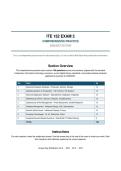
ITE 152 EXAM 3
COMPREHENSIVE PRACTICE
2026/2027 EDITION
This is an independent practice exam for educational study; it is not an official Wall Street Prep certification examination.
Section Overview
This comprehensive practice exam contains 100 questions across nine sections, aligned with the standard
introductory information technology curriculum, current digital literacy standards, and evidence-based computer
applications practices for 2026/2027.
Sec Topic Qs
1 Advanced Computer Hardware - Processors, Memory, Storage 12
2 Operating Systems & Virtualization - OS Functions, File Systems 12
3 Advanced Application Software - Spreadsheets, Databases, Integration 16
4 Networking & Internet - Security, Protocols, Troubleshooting 12
5 Cybersecurity & Risk Management - Threat Assessment, Incident Response 12
6 Database Management - Relational Design, SQL, Normalization 10
7 Social & Ethical Issues - Intellectual Property, Privacy 10
8 Emerging Technologies - AI, IoT, Blockchain, Cloud 10
9 Integrated Scenario-Based Questions - Real-World IT Problem Solving 6
TOTAL 100
Instructions
For each question, select the single best answer. Use the answer key at the end of the exam to check your work. Each
item includes a brief rationale explaining the correct response.
Answer Key Distribution: 25 A · 25 B · 25 C · 25 D
, Section 1: Advanced Computer Hardware - Processors, Memory Hierarchy, and
Storage Technologies
Q1: CPU pipelining improves performance by:
A. Overlapping the execution of multiple instructions [CORRECT]
B. Increasing the clock speed only
C. Adding more RAM
D. Reducing the cache
Correct Answer: A
Rationale: Pipelining overlaps instruction execution to improve throughput. The other options are incorrect.
Q2: A multicore CPU:
A. Contains multiple processing cores on one chip [CORRECT]
B. Has a single core
C. Only increases storage
D. Is only for servers
Correct Answer: A
Rationale: A multicore CPU has multiple cores on one chip. The other options are incorrect.
Q3: The memory hierarchy, from fastest to slowest, is generally:
A. RAM, cache, registers, storage
B. Registers, cache, RAM, secondary storage [CORRECT]
C. Storage, RAM, cache, registers
D. Cache, storage, RAM, registers
Correct Answer: B
Rationale: Registers are fastest, then cache, then RAM, then secondary storage. The other options are incorrect.
Q4: Cache memory is:
A. A type of hard drive
B. RAM that is always full
C. A peripheral
D. A small, fast memory close to the CPU [CORRECT]
Correct Answer: D
Rationale: Cache is small, fast memory near the CPU. The other options are incorrect.
Q5: Virtual memory uses:
A. Only RAM
B. Disk space to extend the apparent amount of RAM [CORRECT]
C. Only the CPU
D. Only the cache
Correct Answer: B
Rationale: Virtual memory uses disk space to extend apparent RAM. The other options are incorrect.
Q6: Which is an advantage of an SSD over an HDD?
A. Larger physical size
B. Higher power use
C. Slower performance
D. Faster access and no moving parts [CORRECT]
Correct Answer: D
Rationale: SSDs are faster and have no moving parts. The other options are incorrect.
Q7: RAID 1 (mirroring) provides:
A. Redundancy by duplicating data across two disks [CORRECT]
ITE 152 Exam 3 - 2026/2027 Page 2
, B. Faster writes only
C. No redundancy
D. Only more storage without redundancy
Correct Answer: A
Rationale: RAID 1 mirrors data for redundancy. The other options are incorrect.
Q8: Which interface is commonly used to connect modern external devices?
A. SATA only
B. The CPU socket
C. The RAM slot
D. USB [CORRECT]
Correct Answer: D
Rationale: USB is a common external interface. The other options are internal or not interfaces.
Q9: Thunderbolt is:
A. A type of RAM
B. A high-speed interface that can carry data, video, and power [CORRECT]
C. A CPU
D. A printer
Correct Answer: B
Rationale: Thunderbolt is a high-speed interface carrying data, video, and power. The other options are incorrect.
Q10: HDMI is primarily used to:
A. Transmit audio and video to a display [CORRECT]
B. Store data
C. Cool the CPU
D. Provide power
Correct Answer: A
Rationale: HDMI transmits audio/video to a display. The other options are incorrect.
Q11: The 'clock speed' of a CPU is measured in:
A. GHz (gigahertz) [CORRECT]
B. GB (gigabytes)
C. Mbps
D. Watts
Correct Answer: A
Rationale: CPU clock speed is measured in gigahertz. The other options measure other things.
Q12: Which is an example of a volatile memory that loses data on power-off?
A. ROM
B. An SSD
C. RAM [CORRECT]
D. An HDD
Correct Answer: C
Rationale: RAM is volatile. ROM, SSDs, and HDDs are non-volatile.
Section 2: Operating Systems & Virtualization - OS Functions, File Systems, and
Virtual Machines
Q13: Process management in an OS involves:
A. Managing the execution and scheduling of processes [CORRECT]
B. Only storing files
ITE 152 Exam 3 - 2026/2027 Page 3
COMPREHENSIVE PRACTICE
2026/2027 EDITION
This is an independent practice exam for educational study; it is not an official Wall Street Prep certification examination.
Section Overview
This comprehensive practice exam contains 100 questions across nine sections, aligned with the standard
introductory information technology curriculum, current digital literacy standards, and evidence-based computer
applications practices for 2026/2027.
Sec Topic Qs
1 Advanced Computer Hardware - Processors, Memory, Storage 12
2 Operating Systems & Virtualization - OS Functions, File Systems 12
3 Advanced Application Software - Spreadsheets, Databases, Integration 16
4 Networking & Internet - Security, Protocols, Troubleshooting 12
5 Cybersecurity & Risk Management - Threat Assessment, Incident Response 12
6 Database Management - Relational Design, SQL, Normalization 10
7 Social & Ethical Issues - Intellectual Property, Privacy 10
8 Emerging Technologies - AI, IoT, Blockchain, Cloud 10
9 Integrated Scenario-Based Questions - Real-World IT Problem Solving 6
TOTAL 100
Instructions
For each question, select the single best answer. Use the answer key at the end of the exam to check your work. Each
item includes a brief rationale explaining the correct response.
Answer Key Distribution: 25 A · 25 B · 25 C · 25 D
, Section 1: Advanced Computer Hardware - Processors, Memory Hierarchy, and
Storage Technologies
Q1: CPU pipelining improves performance by:
A. Overlapping the execution of multiple instructions [CORRECT]
B. Increasing the clock speed only
C. Adding more RAM
D. Reducing the cache
Correct Answer: A
Rationale: Pipelining overlaps instruction execution to improve throughput. The other options are incorrect.
Q2: A multicore CPU:
A. Contains multiple processing cores on one chip [CORRECT]
B. Has a single core
C. Only increases storage
D. Is only for servers
Correct Answer: A
Rationale: A multicore CPU has multiple cores on one chip. The other options are incorrect.
Q3: The memory hierarchy, from fastest to slowest, is generally:
A. RAM, cache, registers, storage
B. Registers, cache, RAM, secondary storage [CORRECT]
C. Storage, RAM, cache, registers
D. Cache, storage, RAM, registers
Correct Answer: B
Rationale: Registers are fastest, then cache, then RAM, then secondary storage. The other options are incorrect.
Q4: Cache memory is:
A. A type of hard drive
B. RAM that is always full
C. A peripheral
D. A small, fast memory close to the CPU [CORRECT]
Correct Answer: D
Rationale: Cache is small, fast memory near the CPU. The other options are incorrect.
Q5: Virtual memory uses:
A. Only RAM
B. Disk space to extend the apparent amount of RAM [CORRECT]
C. Only the CPU
D. Only the cache
Correct Answer: B
Rationale: Virtual memory uses disk space to extend apparent RAM. The other options are incorrect.
Q6: Which is an advantage of an SSD over an HDD?
A. Larger physical size
B. Higher power use
C. Slower performance
D. Faster access and no moving parts [CORRECT]
Correct Answer: D
Rationale: SSDs are faster and have no moving parts. The other options are incorrect.
Q7: RAID 1 (mirroring) provides:
A. Redundancy by duplicating data across two disks [CORRECT]
ITE 152 Exam 3 - 2026/2027 Page 2
, B. Faster writes only
C. No redundancy
D. Only more storage without redundancy
Correct Answer: A
Rationale: RAID 1 mirrors data for redundancy. The other options are incorrect.
Q8: Which interface is commonly used to connect modern external devices?
A. SATA only
B. The CPU socket
C. The RAM slot
D. USB [CORRECT]
Correct Answer: D
Rationale: USB is a common external interface. The other options are internal or not interfaces.
Q9: Thunderbolt is:
A. A type of RAM
B. A high-speed interface that can carry data, video, and power [CORRECT]
C. A CPU
D. A printer
Correct Answer: B
Rationale: Thunderbolt is a high-speed interface carrying data, video, and power. The other options are incorrect.
Q10: HDMI is primarily used to:
A. Transmit audio and video to a display [CORRECT]
B. Store data
C. Cool the CPU
D. Provide power
Correct Answer: A
Rationale: HDMI transmits audio/video to a display. The other options are incorrect.
Q11: The 'clock speed' of a CPU is measured in:
A. GHz (gigahertz) [CORRECT]
B. GB (gigabytes)
C. Mbps
D. Watts
Correct Answer: A
Rationale: CPU clock speed is measured in gigahertz. The other options measure other things.
Q12: Which is an example of a volatile memory that loses data on power-off?
A. ROM
B. An SSD
C. RAM [CORRECT]
D. An HDD
Correct Answer: C
Rationale: RAM is volatile. ROM, SSDs, and HDDs are non-volatile.
Section 2: Operating Systems & Virtualization - OS Functions, File Systems, and
Virtual Machines
Q13: Process management in an OS involves:
A. Managing the execution and scheduling of processes [CORRECT]
B. Only storing files
ITE 152 Exam 3 - 2026/2027 Page 3


