

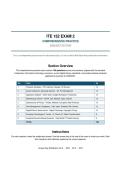
ITE 152 EXAM 2
COMPREHENSIVE PRACTICE
2026/2027 EDITION
This is an independent practice exam for educational study; it is not an official Wall Street Prep certification examination.
Section Overview
This comprehensive practice exam contains 100 questions across nine sections, aligned with the standard
introductory information technology curriculum, current digital literacy standards, and evidence-based computer
applications practices for 2026/2027.
Sec Topic Qs
1 Computer Hardware - CPU, Memory, Storage, I/O Devices 15
2 System Software & Operating Systems - OS, File Management 12
3 Application Software - Office Suite, Google Workspace, Productivity 15
4 Networking & Internet - TCP/IP, OSI, Network Types, Internet 12
5 Cybersecurity & Privacy - Threats, Malware, Encryption, Best Practices 12
6 Data Management & Databases - Data Types, Relational DB, Queries 10
7 Digital Ethics & Social Issues - Digital Citizenship, Copyright, Privacy 10
8 Emerging Technologies & Trends - AI, Cloud, IoT, Digital Transformation 8
9 Integrated Scenario-Based Questions - Real-World IT Problem Solving 6
TOTAL 100
Instructions
For each question, select the single best answer. Use the answer key at the end of the exam to check your work. Each
item includes a brief rationale explaining the correct response.
Answer Key Distribution: 25 A · 25 B · 25 C · 25 D
, Section 1: Computer Hardware - CPU, Memory, Storage, Input/Output Devices, and
Peripherals
Q1: The CPU (central processing unit) is often called the:
A. Storage device
B. Brain of the computer [CORRECT]
C. Monitor
D. Printer
Correct Answer: B
Rationale: The CPU is the 'brain' of the computer that processes instructions. The other options are not the CPU.
Q2: Which type of memory is volatile and loses data when the computer is turned off?
A. RAM (random access memory) [CORRECT]
B. ROM
C. A hard drive
D. An SSD
Correct Answer: A
Rationale: RAM is volatile and loses data on power-off. ROM and storage are non-volatile.
Q3: ROM (read-only memory) is:
A. Volatile memory
B. A type of storage only
C. Always user-writable
D. Non-volatile memory that retains data without power [CORRECT]
Correct Answer: D
Rationale: ROM is non-volatile and retains data without power. The other options are incorrect.
Q4: Which is a permanent storage device?
A. RAM
B. The CPU cache
C. A hard disk drive (HDD) or solid-state drive (SSD) [CORRECT]
D. A register
Correct Answer: C
Rationale: HDDs and SSDs are permanent storage. The other options are volatile memory.
Q5: Which is an input device?
A. A keyboard [CORRECT]
B. A monitor
C. A printer
D. A speaker
Correct Answer: A
Rationale: A keyboard is an input device. Monitors, printers, and speakers are output devices.
Q6: Which is an output device?
A. A keyboard
B. A monitor [CORRECT]
C. A mouse
D. A scanner
Correct Answer: B
Rationale: A monitor is an output device. Keyboards, mice, and scanners are input devices.
Q7: A solid-state drive (SSD) differs from an HDD because it:
A. Has spinning disks
ITE 152 Exam 2 - 2026/2027 Page 2
, B. Is always slower
C. Is larger
D. Has no moving parts and is faster [CORRECT]
Correct Answer: D
Rationale: An SSD has no moving parts and is faster than an HDD. The other options are incorrect.
Q8: Which unit measures CPU clock speed?
A. Gigahertz (GHz) [CORRECT]
B. Gigabytes (GB)
C. Megapixels
D. Lumens
Correct Answer: A
Rationale: CPU speed is measured in gigahertz (GHz). The other options measure other things.
Q9: Which is an example of a peripheral device?
A. A printer [CORRECT]
B. The CPU
C. RAM
D. The motherboard
Correct Answer: A
Rationale: A printer is a peripheral. The CPU, RAM, and motherboard are internal components.
Q10: A touchscreen serves as:
A. Only an input device
B. Only an output device
C. Both an input and output device [CORRECT]
D. Neither
Correct Answer: C
Rationale: A touchscreen is both an input and output device. The other options are incorrect.
Q11: Which is used to permanently store the computer's startup (boot) instructions?
A. RAM
B. The CPU cache
C. A USB drive
D. ROM/BIOS (or UEFI) [CORRECT]
Correct Answer: D
Rationale: The BIOS/UEFI in ROM stores boot instructions. The other options are incorrect.
Q12: Which is an example of cloud storage?
A. Storing on an internal HDD
B. Storing on a USB stick
C. Storing on a DVD
D. Storing files on an online service such as Google Drive or OneDrive [CORRECT]
Correct Answer: D
Rationale: Cloud storage is online (e.g., Google Drive, OneDrive). The other options are local storage.
Q13: The motherboard is:
A. The main circuit board that connects all components [CORRECT]
B. A type of memory
C. A storage device
D. An output device
Correct Answer: A
Rationale: The motherboard connects all components. The other options are incorrect.
ITE 152 Exam 2 - 2026/2027 Page 3
COMPREHENSIVE PRACTICE
2026/2027 EDITION
This is an independent practice exam for educational study; it is not an official Wall Street Prep certification examination.
Section Overview
This comprehensive practice exam contains 100 questions across nine sections, aligned with the standard
introductory information technology curriculum, current digital literacy standards, and evidence-based computer
applications practices for 2026/2027.
Sec Topic Qs
1 Computer Hardware - CPU, Memory, Storage, I/O Devices 15
2 System Software & Operating Systems - OS, File Management 12
3 Application Software - Office Suite, Google Workspace, Productivity 15
4 Networking & Internet - TCP/IP, OSI, Network Types, Internet 12
5 Cybersecurity & Privacy - Threats, Malware, Encryption, Best Practices 12
6 Data Management & Databases - Data Types, Relational DB, Queries 10
7 Digital Ethics & Social Issues - Digital Citizenship, Copyright, Privacy 10
8 Emerging Technologies & Trends - AI, Cloud, IoT, Digital Transformation 8
9 Integrated Scenario-Based Questions - Real-World IT Problem Solving 6
TOTAL 100
Instructions
For each question, select the single best answer. Use the answer key at the end of the exam to check your work. Each
item includes a brief rationale explaining the correct response.
Answer Key Distribution: 25 A · 25 B · 25 C · 25 D
, Section 1: Computer Hardware - CPU, Memory, Storage, Input/Output Devices, and
Peripherals
Q1: The CPU (central processing unit) is often called the:
A. Storage device
B. Brain of the computer [CORRECT]
C. Monitor
D. Printer
Correct Answer: B
Rationale: The CPU is the 'brain' of the computer that processes instructions. The other options are not the CPU.
Q2: Which type of memory is volatile and loses data when the computer is turned off?
A. RAM (random access memory) [CORRECT]
B. ROM
C. A hard drive
D. An SSD
Correct Answer: A
Rationale: RAM is volatile and loses data on power-off. ROM and storage are non-volatile.
Q3: ROM (read-only memory) is:
A. Volatile memory
B. A type of storage only
C. Always user-writable
D. Non-volatile memory that retains data without power [CORRECT]
Correct Answer: D
Rationale: ROM is non-volatile and retains data without power. The other options are incorrect.
Q4: Which is a permanent storage device?
A. RAM
B. The CPU cache
C. A hard disk drive (HDD) or solid-state drive (SSD) [CORRECT]
D. A register
Correct Answer: C
Rationale: HDDs and SSDs are permanent storage. The other options are volatile memory.
Q5: Which is an input device?
A. A keyboard [CORRECT]
B. A monitor
C. A printer
D. A speaker
Correct Answer: A
Rationale: A keyboard is an input device. Monitors, printers, and speakers are output devices.
Q6: Which is an output device?
A. A keyboard
B. A monitor [CORRECT]
C. A mouse
D. A scanner
Correct Answer: B
Rationale: A monitor is an output device. Keyboards, mice, and scanners are input devices.
Q7: A solid-state drive (SSD) differs from an HDD because it:
A. Has spinning disks
ITE 152 Exam 2 - 2026/2027 Page 2
, B. Is always slower
C. Is larger
D. Has no moving parts and is faster [CORRECT]
Correct Answer: D
Rationale: An SSD has no moving parts and is faster than an HDD. The other options are incorrect.
Q8: Which unit measures CPU clock speed?
A. Gigahertz (GHz) [CORRECT]
B. Gigabytes (GB)
C. Megapixels
D. Lumens
Correct Answer: A
Rationale: CPU speed is measured in gigahertz (GHz). The other options measure other things.
Q9: Which is an example of a peripheral device?
A. A printer [CORRECT]
B. The CPU
C. RAM
D. The motherboard
Correct Answer: A
Rationale: A printer is a peripheral. The CPU, RAM, and motherboard are internal components.
Q10: A touchscreen serves as:
A. Only an input device
B. Only an output device
C. Both an input and output device [CORRECT]
D. Neither
Correct Answer: C
Rationale: A touchscreen is both an input and output device. The other options are incorrect.
Q11: Which is used to permanently store the computer's startup (boot) instructions?
A. RAM
B. The CPU cache
C. A USB drive
D. ROM/BIOS (or UEFI) [CORRECT]
Correct Answer: D
Rationale: The BIOS/UEFI in ROM stores boot instructions. The other options are incorrect.
Q12: Which is an example of cloud storage?
A. Storing on an internal HDD
B. Storing on a USB stick
C. Storing on a DVD
D. Storing files on an online service such as Google Drive or OneDrive [CORRECT]
Correct Answer: D
Rationale: Cloud storage is online (e.g., Google Drive, OneDrive). The other options are local storage.
Q13: The motherboard is:
A. The main circuit board that connects all components [CORRECT]
B. A type of memory
C. A storage device
D. An output device
Correct Answer: A
Rationale: The motherboard connects all components. The other options are incorrect.
ITE 152 Exam 2 - 2026/2027 Page 3


