

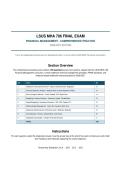
LSUS MHA 706 FINAL EXAM
FINANCIAL MANAGEMENT - COMPREHENSIVE PRACTICE
2026/2027 EDITION
This is an independent practice exam for educational study; it is not an official LSUS MHA 706 course examination.
Section Overview
This comprehensive practice exam contains 100 questions across nine sections, aligned with the LSUS MHA 706
Financial Management curriculum, current healthcare financial management principles, HFMA standards, and
evidence-based healthcare finance practices for 2026/2027.
Sec Topic Qs
1 Healthcare Financial Environment - Payers, Reimbursement, Regulation 12
2 Financial Statement Analysis - Balance Sheet, Income Statement, Ratios 15
3 Cost Concepts & Behavior - Fixed, Variable, CVP, Break-Even 14
4 Budgeting & Variance Analysis - Operating, Capital, Flexible/Static 12
5 Capital Budgeting & Investment Decisions - NPV, IRR, Payback, PI 12
6 Working Capital Management - Cash, AR, Inventory, Short-Term 10
7 Healthcare Reimbursement & Revenue Cycle - Medicare, Medicaid 10
8 Cost Allocation & Pricing - Direct/Indirect, Cost Drivers 10
9 Integrated Case Studies - Complex Financial Scenarios 5
TOTAL 100
Instructions
For each question, select the single best answer. Use the answer key at the end of the exam to check your work. Each
item includes a brief rationale explaining the correct response.
Answer Key Distribution: 25 A · 25 B · 25 C · 25 D
, Section 1: Healthcare Financial Environment - Payers, Reimbursement Models, and
Regulatory Impact
Q1: Which type of healthcare organization is exempt from federal income tax?
A. A for-profit corporation
B. A non-profit (not-for-profit) organization [CORRECT]
C. A government-owned for-profit
D. A private equity firm
Correct Answer: B
Rationale: Non-profit organizations are generally tax-exempt. The other options are taxable.
Q2: A third-party payer is:
A. An entity that pays for healthcare services on behalf of the patient [CORRECT]
B. The patient paying out of pocket
C. The provider
D. The employer only
Correct Answer: A
Rationale: A third-party payer reimburses providers on behalf of the patient. The other options are incorrect.
Q3: Fee-for-service (FFS) reimbursement pays providers:
A. A fixed amount per patient regardless of services
B. A capitated rate
C. Only for outcomes
D. For each service provided [CORRECT]
Correct Answer: D
Rationale: FFS pays per service rendered. Capitation pays a fixed amount per member, and value-based models pay for
outcomes.
Q4: Capitation is a payment model in which providers:
A. Are paid per service
B. Are paid only for outcomes
C. Receive a fixed payment per enrolled member regardless of services used [CORRECT]
D. Bill after each visit
Correct Answer: C
Rationale: Capitation pays a fixed amount per member per period. The other options describe other models.
Q5: Medicare is a federal program primarily for:
A. Adults 65 and older and certain younger people with disabilities [CORRECT]
B. Low-income families
C. All uninsured people
D. Children only
Correct Answer: A
Rationale: Medicare covers adults 65+ and certain disabled individuals. Medicaid covers low-income populations.
Q6: Medicaid is a program that is:
A. Funded only by the federal government
B. Jointly funded by federal and state governments [CORRECT]
C. Funded only by states
D. Private
Correct Answer: B
Rationale: Medicaid is jointly funded by federal and state governments. The other options are incorrect.
Q7: The Affordable Care Act (ACA) primarily aimed to:
A. Reduce all coverage
LSUS MHA 706 Final Exam - Financial Management - 2026/2027 Page 2
, B. Eliminate Medicare
C. End private insurance
D. Expand health insurance coverage [CORRECT]
Correct Answer: D
Rationale: A key ACA goal is expanding health insurance coverage. The other options are incorrect.
Q8: Value-based purchasing (VBP) reimburses providers based on:
A. Quality and outcomes rather than volume alone [CORRECT]
B. Only the volume of services
C. Only the number of visits
D. Only the cost
Correct Answer: A
Rationale: VBP ties reimbursement to quality/outcomes. The other options are incorrect.
Q9: MACRA (Medicare Access and CHIP Reauthorization Act) reformed:
A. How Medicare pays physicians, emphasizing value [CORRECT]
B. Medicaid eligibility
C. Private insurance
D. Hospital staffing
Correct Answer: A
Rationale: MACRA reformed Medicare physician payment to emphasize value. The other options are incorrect.
Q10: Managed care organizations (MCOs) aim to:
A. Increase costs
B. Avoid coordination
C. Coordinate and manage care to control costs and quality [CORRECT]
D. Only bill patients
Correct Answer: C
Rationale: MCOs coordinate care to control cost and quality. The other options are incorrect.
Q11: A for-profit healthcare organization is accountable to:
A. Only the government
B. No one
C. Only patients
D. Its shareholders/owners [CORRECT]
Correct Answer: D
Rationale: For-profit organizations are accountable to shareholders. The other options are incorrect.
Q12: Which is an example of a commercial (private) payer?
A. Medicare
B. Medicaid
C. A charity
D. A private insurance company [CORRECT]
Correct Answer: D
Rationale: A private insurance company is a commercial payer. Medicare and Medicaid are public payers.
Section 2: Financial Statement Analysis - Balance Sheet, Income Statement, Statement of
Cash Flows, and Ratio Analysis
Q13: The balance sheet presents a healthcare organization's:
A. Assets, liabilities, and equity at a point in time [CORRECT]
B. Revenues and expenses over a period
C. Cash flows
LSUS MHA 706 Final Exam - Financial Management - 2026/2027 Page 3
FINANCIAL MANAGEMENT - COMPREHENSIVE PRACTICE
2026/2027 EDITION
This is an independent practice exam for educational study; it is not an official LSUS MHA 706 course examination.
Section Overview
This comprehensive practice exam contains 100 questions across nine sections, aligned with the LSUS MHA 706
Financial Management curriculum, current healthcare financial management principles, HFMA standards, and
evidence-based healthcare finance practices for 2026/2027.
Sec Topic Qs
1 Healthcare Financial Environment - Payers, Reimbursement, Regulation 12
2 Financial Statement Analysis - Balance Sheet, Income Statement, Ratios 15
3 Cost Concepts & Behavior - Fixed, Variable, CVP, Break-Even 14
4 Budgeting & Variance Analysis - Operating, Capital, Flexible/Static 12
5 Capital Budgeting & Investment Decisions - NPV, IRR, Payback, PI 12
6 Working Capital Management - Cash, AR, Inventory, Short-Term 10
7 Healthcare Reimbursement & Revenue Cycle - Medicare, Medicaid 10
8 Cost Allocation & Pricing - Direct/Indirect, Cost Drivers 10
9 Integrated Case Studies - Complex Financial Scenarios 5
TOTAL 100
Instructions
For each question, select the single best answer. Use the answer key at the end of the exam to check your work. Each
item includes a brief rationale explaining the correct response.
Answer Key Distribution: 25 A · 25 B · 25 C · 25 D
, Section 1: Healthcare Financial Environment - Payers, Reimbursement Models, and
Regulatory Impact
Q1: Which type of healthcare organization is exempt from federal income tax?
A. A for-profit corporation
B. A non-profit (not-for-profit) organization [CORRECT]
C. A government-owned for-profit
D. A private equity firm
Correct Answer: B
Rationale: Non-profit organizations are generally tax-exempt. The other options are taxable.
Q2: A third-party payer is:
A. An entity that pays for healthcare services on behalf of the patient [CORRECT]
B. The patient paying out of pocket
C. The provider
D. The employer only
Correct Answer: A
Rationale: A third-party payer reimburses providers on behalf of the patient. The other options are incorrect.
Q3: Fee-for-service (FFS) reimbursement pays providers:
A. A fixed amount per patient regardless of services
B. A capitated rate
C. Only for outcomes
D. For each service provided [CORRECT]
Correct Answer: D
Rationale: FFS pays per service rendered. Capitation pays a fixed amount per member, and value-based models pay for
outcomes.
Q4: Capitation is a payment model in which providers:
A. Are paid per service
B. Are paid only for outcomes
C. Receive a fixed payment per enrolled member regardless of services used [CORRECT]
D. Bill after each visit
Correct Answer: C
Rationale: Capitation pays a fixed amount per member per period. The other options describe other models.
Q5: Medicare is a federal program primarily for:
A. Adults 65 and older and certain younger people with disabilities [CORRECT]
B. Low-income families
C. All uninsured people
D. Children only
Correct Answer: A
Rationale: Medicare covers adults 65+ and certain disabled individuals. Medicaid covers low-income populations.
Q6: Medicaid is a program that is:
A. Funded only by the federal government
B. Jointly funded by federal and state governments [CORRECT]
C. Funded only by states
D. Private
Correct Answer: B
Rationale: Medicaid is jointly funded by federal and state governments. The other options are incorrect.
Q7: The Affordable Care Act (ACA) primarily aimed to:
A. Reduce all coverage
LSUS MHA 706 Final Exam - Financial Management - 2026/2027 Page 2
, B. Eliminate Medicare
C. End private insurance
D. Expand health insurance coverage [CORRECT]
Correct Answer: D
Rationale: A key ACA goal is expanding health insurance coverage. The other options are incorrect.
Q8: Value-based purchasing (VBP) reimburses providers based on:
A. Quality and outcomes rather than volume alone [CORRECT]
B. Only the volume of services
C. Only the number of visits
D. Only the cost
Correct Answer: A
Rationale: VBP ties reimbursement to quality/outcomes. The other options are incorrect.
Q9: MACRA (Medicare Access and CHIP Reauthorization Act) reformed:
A. How Medicare pays physicians, emphasizing value [CORRECT]
B. Medicaid eligibility
C. Private insurance
D. Hospital staffing
Correct Answer: A
Rationale: MACRA reformed Medicare physician payment to emphasize value. The other options are incorrect.
Q10: Managed care organizations (MCOs) aim to:
A. Increase costs
B. Avoid coordination
C. Coordinate and manage care to control costs and quality [CORRECT]
D. Only bill patients
Correct Answer: C
Rationale: MCOs coordinate care to control cost and quality. The other options are incorrect.
Q11: A for-profit healthcare organization is accountable to:
A. Only the government
B. No one
C. Only patients
D. Its shareholders/owners [CORRECT]
Correct Answer: D
Rationale: For-profit organizations are accountable to shareholders. The other options are incorrect.
Q12: Which is an example of a commercial (private) payer?
A. Medicare
B. Medicaid
C. A charity
D. A private insurance company [CORRECT]
Correct Answer: D
Rationale: A private insurance company is a commercial payer. Medicare and Medicaid are public payers.
Section 2: Financial Statement Analysis - Balance Sheet, Income Statement, Statement of
Cash Flows, and Ratio Analysis
Q13: The balance sheet presents a healthcare organization's:
A. Assets, liabilities, and equity at a point in time [CORRECT]
B. Revenues and expenses over a period
C. Cash flows
LSUS MHA 706 Final Exam - Financial Management - 2026/2027 Page 3


