
• Wrong document? Swap it for free
  • Written by students who passed
  • Immediately available after payment
  • Read online or as PDF
Sell
Where do you study
Your language
Document preview thumbnail
Preview 4 out of 82 pages
Exam (elaborations)

Sterile Processing Final Exam 2026/2027 | 240+ Questions & Answers | Decontamination, Sterilization, Instruments, Infection Control & Endoscopes | Chapters 1–6, 8, 10–13

Document preview thumbnail
Preview 4 out of 82 pages

This comprehensive Sterile Processing Final Exam Practice Test 2026/2027 contains approximately 240+ exam-style questions with answers across 82 pages, covering Chapters 1, 2, 3, 4, 5, 6, 8, 10, 11, 12, and 13. The material provides extensive review of Central Service/Sterile Processing workflows, decontamination, cleaning, disinfection, sterilization, surgical instrumentation, infection prevention, microbiology, anatomy and physiology, medical terminology, endoscope processing, regulatory standards, PPE, packaging, sterile storage, and quality and safety practices. Questions use multiple-choice and true/false formats, making the document suitable for final-exam preparation and comprehensive sterile-processing review. A major portion concentrates on decontamination, cleaning, and infection prevention. Students review one-way workflow from soiled to clean processing areas, negative airflow in decontamination, positive airflow in preparation and packaging, appropriate PPE, Standard Precautions, bloodborne pathogens, hand hygiene, biohazard labeling, cleaning brushes, neutral-pH detergents, enzymatic cleaners, mechanical washers, ultrasonic cleaning and cavitation, treated-water rinsing, and the importance of following manufacturers' Instructions for Use (IFUs). The document also addresses microorganisms such as bacteria, viruses, fungi, pathogens and prions, alongside asepsis, healthcare-associated infections, binary fission, Gram staining and transmission risks. The practice test provides substantial coverage of sterilization, packaging, monitoring, and Immediate Use Steam Sterilization (IUSS). Questions examine sterilization packaging, rigid containers, tamper-evident seals, paper/plastic pouches, chemical indicators, low-temperature hydrogen-peroxide processing, sterilizer loading, implantable devices, documentation and point-of-use sterilization. Learners also review why thorough cleaning must precede sterilization, why IUSS should not substitute routinely for adequate instrument inventory, and why manufacturer instructions and traceability are important when processing medical devices. Another high-value section focuses on surgical instruments and inspection. The exam covers osteotomes, hemostats, tissue forceps, scissors, needle holders, Kerrison/laminectomy rongeurs, suction devices, arthroscopy instruments, laparoscopic equipment, robotic instruments, powered surgical devices and instrument finishes. Students review tungsten-carbide and microgrind/supercut instrument identification, box locks, insulation testing, sharpness testing, lubrication, passivation, instrument marking tape, functionality testing and proper tray assembly. The material repeatedly emphasizes inspection for both cleanliness and function before instruments proceed to sterilization. Flexible endoscope reprocessing is also extensively represented. Topics include leak testing, manual cleaning, automated endoscope reprocessors (AERs), internal channels, rinsing, drying, manufacturer cleaning instructions, high-level disinfection and safe storage. The test reinforces that failed leak tests require action, that not every endoscope can necessarily be processed in every automated system, and that endoscope channels require appropriate cleaning and drying procedures. The resource additionally integrates anatomy, physiology, medical terminology, and surgical procedures relevant to sterile-processing technicians. Questions address the skeletal, muscular, circulatory, nervous and reproductive systems; cells and tissues; the cerebrum, pituitary gland, liver, blood and plasma; and anatomical structures such as the eye and ear. Terminology includes prefixes, suffixes and roots such as hemi-, hypo-, ante-, para-, gastro-, hyster-, -itis, -ectomy, -oscopy, -plasty, -ostomy, and -tome, together with procedures including arthroscopy, gastrectomy, hysterectomy, cholecystectomy, septoplasty, laminectomy, tympanoplasty and herniorrhaphy. Regulatory and professional-practice questions address OSHA, FDA, EPA, AAMI, AORN, The Joint Commission, SGNA, medical-device reporting, recalls, the Bloodborne Pathogens Standard, worker protection, environmental requirements, accreditation, quality and safety standards, professional conduct, job descriptions and employability skills. This breadth makes the document relevant not only for memorizing instrument-processing steps but also for understanding the regulatory environment in which sterile-processing departments operate. For authoritative reference, students should compare the answers with current editions of the Healthcare Sterile Processing Association (HSPA) Sterile Processing Technical Manual, AAMI's ANSI/AAMI ST79: Comprehensive Guide to Steam Sterilization and Sterility Assurance in Health Care Facilities, current AAMI endoscope-processing standards, CDC infection-control guidance, OSHA's Bloodborne Pathogens Standard, and each medical-device manufacturer's current IFU. The uploaded answer key appears to contain some questionable or outdated answers—for example, certain FDA device-classification/medical-device-reporting items—so current standards and official references should take precedence over the practice-test key. Relevant Students: This document is relevant to Sterile Processing Technician students, Central Service Technician students, CRCST candidates, CSPDT candidates, sterile processing certification candidates, surgical technology students, operating-room support staff, endoscope reprocessing technicians, instrument technicians, infection-prevention trainees, healthcare students studying medical-device reprocessing, and sterile processing professionals preparing for final examinations, certification review, or continuing education. Keywords: sterile processing final exam , sterile processing questions and answers, sterile processing practice test, sterile processing final exam answers, sterile processing technician exam, central service final exam, CRCST practice questions, CRCST exam preparation, CSPDT practice test, sterile processing study guide, decontamination sterile processing, sterilization questions, steam sterilization, Immediate Use Steam Sterilization, IUSS, surgical instrument identification, surgical instruments practice test, instrument inspection, instrument assembly, sterile packaging, rigid sterilization containers, infection control sterile processing, Standard Precautions, bloodborne pathogens, OSHA sterile processing, AAMI sterilization standards, endoscope reprocessing, flexible endoscope cleaning, automated endoscope reprocessor, AER endoscope, leak testing endoscopes, ultrasonic cleaner cavitation, mechanical washer disinfector, enzymatic cleaner, PPE decontamination, medical terminology sterile processing, microbiology sterile processing, prion processing, laparoscopic instruments, powered surgical instruments, sterile storage, sterile processing certification 2026, central sterile processing exam

Content preview

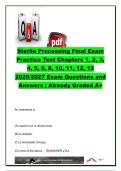
Sterile Processing Final Exam
Practice Test Chapters 1, 2, 3,
4, 5, 6, 8, 10, 11, 12, 13
2026/2027 Exam Questions and
Answers | Already Graded A+


An osteotome is


(A) used to cut or shave bone.

(B) a retractor.

(C) a hemostatic forceps.


(D) none of the above. - ANSWER ✔✔A

,When returning loaner items to the vendor


(A) all items should be completely assembled, tested and sterile.

(B) trays should be returned immediately after point-of-use cleaning.(C)

all items should be cleaned and decontaminated.

(D) trays should be terminally sterilized before returning them to the

vendor. - ANSWER ✔✔C


The first goal of creating an instrument pack is


(A) obtain the proper packaging container for the pack.

(B) decide on the order of instrument placement.

(C) create a pack that meets user needs.


(D) create a pack that makes the physician happy. - ANSWER ✔✔C


Positive air flow means when the door is opened, air flows out instead of

into the area.


(A) True


(B) False - ANSWER ✔✔A

,Molds, mushrooms and yeast are common


(A) gram-negative organisms.

(B) fungi.

(C) gram-positive organisms.


(D) prions. - ANSWER ✔✔B


The surgery of the ear that reconstructs the eardrum so sound waves

can be sent to the middle ear


(A) tympanoplasty.

(B) stapedectomy.

(C) auditory implantation.


(D) myringotomy. - ANSWER ✔✔A


Dark areas on the lens of an endoscope are?


(A) Debris

(B) Light-emitting diode optics

3
COPYRIGHT©JOSHCLAY 2025/2026. YEAR PUBLISHED 2026. COMPANY REGISTRATION NUMBER: 619652435. TERMS OF USE. PRIVACY
STATEMENT. ALL RIGHTS RESERVED

, (C) Light-emitting diode bulbs


(D) Damaged light fibers - ANSWER ✔✔D


Soiled instruments and other items are received in the (blank) area of

the Central Service department.


(A) preparation

(B) packaging

(C) decontamination


(D) sterilization - ANSWER ✔✔C


Which of the following statements about the use of mechanical washers

is NOT true?


(A) Multi-level trays should be separated

(B) Trays with lids should be opened

(C) Instruments should be disassembled and opened


(D) All items should be washed on the same cycle - ANSWER ✔✔D


Agency which may intervene in a matter of worker protection even if

there are no specific regulations covering the situation.

Document information

Uploaded on
August 11, 2026
Number of pages
82
Written in
2026/2027
Type
Exam (elaborations)
Contains
Questions & answers
$18.99

Wrong document? Swap it for free Within 14 days of purchase and before downloading, you can choose a different document. You can simply spend the amount again.
Written by students who passed
Immediately available after payment
Read online or as PDF

Seller avatar
Reputation scores are based on the amount of documents a seller has sold for a fee and the reviews they have received for those documents. There are three levels: Bronze, Silver and Gold. The better the reputation, the more your can rely on the quality of the sellers work.
JOSHCLAY
3.5
(88)
Sold
414
Followers
16
Items
20850
Last sold
3 hours ago


Why students choose Stuvia

Created by fellow students, verified by reviews

Quality you can trust: written by students who passed their tests and reviewed by others who've used these notes.

Didn't get what you expected? Choose another document

No worries! You can instantly pick a different document that better fits what you're looking for.

Pay as you like, start learning right away

No subscription, no commitments. Pay the way you're used to via credit card and download your PDF document instantly.

Student with book image

“Bought, downloaded, and aced it. It really can be that simple.”

Alisha Student

Working on your references?

Create accurate citations in APA, MLA and Harvard with our free citation generator.

Working on your references?

Frequently asked questions

