

Written by students who passed Immediately available after payment Read online or as PDF Wrong document? Swap it for free 4.6 TrustPilot
logo-home
Document preview thumbnail
Preview 2 out of 12 pages
Exam (elaborations)

NRS 320 Final Exam 2026/2027 – 100+ Questions & Answers | Heart Failure, Stroke, CAD, Diabetes, Endocrine, Renal & Med-Surg Nursing

Document preview thumbnail
Preview 2 out of 12 pages

This comprehensive NRS 320 Final Exam 2026/2027 study resource contains 100+ questions and answers across 12 pages, providing concentrated preparation in adult medical-surgical nursing, pharmacology, acute care and patient safety. Major areas include heart failure and coronary artery disease, anticoagulation, acid-base disorders, pulmonary embolism, tuberculosis, ischemic and hemorrhagic stroke, spinal cord injury, orthopedic nursing, diabetes, thyroid and adrenal disorders, gastrointestinal and hepatic disease, perioperative care, oncology, renal care and medication administration. The material emphasizes recognition of clinical findings, priority nursing interventions, laboratory monitoring, medication safety and patient education. The cardiovascular and pharmacology section reviews heart failure, furosemide, spironolactone, warfarin and digoxin. Students encounter potassium disturbances, PT/INR monitoring, bleeding precautions, digoxin toxicity and digoxin immune Fab, alongside heart-failure interventions such as sodium and fluid restriction and evaluation of edema, weight, lung sounds, dyspnea and urine output. Coronary artery disease content covers cardiac biomarkers, post-cardiac-catheterization assessment, antiplatelet therapy and modifiable cardiovascular risk factors. The document provides focused preparation in respiratory and neurological emergencies. Students differentiate respiratory and metabolic acidosis and alkalosis and review airborne precautions for tuberculosis. Pulmonary embolism material addresses sudden dyspnea, pleuritic chest pain, hypoxia, oxygen administration, positioning and anticoagulation. Stroke content distinguishes ischemic from hemorrhagic events and covers BEFAST, NIHSS, oxygenation, blood-pressure management, thrombolytic therapy, aspiration precautions, swallowing assessment and nimodipine. Neurological and musculoskeletal nursing topics extend to autonomic dysreflexia and spinal cord injury, including common triggers, severe hypertension and immediate positioning and trigger-removal interventions. Orthopedic material covers total hip and knee arthroplasty precautions, osteomyelitis, osteoporosis risk factors and DEXA scanning. These sections emphasize prevention of postoperative complications, maintenance of mobility and protection against skin breakdown. The endocrine and metabolic section reviews hyperglycemia, hypoglycemia, diabetic ketoacidosis prevention, hypothyroidism, hyperthyroidism, Cushing syndrome and Addison disease. Students encounter characteristic manifestations, dietary teaching and medication-related concepts. Insulin questions reinforce the distinction between rapid- and long-acting preparations, including meal timing and the rule against mixing insulin glargine or detemir with other insulin preparations in the same syringe. Levothyroxine administration and interactions with calcium and iron are also reviewed. Gastrointestinal and hepatic nursing content includes TPN, enteral feeding, cirrhosis, hepatitis C, GERD, peptic ulcer perforation, ostomy assessment and hepatic encephalopathy. Questions address aspiration prevention during tube feeding, nutrition support, ascites and ammonia management, direct-acting antiviral therapy, GERD lifestyle modifications, recognition of a board-like abdomen and lactulose therapy. The final sections concentrate on perioperative, oncology, hematology and renal nursing. Students review informed consent, malignant hyperthermia and dantrolene, postoperative atelectasis and DVT prevention, oral mucositis, teletherapy versus brachytherapy and neutropenic precautions. Renal material includes AV fistula protection and assessment, BPH, renal calculi, epoetin alfa and anticoagulant monitoring. Medication safety is reinforced through heparin/aPTT/protamine sulfate and warfarin/PT-INR/vitamin K relationships. Relevant students: This document is particularly relevant for NRS 320 students, BSN and prelicensure nursing students, medical-surgical nursing students, adult health nursing students, RN students preparing for comprehensive finals and nursing learners reviewing NCLEX-style cardiovascular, neurological, endocrine, gastrointestinal and renal concepts. Its concise question-and-answer format supports active recall, rapid final-exam revision, medication review and reinforcement of priority nursing interventions. Keywords: NRS 320 final exam , NRS 320 questions and answers, NRS 320 exam prep, NRS 320 study guide, medical surgical nursing final exam, med surg exam questions, adult health nursing, heart failure nursing, furosemide, spironolactone, digoxin toxicity, warfarin nursing, coronary artery disease, cardiac catheterization care, acid base balance, respiratory acidosis, metabolic acidosis, pulmonary embolism nursing, tuberculosis precautions, ischemic stroke nursing, hemorrhagic stroke, BEFAST assessment, NIHSS, autonomic dysreflexia, spinal cord injury nursing, total hip arthroplasty, osteomyelitis, osteoporosis, DKA nursing, diabetes nursing, hypothyroidism nursing, hyperthyroidism nursing, Cushing syndrome, Addison disease, TPN nursing, cirrhosis nursing, hepatic encephalopathy, lactulose, GERD nursing, malignant hyperthermia, dantrolene, brachytherapy precautions, neutropenic precautions, AV fistula care, renal calculi, heparin monitoring, insulin administration, levothyroxine, med surg nursing study guide

Content preview

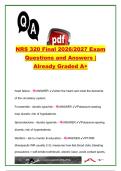
NRS 320 Final 2026/2027 Exam
Questions and Answers |
Already Graded A+


heart failure - ANSWER ✔✔when the heart cant meet the demands

of the circulatory system


Furosemide - diuretic type/risk - ANSWER ✔✔Potassium-wasting

loop diuretic; risk of hypokalemia.


Spironolactone - diuretic type/risk - ANSWER ✔✔Potassium-sparing

diuretic; risk of hyperkalemia


Warfarin - lab to monitor & education - ANSWER ✔✔PT/INR

(therapeutic INR usually 2-3); measures how fast blood clots; bleeding

precautions = soft-bristle toothbrush, electric razor, avoid contact sports,

, apply firm pressure to cuts; interacts w/ NSAIDs, antibiotics, antifungals,

alcohol


Digoxin toxicity - key sign - ANSWER ✔✔Yellow-green halos around

eyes; also N/V, arrhythmias, confusion.


Digoxin - hold parameter - ANSWER ✔✔Hold for HR less than 60

bpm.


Digoxin - electrolyte to monitor - ANSWER ✔✔Potassium;

hypokalemia increases digoxin toxicity risk.


Digoxin toxicity - antidote - ANSWER ✔✔Digoxin immune Fab

(Digibind).


Heart failure - dietary teaching - ANSWER ✔✔Low sodium diet (2

g/day) and fluid restriction.


Heart failure - signs treatment is effective - ANSWER ✔✔Decreased

edema/weight toward baseline, clearer lung sounds, decreased

dyspnea/orthopnea, better exercise tolerance, stable VS, adequate urine

output.


CAD (coronary artery disease) - definition - ANSWER ✔✔Plaque

builds up in the coronary arteries, reducing blood/oxygen flow to the

heart.

Document information

Uploaded on
August 11, 2026
Number of pages
12
Written in
2026/2027
Type
Exam (elaborations)
Contains
Questions & answers
$18.99

Wrong document? Swap it for free Within 14 days of purchase and before downloading, you can choose a different document. You can simply spend the amount again.
Written by students who passed
Immediately available after payment
Read online or as PDF

Seller avatar
Reputation scores are based on the amount of documents a seller has sold for a fee and the reviews they have received for those documents. There are three levels: Bronze, Silver and Gold. The better the reputation, the more your can rely on the quality of the sellers work.
PROFFKERRYMARTIN
3.3
(60)
Sold
303
Followers
10
Items
11362
Last sold
1 day ago


Why students choose Stuvia

Created by fellow students, verified by reviews

Quality you can trust: written by students who passed their tests and reviewed by others who've used these notes.

Didn't get what you expected? Choose another document

No worries! You can instantly pick a different document that better fits what you're looking for.

Pay as you like, start learning right away

No subscription, no commitments. Pay the way you're used to via credit card and download your PDF document instantly.

Student with book image

“Bought, downloaded, and aced it. It really can be that simple.”

Alisha Student

Working on your references?

Create accurate citations in APA, MLA and Harvard with our free citation generator.

Working on your references?

Frequently asked questions

