
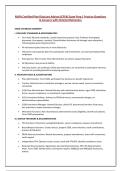
EXAM COVERAGE SUMMARY
I. FIDUCIARY STANDARDS & RESPONSIBILITIES
Four basic fiduciary standards: Loyalty (exclusive purpose rule), Prudence (investigate,
document, hire experts, monitor), Diversification (minimize risk through asset allocation),
Following plan governing documents
All retirement plans have one or more fiduciaries
Fiduciaries must operate plans for participants and beneficiaries, not owners/employer/key
employees
Plan Sponsor, Plan Trustee, Plan Administrator are almost always fiduciaries
All fiduciaries have personal liability
Fiduciary duties: act prudently, follow plan document, act exclusively in participant interests,
run plan for providing benefits and paying expenses
II. FIDUCIARY ROLES & CLASSIFICATIONS
Plan Administrator: Form 5500, participant fee disclosures, benefit statements
Trustee: Select/monitor investment managers, pursue monies owed, serve on investment
committee
3(16) Plan Administrator: Named fiduciary with administrative duties, signs 5500, distributes
forms, assures compliance, no investment responsibilities
3(21) Investment Advisor: Advises on IPS/fund menus, recommends changes, no
administrative responsibilities
3(38) Investment Manager: Named fiduciary, drafts IPS, determines/monitors fund menu,
has authority to make investment changes
Ministerial functions: Non-discretionary administrative tasks (eligibility, benefit calculations,
Form 5500 preparation)
III. SERVICE PROVIDERS & DOCUMENTATION
TPA functions: Determine vesting/distribution, assure compliance, prepare amendments
Recordkeeper functions: Create notices, prepare 5500, store elections, track contributions,
process distributions
ERISA Attorney functions: Review documents, prepare amendments, assist with corrections,
audit support
Independent CPA: Opinion on plan assets, work with TPA/RK, identify compliance issues
Required documentation: Signed plan document/amendments, SPD, IRS determination
letter, Form 5500, fidelity bond, contribution reports, 408(b)(2) and 404(a)(5) disclosures,
notices
, Additional documentation: Meeting minutes, IPS, monitoring/benchmarking reports, service
provider agreements
IV. PROHIBITED TRANSACTIONS & BREACHES
Parties-in-interest: Employer/owners/officers/relatives, participants, fiduciaries, service
providers
Prohibited transactions: Sale/exchange/lease of property, lending money, furnishing
goods/services, transfer/use of plan assets, holding certain employer securities
Consequences: Restore losses, removal of fiduciary, civil/criminal charges, 20% DOL penalty
Correction programs: VFCP (late contributions, improper payments), DFVCP, EPCRS
V. PLAN DESIGN & BUSINESS STRUCTURE
Controlled groups: Parent-subsidiary (80% ownership), Brother-sister (5 or fewer individuals
own >80%), Combined group
IRA-based plans: SEP (employer only, 100% vested), SIMPLE IRA (employee + required
employer, lower limits), SIMPLE 401(k) (cross between SIMPLE IRA and 401(k) Safe Harbor)
Plan features: Eligibility/participation, compensation, contributions, vesting,
distributions/loans
Hybrid plans: Combine DB and DC elements
VI. PARTICIPANT OUTCOMES & BEHAVIORAL FINANCE
Successful participant outcomes: Education, "stretch" match, automatic
enrollment/escalation, re-enrollment
Re-enrollment: Default to TDF/managed accounts, age-appropriate allocation, opt-out
option
Gap analysis: Project current balance through retirement, deferral rate, projected return
Behavioral finance: Auto-enrollment with targeted education improves outcomes
VII. INVESTMENT SELECTION & MONITORING
QDIA rules: TDFs, TRFs, balanced funds, managed portfolios; provides fiduciary safe harbor;
notices required
Investment types: Mutual funds, brokerage accounts, separate accounts, asset allocation
funds, ETFs, alternatives, GICs/stable value, CIFs, employer stock
Active vs passive management: Passive tracks benchmarks, lower costs, less revenue sharing
Revenue sharing: Plan asset subject to ERISA; may pay expenses or credit participants
IPS: Purpose, selection criteria, responsibilities, monitoring, asset class guidelines,
expenses/fees
Investment reviews: Compare to IPS criteria, discuss demographics, watch list for
underperformers
VIII. FEE REASONABLENESS & PLAN EXPENSES
408(b)(2): Plan sponsor disclosure of fees paid to service providers
, 404(a)(5): Participant disclosure of fees from accounts
Benchmarking: Determines value, shows prudent process
Payable expenses (administrative/fiduciary): Recordkeeping, investment/custodial,
compliance testing, Form 5500, participant communications, actuarial, claims processing,
legal/consulting for administration
Non-payable (settlor): Plan design studies, initial document creation, discretionary
amendments, termination decisions, employer communication campaigns
IX. FIDELITY BONDS & INSURANCE
ERISA Fidelity Bond: Required by law, protects the PLAN from theft/fraud
Fiduciary Insurance: Protects FIDUCIARIES from errors/omissions, not required
X. CONVERSIONS & PLAN MANAGEMENT
Conversion documentation: Decision to replace provider, reasons, RFP, participant notices
(blackout, QDIA), new provider fee schedule, service agreements, new plan documents
Common errors: Late contributions, improper benefit payments, improper fee payments
Prevention: Good governance, review plan documents annually, verify timing of deposits
QUESTIONS
1. A plan fiduciary must act solely in the best interest of plan participants under which ERISA rule?
a) Prudence rule
b) Exclusive purpose rule
c) Diversification rule
d) Plan document rule
The exclusive purpose rule requires fiduciaries to act solely for the benefit of participants and
beneficiaries, not for employers or owners.
2. Which of the following is NOT one of the four basic fiduciary standards under ERISA Section
404?
a) Loyalty
b) Profit maximization
c) Prudence
d) Diversification
, Profit maximization is not a fiduciary standard; the four standards are loyalty, prudence,
diversification, and following plan documents.
3. A Plan Sponsor who fails to document their investment decision-making process has likely
violated which fiduciary standard?
a) Loyalty
b) Diversification
c) Prudence
d) Following plan documents
The prudence standard requires investigating before decisions, documenting the process, and
monitoring outcomes.
4. Under the exclusive purpose rule, fiduciaries must operate the plan primarily for whose benefit?
a) The employer and key employees
b) Shareholders and board members
c) Plan participants and their beneficiaries
d) The plan sponsor and owners
ERISA's primary rule requires fiduciaries to act for participants and beneficiaries, not for owners or
employers.
5. Which individuals or entities will almost always be fiduciaries to a retirement plan?
a) Plan Sponsor, Plan Trustee, and Plan Administrator
b) Investment advisors and TPAs only
c) Recordkeepers and CPAs
d) Legal counsel and consultants
The Plan Sponsor, Plan Trustee, and Plan Administrator are almost always fiduciaries due to their
discretionary authority over plan management.
6. Which statement about personal liability for fiduciaries is true?
I. FIDUCIARY STANDARDS & RESPONSIBILITIES
Four basic fiduciary standards: Loyalty (exclusive purpose rule), Prudence (investigate,
document, hire experts, monitor), Diversification (minimize risk through asset allocation),
Following plan governing documents
All retirement plans have one or more fiduciaries
Fiduciaries must operate plans for participants and beneficiaries, not owners/employer/key
employees
Plan Sponsor, Plan Trustee, Plan Administrator are almost always fiduciaries
All fiduciaries have personal liability
Fiduciary duties: act prudently, follow plan document, act exclusively in participant interests,
run plan for providing benefits and paying expenses
II. FIDUCIARY ROLES & CLASSIFICATIONS
Plan Administrator: Form 5500, participant fee disclosures, benefit statements
Trustee: Select/monitor investment managers, pursue monies owed, serve on investment
committee
3(16) Plan Administrator: Named fiduciary with administrative duties, signs 5500, distributes
forms, assures compliance, no investment responsibilities
3(21) Investment Advisor: Advises on IPS/fund menus, recommends changes, no
administrative responsibilities
3(38) Investment Manager: Named fiduciary, drafts IPS, determines/monitors fund menu,
has authority to make investment changes
Ministerial functions: Non-discretionary administrative tasks (eligibility, benefit calculations,
Form 5500 preparation)
III. SERVICE PROVIDERS & DOCUMENTATION
TPA functions: Determine vesting/distribution, assure compliance, prepare amendments
Recordkeeper functions: Create notices, prepare 5500, store elections, track contributions,
process distributions
ERISA Attorney functions: Review documents, prepare amendments, assist with corrections,
audit support
Independent CPA: Opinion on plan assets, work with TPA/RK, identify compliance issues
Required documentation: Signed plan document/amendments, SPD, IRS determination
letter, Form 5500, fidelity bond, contribution reports, 408(b)(2) and 404(a)(5) disclosures,
notices
, Additional documentation: Meeting minutes, IPS, monitoring/benchmarking reports, service
provider agreements
IV. PROHIBITED TRANSACTIONS & BREACHES
Parties-in-interest: Employer/owners/officers/relatives, participants, fiduciaries, service
providers
Prohibited transactions: Sale/exchange/lease of property, lending money, furnishing
goods/services, transfer/use of plan assets, holding certain employer securities
Consequences: Restore losses, removal of fiduciary, civil/criminal charges, 20% DOL penalty
Correction programs: VFCP (late contributions, improper payments), DFVCP, EPCRS
V. PLAN DESIGN & BUSINESS STRUCTURE
Controlled groups: Parent-subsidiary (80% ownership), Brother-sister (5 or fewer individuals
own >80%), Combined group
IRA-based plans: SEP (employer only, 100% vested), SIMPLE IRA (employee + required
employer, lower limits), SIMPLE 401(k) (cross between SIMPLE IRA and 401(k) Safe Harbor)
Plan features: Eligibility/participation, compensation, contributions, vesting,
distributions/loans
Hybrid plans: Combine DB and DC elements
VI. PARTICIPANT OUTCOMES & BEHAVIORAL FINANCE
Successful participant outcomes: Education, "stretch" match, automatic
enrollment/escalation, re-enrollment
Re-enrollment: Default to TDF/managed accounts, age-appropriate allocation, opt-out
option
Gap analysis: Project current balance through retirement, deferral rate, projected return
Behavioral finance: Auto-enrollment with targeted education improves outcomes
VII. INVESTMENT SELECTION & MONITORING
QDIA rules: TDFs, TRFs, balanced funds, managed portfolios; provides fiduciary safe harbor;
notices required
Investment types: Mutual funds, brokerage accounts, separate accounts, asset allocation
funds, ETFs, alternatives, GICs/stable value, CIFs, employer stock
Active vs passive management: Passive tracks benchmarks, lower costs, less revenue sharing
Revenue sharing: Plan asset subject to ERISA; may pay expenses or credit participants
IPS: Purpose, selection criteria, responsibilities, monitoring, asset class guidelines,
expenses/fees
Investment reviews: Compare to IPS criteria, discuss demographics, watch list for
underperformers
VIII. FEE REASONABLENESS & PLAN EXPENSES
408(b)(2): Plan sponsor disclosure of fees paid to service providers
, 404(a)(5): Participant disclosure of fees from accounts
Benchmarking: Determines value, shows prudent process
Payable expenses (administrative/fiduciary): Recordkeeping, investment/custodial,
compliance testing, Form 5500, participant communications, actuarial, claims processing,
legal/consulting for administration
Non-payable (settlor): Plan design studies, initial document creation, discretionary
amendments, termination decisions, employer communication campaigns
IX. FIDELITY BONDS & INSURANCE
ERISA Fidelity Bond: Required by law, protects the PLAN from theft/fraud
Fiduciary Insurance: Protects FIDUCIARIES from errors/omissions, not required
X. CONVERSIONS & PLAN MANAGEMENT
Conversion documentation: Decision to replace provider, reasons, RFP, participant notices
(blackout, QDIA), new provider fee schedule, service agreements, new plan documents
Common errors: Late contributions, improper benefit payments, improper fee payments
Prevention: Good governance, review plan documents annually, verify timing of deposits
QUESTIONS
1. A plan fiduciary must act solely in the best interest of plan participants under which ERISA rule?
a) Prudence rule
b) Exclusive purpose rule
c) Diversification rule
d) Plan document rule
The exclusive purpose rule requires fiduciaries to act solely for the benefit of participants and
beneficiaries, not for employers or owners.
2. Which of the following is NOT one of the four basic fiduciary standards under ERISA Section
404?
a) Loyalty
b) Profit maximization
c) Prudence
d) Diversification
, Profit maximization is not a fiduciary standard; the four standards are loyalty, prudence,
diversification, and following plan documents.
3. A Plan Sponsor who fails to document their investment decision-making process has likely
violated which fiduciary standard?
a) Loyalty
b) Diversification
c) Prudence
d) Following plan documents
The prudence standard requires investigating before decisions, documenting the process, and
monitoring outcomes.
4. Under the exclusive purpose rule, fiduciaries must operate the plan primarily for whose benefit?
a) The employer and key employees
b) Shareholders and board members
c) Plan participants and their beneficiaries
d) The plan sponsor and owners
ERISA's primary rule requires fiduciaries to act for participants and beneficiaries, not for owners or
employers.
5. Which individuals or entities will almost always be fiduciaries to a retirement plan?
a) Plan Sponsor, Plan Trustee, and Plan Administrator
b) Investment advisors and TPAs only
c) Recordkeepers and CPAs
d) Legal counsel and consultants
The Plan Sponsor, Plan Trustee, and Plan Administrator are almost always fiduciaries due to their
discretionary authority over plan management.
6. Which statement about personal liability for fiduciaries is true?


