
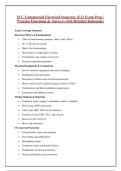
Exam Coverage Summary
Electrical Theory & Fundamentals
Units of measurement (amperes, ohms, watts, hertz)
AC vs DC power systems
Ohm's Law relationships
Three-phase vs single-phase systems
Transformers and voltage conversion
Generator operation principles
Electrical Equipment & Components
Service entrance equipment and main switchgear
Panelboards and load centers
Disconnect switches and overcurrent protection
Motor controls and Variable Frequency Drives (VFDs)
Transformers and their installation requirements
Luminaires and lighting systems
Wiring Methods & Materials
Conductor types (copper vs aluminum, solid vs stranded)
Wire sizing (AWG and kcmil)
Cable types (MC, NM, service entrance)
Conduit systems (EMT, PVC, rigid metal)
Raceways and wireways
Boxes and enclosures
Overcurrent Protection
Circuit breaker types and markings
Fuse ratings and applications
Interrupting ratings
Continuous loads and demand factors
Panelboard overcurrent protection
Feeder and branch circuit protection
,Grounding & Bonding
Equipment grounding conductors
Grounding electrode systems
Main bonding jumpers
Bonding of metallic raceways
Insulated grounded conductors
Service grounding requirements
Special Locations & Equipment
GFCI requirements and locations
Hazardous locations (Class 1, Division 2)
Pools, spas, and fountains
Healthcare facilities
Aircraft hangars and garages
Agricultural buildings
Special Inspections Process
Statement of Special Inspections
Roles and responsibilities
Reporting requirements
Non-conformance procedures
Contractor and RDP obligations
SET 1
Questions 1-50
1. What rating must equipment have to safely interrupt current at fault levels without
damage?
a) Voltage rating
b) Interrupting rating
c) Continuous rating
d) Horsepower rating
The interrupting rating specifies the maximum fault current equipment can safely
interrupt without sustaining damage.
2. Which enclosure type is specifically required for outdoor equipment that may be
subjected to prolonged submersion?
a) Type 3R
b) Type 4
, c) Type 6P
d) Type 12
Type 6P enclosures are designed for prolonged submersion conditions and are
required for equipment in flood-prone or submerged locations.
3. How long must a load operate at maximum current to be classified as a continuous
load?
a) 1 hour
b) 2 hours
c) 3 hours
d) 4 hours
Continuous loads are defined as those expected to last 3 hours or more at maximum
current, requiring special overcurrent protection sizing.
4. How is an insulated grounded conductor identified for sizes 6 AWG or smaller?
a) Green insulation
b) Continuous grey insulation
c) White with black stripe
d) Yellow insulation
Continuous grey insulation is the required identification for grounded conductors 6
AWG and smaller, though white is also permitted.
5. What special identification is required for conductors intended for direct burial
applications?
a) They must be marked "Direct Burial"
b) They must have a green stripe
c) They must be type THHN
d) They must be copper only
Direct burial conductors must be specifically identified and listed for burial
applications to ensure longevity in soil conditions.
6. What wiring method can be used to protect service-entrance conductors against
physical damage?
a) NM cable
b) Electrical Metallic Tubing (EMT)
c) Non-metallic sheathed cable
d) Flexible cord
EMT can serve as protection for service-entrance conductors when physical damage
is a concern, providing mechanical protection.
7. What is the minimum service disconnect rating for a service supplying two 2-wire
branch circuits?
a) 15 amperes
b) 20 amperes
c) 30 amperes
d) 60 amperes
The minimum service disconnect rating is 30 amperes for up to two 2-wire branch
circuits, ensuring adequate capacity.
, 8. When is an additional service permitted for a building with 1000V or less service?
a) When voltage drop exceeds 5%
b) When capacity exceeds 2000 amperes
c) When the building has multiple tenants
d) When the owner requests it
Additional services are permitted when the existing service capacity exceeds 2000
amperes for systems 1000V or less.
9. How many switches or sets of circuit breakers are permitted as service disconnects
per service?
a) 3
b) 6
c) 8
d) 10
A maximum of 6 switches or sets of circuit breakers per service is permitted as service
disconnects.
10. What size grounding electrode conductor is required for a 750 kcmil copper service
conductor?
a) 2/0 AWG
b) 3/0 AWG
c) 4/0 AWG
d) 250 kcmil
4/0 AWG is the required grounding electrode conductor size for a 750 kcmil copper
service conductor, based on NEC Table 250.66.
11. Which method can be used to bond metallic service raceways to ensure continuity?
a) Set-screw fittings
b) Compression fittings
c) Bonding type lock nuts
d) Electrical tape
Bonding type lock nuts provide a reliable method for bonding metallic service
raceways and ensuring electrical continuity.
12. Where is reconnection of the grounded conductor prohibited?
a) At the service disconnect
b) At the meter base
c) On the load side of service disconnecting means
d) At the utility transformer
Reconnection of the grounded conductor is prohibited on the load side of the service
disconnecting means to prevent parallel paths.
13. What is the purpose of the main bonding jumper?
a) Connects equipment grounding conductor to grounded conductor
b) Bonds metal enclosures together
c) Provides grounding to the service
d) Connects to the grounding electrode
The main bonding jumper connects the equipment grounding conductor to the
grounded conductor, establishing the connection to ground.
Electrical Theory & Fundamentals
Units of measurement (amperes, ohms, watts, hertz)
AC vs DC power systems
Ohm's Law relationships
Three-phase vs single-phase systems
Transformers and voltage conversion
Generator operation principles
Electrical Equipment & Components
Service entrance equipment and main switchgear
Panelboards and load centers
Disconnect switches and overcurrent protection
Motor controls and Variable Frequency Drives (VFDs)
Transformers and their installation requirements
Luminaires and lighting systems
Wiring Methods & Materials
Conductor types (copper vs aluminum, solid vs stranded)
Wire sizing (AWG and kcmil)
Cable types (MC, NM, service entrance)
Conduit systems (EMT, PVC, rigid metal)
Raceways and wireways
Boxes and enclosures
Overcurrent Protection
Circuit breaker types and markings
Fuse ratings and applications
Interrupting ratings
Continuous loads and demand factors
Panelboard overcurrent protection
Feeder and branch circuit protection
,Grounding & Bonding
Equipment grounding conductors
Grounding electrode systems
Main bonding jumpers
Bonding of metallic raceways
Insulated grounded conductors
Service grounding requirements
Special Locations & Equipment
GFCI requirements and locations
Hazardous locations (Class 1, Division 2)
Pools, spas, and fountains
Healthcare facilities
Aircraft hangars and garages
Agricultural buildings
Special Inspections Process
Statement of Special Inspections
Roles and responsibilities
Reporting requirements
Non-conformance procedures
Contractor and RDP obligations
SET 1
Questions 1-50
1. What rating must equipment have to safely interrupt current at fault levels without
damage?
a) Voltage rating
b) Interrupting rating
c) Continuous rating
d) Horsepower rating
The interrupting rating specifies the maximum fault current equipment can safely
interrupt without sustaining damage.
2. Which enclosure type is specifically required for outdoor equipment that may be
subjected to prolonged submersion?
a) Type 3R
b) Type 4
, c) Type 6P
d) Type 12
Type 6P enclosures are designed for prolonged submersion conditions and are
required for equipment in flood-prone or submerged locations.
3. How long must a load operate at maximum current to be classified as a continuous
load?
a) 1 hour
b) 2 hours
c) 3 hours
d) 4 hours
Continuous loads are defined as those expected to last 3 hours or more at maximum
current, requiring special overcurrent protection sizing.
4. How is an insulated grounded conductor identified for sizes 6 AWG or smaller?
a) Green insulation
b) Continuous grey insulation
c) White with black stripe
d) Yellow insulation
Continuous grey insulation is the required identification for grounded conductors 6
AWG and smaller, though white is also permitted.
5. What special identification is required for conductors intended for direct burial
applications?
a) They must be marked "Direct Burial"
b) They must have a green stripe
c) They must be type THHN
d) They must be copper only
Direct burial conductors must be specifically identified and listed for burial
applications to ensure longevity in soil conditions.
6. What wiring method can be used to protect service-entrance conductors against
physical damage?
a) NM cable
b) Electrical Metallic Tubing (EMT)
c) Non-metallic sheathed cable
d) Flexible cord
EMT can serve as protection for service-entrance conductors when physical damage
is a concern, providing mechanical protection.
7. What is the minimum service disconnect rating for a service supplying two 2-wire
branch circuits?
a) 15 amperes
b) 20 amperes
c) 30 amperes
d) 60 amperes
The minimum service disconnect rating is 30 amperes for up to two 2-wire branch
circuits, ensuring adequate capacity.
, 8. When is an additional service permitted for a building with 1000V or less service?
a) When voltage drop exceeds 5%
b) When capacity exceeds 2000 amperes
c) When the building has multiple tenants
d) When the owner requests it
Additional services are permitted when the existing service capacity exceeds 2000
amperes for systems 1000V or less.
9. How many switches or sets of circuit breakers are permitted as service disconnects
per service?
a) 3
b) 6
c) 8
d) 10
A maximum of 6 switches or sets of circuit breakers per service is permitted as service
disconnects.
10. What size grounding electrode conductor is required for a 750 kcmil copper service
conductor?
a) 2/0 AWG
b) 3/0 AWG
c) 4/0 AWG
d) 250 kcmil
4/0 AWG is the required grounding electrode conductor size for a 750 kcmil copper
service conductor, based on NEC Table 250.66.
11. Which method can be used to bond metallic service raceways to ensure continuity?
a) Set-screw fittings
b) Compression fittings
c) Bonding type lock nuts
d) Electrical tape
Bonding type lock nuts provide a reliable method for bonding metallic service
raceways and ensuring electrical continuity.
12. Where is reconnection of the grounded conductor prohibited?
a) At the service disconnect
b) At the meter base
c) On the load side of service disconnecting means
d) At the utility transformer
Reconnection of the grounded conductor is prohibited on the load side of the service
disconnecting means to prevent parallel paths.
13. What is the purpose of the main bonding jumper?
a) Connects equipment grounding conductor to grounded conductor
b) Bonds metal enclosures together
c) Provides grounding to the service
d) Connects to the grounding electrode
The main bonding jumper connects the equipment grounding conductor to the
grounded conductor, establishing the connection to ground.


