

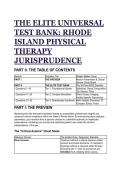
THE ELITE UNIVERSAL
TEST BANK: RHODE
ISLAND PHYSICAL
THERAPY
JURISPRUDENCE
PART 0: THE TABLE OF CONTENTS
Section Cognitive Tier Subject Matter Focus
PART I THE PREVIEW Mission Parameters & Critical
Axioms Cheat Sheet
PART II THE ELITE TEST BANK The 30-Point MCQ Gauntlet
- Questions 1–10 Tier 1: Foundational Syntax Definitions, Board Composition,
CEU Basics, Titles
- Questions 11–20 Tier 2: Complex Simulation Direct Access, Imaging,
Facility-Specific Supervision
- Questions 21–30 Tier 3: Grandmaster Synthesis Multi-Variable Scenarios, PT
Compact, Ethics, Fraud
PART I: THE PREVIEW
Mastering this elite test bank translates directly to unassailable professional integrity and
advanced clinical compliance within the State of Rhode Island. By internalizing these statutory
parameters, you transition from a passive clinician to a definitive authority on healthcare
jurisprudence, insulating your license and optimizing patient care under the strictest
interpretations of the law.
The "Critical Axioms" Cheat Sheet
Statutory Domain The Golden Rule / Regulatory Mandate
Direct Access Treatment without a referral requires written
consent and scope disclosure. A mandatory
physician referral is required within 90 days.
Clinicians with <1 year of experience are
forbidden from initiating direct access.
,Statutory Domain The Golden Rule / Regulatory Mandate
Supervision Hierarchy PTAs require telecommunication accessibility
and monthly on-site PT reassessments.
Unlicensed Supportive Personnel require
continuous line-of-sight supervision and daily
documentation review.
Diagnostic Imaging PTs may order basic radiological imaging
(X-rays) only. MRIs, CT scans, and ultrasounds
are strictly prohibited. Results must be reported
to the patient’s Primary Care Physician within 7
days.
CEU Mandates Licensees must complete 24 contact hours
biennially (by April 30th of even-numbered
years). Documentation must be retained for a
minimum of four (4) years.
Board Composition The Board consists of 7 members (4 PTs, 1
PTA, 1 Physician, 1 Public Consumer)
appointed by the Director of Health to ensure
cross-disciplinary oversight.
PART II: THE ELITE TEST BANK
Tier 1: Foundational Syntax & Application
Q1: The Rhode Island Board of Physical Therapy is responsible for the oversight, discipline,
and licensing of physical therapists. Regarding the statutory composition of this regulatory body,
which configuration is the MOST ACCURATE representation of current state law? A) Five total
members, consisting exclusively of physical therapists who possess a minimum of five years of
clinical experience. B) Seven total members: four physical therapists, one physical therapist
assistant, one physician licensed to practice medicine, and one public consumer member. C)
Seven total members: five physical therapists, one physician, and one representative appointed
directly by the Department of Health. D) Nine total members, including cross-disciplinary
representation from occupational therapy and chiropractic medicine to ensure comprehensive
rehabilitative oversight.
● Answer: B (Seven total members: four physical therapists, one physical therapist
assistant, one physician licensed to practice medicine, and one public consumer
member.)
● Distractor Analysis:
○ A is incorrect: This configuration reflects an outdated legacy model; Rhode Island
expanded the Board to seven members to include diverse professional and public
perspectives.
○ C is incorrect: This breakdown inaccurately allocates the seats, failing to account
for the statutorily mandated Physical Therapist Assistant (PTA) and public
consumer positions.
○ D is incorrect: The Board is strictly capped at seven members under RI Gen. Laws
§ 5-40-3 and does not mandate the inclusion of other rehabilitative disciplines.
The Mentor's Analysis: Regulatory boards are structurally designed to balance professional
clinical expertise with absolute public safety and interdisciplinary medical perspective. In Rhode
, Island, the mandatory inclusion of a PTA, a physician, and a consumer ensures a holistic
approach to regulatory enforcement, preventing the Board from devolving into an insular,
profession-centric echo chamber. Professional/Academic Intuition: Understand that the
Board acts as the ultimate arbiter of public protection, inherently relying on a multi-tiered
perspective to objectively govern the profession.
Q2: A highly ambitious physical therapy student successfully passes the National Physical
Therapy Examination (NPTE) and completes all academic graduation requirements. While
awaiting the formal administrative issuance of their Rhode Island license by the Department of
Health, they accept a position at a local outpatient clinic. Which title or abbreviation is the ONLY
appropriate designation for this individual to utilize in clinical documentation and patient
introductions? A) P.T. (Physical Therapist) B) D.P.T. (Doctor of Physical Therapy) C) P.T.
Applicant D) G.P.T. (Graduate Physical Therapist)
● Answer: D (G.P.T. (Graduate Physical Therapist))
● Distractor Analysis:
○ A is incorrect: Utilizing the abbreviation "P.T." before the formal administrative
issuance of the active license is a direct violation of Title 5, Chapter 40, constituting
unauthorized representation.
○ B is incorrect: While D.P.T. denotes an earned academic degree, it does not
function as the legally authorized regulatory title for clinical practice prior to full state
licensure.
○ C is incorrect: "Applicant" is a colloquial administrative term and not the statutorily
protected abbreviation designated by the Rhode Island Rules and Regulations.
The Mentor's Analysis: Title protection is the absolute bedrock of public trust and legal
accountability. Patients must have immediate, unambiguous clarity regarding the licensure
status of their provider. The designation Graduate Physical Therapist (G.P.T.) correctly bridges
the gap between academic completion and formal legal authorization, signaling to the public
that the clinician is highly trained but operating under a transitional legal framework.
Professional/Academic Intuition: Never assume an academic degree grants regulatory
authority; practice acts protect specific clinical abbreviations to prevent
misrepresentation and safeguard the public.
Q3: A licensed physical therapist is preparing for their upcoming biennial license renewal.
According to the Rules and Regulations for Licensing Physical Therapists (216-RICR-40-05-13),
what is the MINIMUM required completion of continuing education, and how long must the
licensee retain proof of these documents to satisfy potential state audits? A) 24 hours biennially;
documents must be retained for 2 years. B) 24 hours biennially; documents must be retained for
no less than 4 years. C) 30 hours biennially; documents must be retained for 5 years. D) 40
hours biennially; documents must be retained for 3 years.
● Answer: B (24 hours biennially; documents must be retained for no less than 4 years.)
● Distractor Analysis:
○ A is incorrect: While the 24-hour metric is accurate, a two-year retention period fails
to cover the statutorily required audit lookback period, rendering the therapist
non-compliant during an investigation.
○ C is incorrect: This exceeds the mandated standard for Rhode Island, representing
requirements found in other jurisdictions.
○ D is incorrect: This represents a common novice confusion with other professional
medical licenses (such as nursing or medicine) which often require higher hourly
thresholds.
The Mentor's Analysis: Continuing education ensures clinical competence in a rapidly evolving
TEST BANK: RHODE
ISLAND PHYSICAL
THERAPY
JURISPRUDENCE
PART 0: THE TABLE OF CONTENTS
Section Cognitive Tier Subject Matter Focus
PART I THE PREVIEW Mission Parameters & Critical
Axioms Cheat Sheet
PART II THE ELITE TEST BANK The 30-Point MCQ Gauntlet
- Questions 1–10 Tier 1: Foundational Syntax Definitions, Board Composition,
CEU Basics, Titles
- Questions 11–20 Tier 2: Complex Simulation Direct Access, Imaging,
Facility-Specific Supervision
- Questions 21–30 Tier 3: Grandmaster Synthesis Multi-Variable Scenarios, PT
Compact, Ethics, Fraud
PART I: THE PREVIEW
Mastering this elite test bank translates directly to unassailable professional integrity and
advanced clinical compliance within the State of Rhode Island. By internalizing these statutory
parameters, you transition from a passive clinician to a definitive authority on healthcare
jurisprudence, insulating your license and optimizing patient care under the strictest
interpretations of the law.
The "Critical Axioms" Cheat Sheet
Statutory Domain The Golden Rule / Regulatory Mandate
Direct Access Treatment without a referral requires written
consent and scope disclosure. A mandatory
physician referral is required within 90 days.
Clinicians with <1 year of experience are
forbidden from initiating direct access.
,Statutory Domain The Golden Rule / Regulatory Mandate
Supervision Hierarchy PTAs require telecommunication accessibility
and monthly on-site PT reassessments.
Unlicensed Supportive Personnel require
continuous line-of-sight supervision and daily
documentation review.
Diagnostic Imaging PTs may order basic radiological imaging
(X-rays) only. MRIs, CT scans, and ultrasounds
are strictly prohibited. Results must be reported
to the patient’s Primary Care Physician within 7
days.
CEU Mandates Licensees must complete 24 contact hours
biennially (by April 30th of even-numbered
years). Documentation must be retained for a
minimum of four (4) years.
Board Composition The Board consists of 7 members (4 PTs, 1
PTA, 1 Physician, 1 Public Consumer)
appointed by the Director of Health to ensure
cross-disciplinary oversight.
PART II: THE ELITE TEST BANK
Tier 1: Foundational Syntax & Application
Q1: The Rhode Island Board of Physical Therapy is responsible for the oversight, discipline,
and licensing of physical therapists. Regarding the statutory composition of this regulatory body,
which configuration is the MOST ACCURATE representation of current state law? A) Five total
members, consisting exclusively of physical therapists who possess a minimum of five years of
clinical experience. B) Seven total members: four physical therapists, one physical therapist
assistant, one physician licensed to practice medicine, and one public consumer member. C)
Seven total members: five physical therapists, one physician, and one representative appointed
directly by the Department of Health. D) Nine total members, including cross-disciplinary
representation from occupational therapy and chiropractic medicine to ensure comprehensive
rehabilitative oversight.
● Answer: B (Seven total members: four physical therapists, one physical therapist
assistant, one physician licensed to practice medicine, and one public consumer
member.)
● Distractor Analysis:
○ A is incorrect: This configuration reflects an outdated legacy model; Rhode Island
expanded the Board to seven members to include diverse professional and public
perspectives.
○ C is incorrect: This breakdown inaccurately allocates the seats, failing to account
for the statutorily mandated Physical Therapist Assistant (PTA) and public
consumer positions.
○ D is incorrect: The Board is strictly capped at seven members under RI Gen. Laws
§ 5-40-3 and does not mandate the inclusion of other rehabilitative disciplines.
The Mentor's Analysis: Regulatory boards are structurally designed to balance professional
clinical expertise with absolute public safety and interdisciplinary medical perspective. In Rhode
, Island, the mandatory inclusion of a PTA, a physician, and a consumer ensures a holistic
approach to regulatory enforcement, preventing the Board from devolving into an insular,
profession-centric echo chamber. Professional/Academic Intuition: Understand that the
Board acts as the ultimate arbiter of public protection, inherently relying on a multi-tiered
perspective to objectively govern the profession.
Q2: A highly ambitious physical therapy student successfully passes the National Physical
Therapy Examination (NPTE) and completes all academic graduation requirements. While
awaiting the formal administrative issuance of their Rhode Island license by the Department of
Health, they accept a position at a local outpatient clinic. Which title or abbreviation is the ONLY
appropriate designation for this individual to utilize in clinical documentation and patient
introductions? A) P.T. (Physical Therapist) B) D.P.T. (Doctor of Physical Therapy) C) P.T.
Applicant D) G.P.T. (Graduate Physical Therapist)
● Answer: D (G.P.T. (Graduate Physical Therapist))
● Distractor Analysis:
○ A is incorrect: Utilizing the abbreviation "P.T." before the formal administrative
issuance of the active license is a direct violation of Title 5, Chapter 40, constituting
unauthorized representation.
○ B is incorrect: While D.P.T. denotes an earned academic degree, it does not
function as the legally authorized regulatory title for clinical practice prior to full state
licensure.
○ C is incorrect: "Applicant" is a colloquial administrative term and not the statutorily
protected abbreviation designated by the Rhode Island Rules and Regulations.
The Mentor's Analysis: Title protection is the absolute bedrock of public trust and legal
accountability. Patients must have immediate, unambiguous clarity regarding the licensure
status of their provider. The designation Graduate Physical Therapist (G.P.T.) correctly bridges
the gap between academic completion and formal legal authorization, signaling to the public
that the clinician is highly trained but operating under a transitional legal framework.
Professional/Academic Intuition: Never assume an academic degree grants regulatory
authority; practice acts protect specific clinical abbreviations to prevent
misrepresentation and safeguard the public.
Q3: A licensed physical therapist is preparing for their upcoming biennial license renewal.
According to the Rules and Regulations for Licensing Physical Therapists (216-RICR-40-05-13),
what is the MINIMUM required completion of continuing education, and how long must the
licensee retain proof of these documents to satisfy potential state audits? A) 24 hours biennially;
documents must be retained for 2 years. B) 24 hours biennially; documents must be retained for
no less than 4 years. C) 30 hours biennially; documents must be retained for 5 years. D) 40
hours biennially; documents must be retained for 3 years.
● Answer: B (24 hours biennially; documents must be retained for no less than 4 years.)
● Distractor Analysis:
○ A is incorrect: While the 24-hour metric is accurate, a two-year retention period fails
to cover the statutorily required audit lookback period, rendering the therapist
non-compliant during an investigation.
○ C is incorrect: This exceeds the mandated standard for Rhode Island, representing
requirements found in other jurisdictions.
○ D is incorrect: This represents a common novice confusion with other professional
medical licenses (such as nursing or medicine) which often require higher hourly
thresholds.
The Mentor's Analysis: Continuing education ensures clinical competence in a rapidly evolving


