

The Elite Test Bank:
Oklahoma Physical
Therapy Board
Jurisprudence
PART 0: THE TABLE OF CONTENTS
● PART I: THE PREVIEW
○ The Critical Axioms Cheat Sheet
● PART II: THE ELITE TEST BANK
○ Tier 1: Foundational Syntax & Application (Questions 1–10)
○ Tier 2: Complex Application & Simulation (Questions 11–20)
○ Tier 3: Grandmaster Synthesis (Questions 21–30)
PART I: THE PREVIEW
Mastering this jurisprudence test bank translates directly to elite clinical compliance, protecting
physical therapy licenses and elevating the standard of care across the jurisdiction. By
internalizing these regulatory frameworks, the practitioner transcends basic rote memorization
and achieves the executive decision-making capabilities required of a top-tier physical therapist
operating within the bounds of Oklahoma state law.
The Critical Axioms Cheat Sheet
The following table synthesizes the absolute critical parameters dictating legal physical therapy
practice within the jurisdiction.
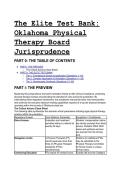
Regulatory Domain Core Statutory Parameter Exceptions / Conditionals
Direct Access Evaluation and treatment Workers' compensation claims
permitted without a referral for are strictly excluded from direct
exactly 30 days. access. Pediatric IDEA 2004
cases and wellness services
are exempt from the 30-day
limit.
Delegation Limits A Physical Therapist (PT) Petitions for additional PTAs
cannot supervise more than may be submitted to the
three (3) Physical Therapist Physical Therapy Committee
Assistants (PTAs) for formal review in unique
simultaneously. clinical cases.
Continuing Education PTs require 40 contact hours; Exactly half must be Category
,Regulatory Domain Core Statutory Parameter Exceptions / Conditionals
PTAs require 30 contact hours A (professional development).
every two-year cycle. Minimum of 3 hours must
encompass ethics. Records
must be retained for 4 years.
Telehealth Telehealth services must be The patient must be physically
strictly synchronous (real-time located in Oklahoma, and the
audio and video). provider must hold a valid OK
license or active Compact
Privilege.
Compact Privilege To secure an interstate A single disciplinary
Compact Privilege in encumbrance on a home state
Oklahoma, the Oklahoma license instantly invalidates the
Jurisprudence Assessment privilege for two years.
Module (OK JAM) must be
passed before applying.
PART II: THE ELITE TEST BANK
Tier 1: Foundational Syntax & Application (Questions 1–10)
Q1: A patient presents to an outpatient physical therapy clinic in Oklahoma with acute
mechanical lower back pain. The patient does not possess a physician's referral and is
self-paying for the episode of care. Based on the principles of the Oklahoma Physical Therapy
Practice Act regarding direct access, which action is the MOST ACCURATE? A) The physical
therapist may evaluate the patient but cannot initiate physical therapy treatment without a
physician's signature authorizing the established plan of care. B) The physical therapist may
evaluate and treat the patient for up to thirty visits, after which a referral from a licensed
healthcare practitioner is legally mandated. C) The physical therapist may evaluate and treat the
patient for a period not to exceed thirty days without a referral, provided the injury is not an
active workers' compensation claim. D) The physical therapist may treat the patient indefinitely
without a referral, provided the patient demonstrates continuous objective clinical improvement
in their functional outcome measures.
● Answer: C (The physical therapist may evaluate and treat the patient for a period not to
exceed thirty days without a referral, provided the injury is not an active workers'
compensation claim.)
● Distractor Analysis:
○ A is incorrect: Oklahoma law explicitly authorizes both evaluation and treatment
under its direct access provisions; it does not restrict the physical therapist to
evaluation-only encounters.
○ B is incorrect: The statutory limitation is measured in chronological days (thirty
days), not the total number of clinical visits (thirty visits). Conflating payer visit
authorizations with statutory time limits is a profound analytical error.
○ D is incorrect: Indefinite treatment without a referral is strictly prohibited under the
thirty-day rule for injury and ailment management, regardless of how well the
patient is progressing clinically.
The Mentor's Analysis: The legislative framework governing direct access strictly limits
interventions using a temporal boundary to force the integration of advanced medical
, diagnostics if the pathology fails to resolve rapidly. When facing unreferred patients, the
immediate priority is calculating the chronological episode timeline and identifying payer
restrictions (e.g., workers' compensation). By utilizing statutory timeframes, the practitioner
bypasses the common trap of confusing insurance visit authorizations with legal practice act
limitations. Professional/Academic Intuition: Direct access is a rigid thirty-day temporal
limitation, entirely voided if the etiology of the human ailment is tied to a workers'
compensation claim.
Q2: A licensed physical therapist assumes the role of clinical director at a high-volume
rehabilitation facility. Corporate management instructs the therapist to supervise a newly hired
cohort of Physical Therapist Assistants (PTAs). Based on the principles of the Oklahoma
Administrative Code (OAC 435:20-7-1), which conclusion regarding staffing ratios is the MOST
ACCURATE? A) The physical therapist may supervise up to five PTAs simultaneously, provided
all are working within the identical physical facility and visual line of sight is maintained. B) The
physical therapist is legally prohibited from supervising more than three PTAs unless a formal
petition is submitted to and approved by the Physical Therapy Committee. C) The physical
therapist may supervise an unlimited number of PTAs, provided formal case consultations are
thoroughly documented in the medical record every fifteen days. D) The physical therapist can
only supervise two PTAs if the therapist is concurrently responsible for supervising an on-the-job
trained physical therapy aide.
● Answer: B (The physical therapist is legally prohibited from supervising more than three
PTAs unless a formal petition is submitted to and approved by the Physical Therapy
Committee.)
● Distractor Analysis:
○ A is incorrect: Five PTAs exceed the standard maximum statutory ratio allowed
without explicit authorization, regardless of facility proximity or visual line of sight.
○ C is incorrect: Case consultation requirements represent a separate supervisory
mechanism and do not override or expand the strict numerical limitation placed on
PTA supervision.
○ D is incorrect: The presence of an unlicensed physical therapy aide does not
automatically or legally reduce the statutory PTA supervision cap from three down
to two.
The Mentor's Analysis: Span of control in clinical practice is legally capped to prevent the
dilution of clinical oversight and ensure patient safety. When facing administrative pressure from
corporate entities to increase supervisory volume, the immediate priority is securing formal
approval from the Physical Therapy Committee. By utilizing the 3-to-1 baseline ratio, the
clinician bypasses the common trap of allowing corporate productivity metrics to force a severe
licensure violation. Professional/Academic Intuition: Clinical delegation scales legally, not
corporately; assuming supervisory liability for more than three PTAs requires explicit,
documented Committee authorization.
Q3: A physical therapist assistant (PTA) is compiling documentation to renew their Oklahoma
license at the conclusion of the biennial compliance period. Based on the principles of the
Oklahoma Physical Therapy Professional Development rules, which conclusion regarding
continuing education (CEU) requirements is the MOST ACCURATE? A) The PTA must
complete forty contact hours, of which fifteen must be Category A, and three hours must be
dedicated to jurisprudence. B) The PTA must complete thirty contact hours, of which at least half
must be Category A, and three hours must contain ethics education. C) The PTA must complete
thirty contact hours, all of which may be Category B if the PTA successfully proves they worked
less than five hundred hours per year. D) The PTA must complete forty contact hours, of which
Oklahoma Physical
Therapy Board
Jurisprudence
PART 0: THE TABLE OF CONTENTS
● PART I: THE PREVIEW
○ The Critical Axioms Cheat Sheet
● PART II: THE ELITE TEST BANK
○ Tier 1: Foundational Syntax & Application (Questions 1–10)
○ Tier 2: Complex Application & Simulation (Questions 11–20)
○ Tier 3: Grandmaster Synthesis (Questions 21–30)
PART I: THE PREVIEW
Mastering this jurisprudence test bank translates directly to elite clinical compliance, protecting
physical therapy licenses and elevating the standard of care across the jurisdiction. By
internalizing these regulatory frameworks, the practitioner transcends basic rote memorization
and achieves the executive decision-making capabilities required of a top-tier physical therapist
operating within the bounds of Oklahoma state law.
The Critical Axioms Cheat Sheet
The following table synthesizes the absolute critical parameters dictating legal physical therapy
practice within the jurisdiction.
Regulatory Domain Core Statutory Parameter Exceptions / Conditionals
Direct Access Evaluation and treatment Workers' compensation claims
permitted without a referral for are strictly excluded from direct
exactly 30 days. access. Pediatric IDEA 2004
cases and wellness services
are exempt from the 30-day
limit.
Delegation Limits A Physical Therapist (PT) Petitions for additional PTAs
cannot supervise more than may be submitted to the
three (3) Physical Therapist Physical Therapy Committee
Assistants (PTAs) for formal review in unique
simultaneously. clinical cases.
Continuing Education PTs require 40 contact hours; Exactly half must be Category
,Regulatory Domain Core Statutory Parameter Exceptions / Conditionals
PTAs require 30 contact hours A (professional development).
every two-year cycle. Minimum of 3 hours must
encompass ethics. Records
must be retained for 4 years.
Telehealth Telehealth services must be The patient must be physically
strictly synchronous (real-time located in Oklahoma, and the
audio and video). provider must hold a valid OK
license or active Compact
Privilege.
Compact Privilege To secure an interstate A single disciplinary
Compact Privilege in encumbrance on a home state
Oklahoma, the Oklahoma license instantly invalidates the
Jurisprudence Assessment privilege for two years.
Module (OK JAM) must be
passed before applying.
PART II: THE ELITE TEST BANK
Tier 1: Foundational Syntax & Application (Questions 1–10)
Q1: A patient presents to an outpatient physical therapy clinic in Oklahoma with acute
mechanical lower back pain. The patient does not possess a physician's referral and is
self-paying for the episode of care. Based on the principles of the Oklahoma Physical Therapy
Practice Act regarding direct access, which action is the MOST ACCURATE? A) The physical
therapist may evaluate the patient but cannot initiate physical therapy treatment without a
physician's signature authorizing the established plan of care. B) The physical therapist may
evaluate and treat the patient for up to thirty visits, after which a referral from a licensed
healthcare practitioner is legally mandated. C) The physical therapist may evaluate and treat the
patient for a period not to exceed thirty days without a referral, provided the injury is not an
active workers' compensation claim. D) The physical therapist may treat the patient indefinitely
without a referral, provided the patient demonstrates continuous objective clinical improvement
in their functional outcome measures.
● Answer: C (The physical therapist may evaluate and treat the patient for a period not to
exceed thirty days without a referral, provided the injury is not an active workers'
compensation claim.)
● Distractor Analysis:
○ A is incorrect: Oklahoma law explicitly authorizes both evaluation and treatment
under its direct access provisions; it does not restrict the physical therapist to
evaluation-only encounters.
○ B is incorrect: The statutory limitation is measured in chronological days (thirty
days), not the total number of clinical visits (thirty visits). Conflating payer visit
authorizations with statutory time limits is a profound analytical error.
○ D is incorrect: Indefinite treatment without a referral is strictly prohibited under the
thirty-day rule for injury and ailment management, regardless of how well the
patient is progressing clinically.
The Mentor's Analysis: The legislative framework governing direct access strictly limits
interventions using a temporal boundary to force the integration of advanced medical
, diagnostics if the pathology fails to resolve rapidly. When facing unreferred patients, the
immediate priority is calculating the chronological episode timeline and identifying payer
restrictions (e.g., workers' compensation). By utilizing statutory timeframes, the practitioner
bypasses the common trap of confusing insurance visit authorizations with legal practice act
limitations. Professional/Academic Intuition: Direct access is a rigid thirty-day temporal
limitation, entirely voided if the etiology of the human ailment is tied to a workers'
compensation claim.
Q2: A licensed physical therapist assumes the role of clinical director at a high-volume
rehabilitation facility. Corporate management instructs the therapist to supervise a newly hired
cohort of Physical Therapist Assistants (PTAs). Based on the principles of the Oklahoma
Administrative Code (OAC 435:20-7-1), which conclusion regarding staffing ratios is the MOST
ACCURATE? A) The physical therapist may supervise up to five PTAs simultaneously, provided
all are working within the identical physical facility and visual line of sight is maintained. B) The
physical therapist is legally prohibited from supervising more than three PTAs unless a formal
petition is submitted to and approved by the Physical Therapy Committee. C) The physical
therapist may supervise an unlimited number of PTAs, provided formal case consultations are
thoroughly documented in the medical record every fifteen days. D) The physical therapist can
only supervise two PTAs if the therapist is concurrently responsible for supervising an on-the-job
trained physical therapy aide.
● Answer: B (The physical therapist is legally prohibited from supervising more than three
PTAs unless a formal petition is submitted to and approved by the Physical Therapy
Committee.)
● Distractor Analysis:
○ A is incorrect: Five PTAs exceed the standard maximum statutory ratio allowed
without explicit authorization, regardless of facility proximity or visual line of sight.
○ C is incorrect: Case consultation requirements represent a separate supervisory
mechanism and do not override or expand the strict numerical limitation placed on
PTA supervision.
○ D is incorrect: The presence of an unlicensed physical therapy aide does not
automatically or legally reduce the statutory PTA supervision cap from three down
to two.
The Mentor's Analysis: Span of control in clinical practice is legally capped to prevent the
dilution of clinical oversight and ensure patient safety. When facing administrative pressure from
corporate entities to increase supervisory volume, the immediate priority is securing formal
approval from the Physical Therapy Committee. By utilizing the 3-to-1 baseline ratio, the
clinician bypasses the common trap of allowing corporate productivity metrics to force a severe
licensure violation. Professional/Academic Intuition: Clinical delegation scales legally, not
corporately; assuming supervisory liability for more than three PTAs requires explicit,
documented Committee authorization.
Q3: A physical therapist assistant (PTA) is compiling documentation to renew their Oklahoma
license at the conclusion of the biennial compliance period. Based on the principles of the
Oklahoma Physical Therapy Professional Development rules, which conclusion regarding
continuing education (CEU) requirements is the MOST ACCURATE? A) The PTA must
complete forty contact hours, of which fifteen must be Category A, and three hours must be
dedicated to jurisprudence. B) The PTA must complete thirty contact hours, of which at least half
must be Category A, and three hours must contain ethics education. C) The PTA must complete
thirty contact hours, all of which may be Category B if the PTA successfully proves they worked
less than five hundred hours per year. D) The PTA must complete forty contact hours, of which


