
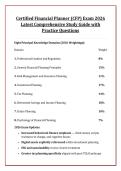
Certified Financial Planner (CFP) Exam 2026
Latest Comprehensive Study Guide with
Practice Questions
Eight Principal Knowledge Domains (2026 Weightings):
Domain Weight
1. Professional Conduct and Regulation 8%
2. General Financial Planning Principles 15%
3. Risk Management and Insurance Planning 11%
4. Investment Planning 17%
5. Tax Planning 14%
6. Retirement Savings and Income Planning 18%
7. Estate Planning 10%
8. Psychology of Financial Planning 7%
2026 Exam Updates:
• Increased behavioral finance emphasis — client money scripts,
resistance to change, and cognitive biases
• Digital assets explicitly referenced within investment planning
• ESG and sustainability receive clearer treatment
• Greater tax planning specificity aligned with post-TCJA landscape
, • Expanded risk management — long-term care, annuities, and
insurance planning strategies
SECTION 1: PROFESSIONAL CONDUCT AND REGULATION (8%)
(Questions 1-10)
Question 1
Under the CFP Board's Code of Ethics and Standards of Conduct, which of the
following is the primary duty owed by a CFP® professional to a client?
A) Duty of confidentiality
B) Duty of loyalty
C) Fiduciary duty
D) Duty of disclosure
Correct Answer: C
Rationale: The primary duty owed by a CFP® professional to a client is
the fiduciary duty. As a fiduciary, the CFP professional must act in the client's
best interests at all times when providing financial advice. While duties of
loyalty (B), confidentiality (A), and disclosure (D) are all important
components of the fiduciary duty, the overarching fiduciary obligation
encompasses all of these and is the foundational ethical principle. The
fiduciary duty requires the professional to put the client's interests above
their own and to avoid conflicts of interest.
Question 2
Under CFP Board's Code of Ethics, a CFP® professional must disclose to a
client all material conflicts of interest:
A) Only if the client specifically asks
B) Before or at the time the professional provides financial advice
C) Only after the advice has been provided
D) Only if the conflict involves a financial incentive
,Correct Answer: B
Rationale: CFP® professionals must disclose all material conflicts of
interest before or at the time the professional provides financial advice.
This timely disclosure allows clients to make informed decisions about
whether to proceed with the advice. Disclosure should include the nature of
the conflict and how it will be managed. Waiting until after advice is provided
(C) or only disclosing upon request (A) would violate the standard. All
material conflicts must be disclosed, not just those involving financial
incentives (D).
Question 3
Which of the following best describes the "duty of care" under the CFP Board's
Standards of Conduct?
A) The duty to keep client information confidential
B) The duty to provide advice that is in the client's best interest
C) The duty to act with the skill, care, diligence, and judgment of a prudent
professional
D) The duty to follow all client instructions without question
Correct Answer: C
Rationale: The duty of care requires CFP® professionals to act with the
skill, care, diligence, and judgment of a prudent professional under the
circumstances. This means applying the knowledge and expertise expected of
a competent financial planner. The duty of confidentiality (A) is separate. The
duty to act in the client's best interest (B) describes the fiduciary duty more
broadly. Following all client instructions without question (D) would not
satisfy the duty of care if the instructions are imprudent.
Question 4
Under the CFP Board's disciplinary rules, which of the following is a potential
sanction for a violation of the Code of Ethics?
, A) Monetary fine
B) Public letter of admonition
C) Suspension or revocation of CFP® certification
D) All of the above
Correct Answer: D
Rationale: The CFP Board has authority to impose various sanctions for
ethical violations, including public letter of admonition, suspension, and
revocation of CFP® certification. While the CFP Board does not typically
impose monetary fines (A) as a direct sanction, the other options are valid
disciplinary actions. The severity of the sanction depends on the nature and
seriousness of the violation.
Question 5
A CFP® professional is recommending a proprietary investment product
offered by their firm. What is the professional's obligation under the
Standards of Conduct?
A) No disclosure is required since the product is offered by their firm
B) The professional must disclose the conflict of interest and explain why the
product is suitable
C) The professional cannot recommend proprietary products under any
circumstances
D) The professional must recommend the product only if it has the lowest fees
Correct Answer: B
Rationale: When recommending a proprietary product, the CFP®
professional must disclose the conflict of interest and explain why the
product is suitable for the client. The fiduciary duty requires that the
recommendation be in the client's best interest despite the potential conflict.
The conflict does not prohibit the recommendation (C), but it must be
disclosed and justified. The product need not have the lowest fees (D)—it
must be suitable and in the client's best interest considering all factors.
Question 6
Latest Comprehensive Study Guide with
Practice Questions
Eight Principal Knowledge Domains (2026 Weightings):
Domain Weight
1. Professional Conduct and Regulation 8%
2. General Financial Planning Principles 15%
3. Risk Management and Insurance Planning 11%
4. Investment Planning 17%
5. Tax Planning 14%
6. Retirement Savings and Income Planning 18%
7. Estate Planning 10%
8. Psychology of Financial Planning 7%
2026 Exam Updates:
• Increased behavioral finance emphasis — client money scripts,
resistance to change, and cognitive biases
• Digital assets explicitly referenced within investment planning
• ESG and sustainability receive clearer treatment
• Greater tax planning specificity aligned with post-TCJA landscape
, • Expanded risk management — long-term care, annuities, and
insurance planning strategies
SECTION 1: PROFESSIONAL CONDUCT AND REGULATION (8%)
(Questions 1-10)
Question 1
Under the CFP Board's Code of Ethics and Standards of Conduct, which of the
following is the primary duty owed by a CFP® professional to a client?
A) Duty of confidentiality
B) Duty of loyalty
C) Fiduciary duty
D) Duty of disclosure
Correct Answer: C
Rationale: The primary duty owed by a CFP® professional to a client is
the fiduciary duty. As a fiduciary, the CFP professional must act in the client's
best interests at all times when providing financial advice. While duties of
loyalty (B), confidentiality (A), and disclosure (D) are all important
components of the fiduciary duty, the overarching fiduciary obligation
encompasses all of these and is the foundational ethical principle. The
fiduciary duty requires the professional to put the client's interests above
their own and to avoid conflicts of interest.
Question 2
Under CFP Board's Code of Ethics, a CFP® professional must disclose to a
client all material conflicts of interest:
A) Only if the client specifically asks
B) Before or at the time the professional provides financial advice
C) Only after the advice has been provided
D) Only if the conflict involves a financial incentive
,Correct Answer: B
Rationale: CFP® professionals must disclose all material conflicts of
interest before or at the time the professional provides financial advice.
This timely disclosure allows clients to make informed decisions about
whether to proceed with the advice. Disclosure should include the nature of
the conflict and how it will be managed. Waiting until after advice is provided
(C) or only disclosing upon request (A) would violate the standard. All
material conflicts must be disclosed, not just those involving financial
incentives (D).
Question 3
Which of the following best describes the "duty of care" under the CFP Board's
Standards of Conduct?
A) The duty to keep client information confidential
B) The duty to provide advice that is in the client's best interest
C) The duty to act with the skill, care, diligence, and judgment of a prudent
professional
D) The duty to follow all client instructions without question
Correct Answer: C
Rationale: The duty of care requires CFP® professionals to act with the
skill, care, diligence, and judgment of a prudent professional under the
circumstances. This means applying the knowledge and expertise expected of
a competent financial planner. The duty of confidentiality (A) is separate. The
duty to act in the client's best interest (B) describes the fiduciary duty more
broadly. Following all client instructions without question (D) would not
satisfy the duty of care if the instructions are imprudent.
Question 4
Under the CFP Board's disciplinary rules, which of the following is a potential
sanction for a violation of the Code of Ethics?
, A) Monetary fine
B) Public letter of admonition
C) Suspension or revocation of CFP® certification
D) All of the above
Correct Answer: D
Rationale: The CFP Board has authority to impose various sanctions for
ethical violations, including public letter of admonition, suspension, and
revocation of CFP® certification. While the CFP Board does not typically
impose monetary fines (A) as a direct sanction, the other options are valid
disciplinary actions. The severity of the sanction depends on the nature and
seriousness of the violation.
Question 5
A CFP® professional is recommending a proprietary investment product
offered by their firm. What is the professional's obligation under the
Standards of Conduct?
A) No disclosure is required since the product is offered by their firm
B) The professional must disclose the conflict of interest and explain why the
product is suitable
C) The professional cannot recommend proprietary products under any
circumstances
D) The professional must recommend the product only if it has the lowest fees
Correct Answer: B
Rationale: When recommending a proprietary product, the CFP®
professional must disclose the conflict of interest and explain why the
product is suitable for the client. The fiduciary duty requires that the
recommendation be in the client's best interest despite the potential conflict.
The conflict does not prohibit the recommendation (C), but it must be
disclosed and justified. The product need not have the lowest fees (D)—it
must be suitable and in the client's best interest considering all factors.
Question 6


