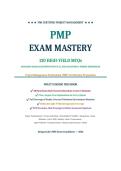
★ ★ ★ PMI CERTIFIED PROJECT MANAGEMENT ★ ★ ★
PMP
EXAM MASTERY
120 HIGH-YIELD MCQs
SCENARIO-BASED QUESTIONS WITH FULL EXPLANATIONS & PMBOK REFERENCES
Project Management Professional (PMP) Certification Preparation
WHAT'S INSIDE THIS BOOK
✔ 120 Real Exam-Style Scenario Questions Across 14 Domains
✔ Clear, Jargon-Free Explanations for Every Option
✔ Full Coverage of People, Process & Business Environment Domains
✔ Dedicated Agile & Hybrid Approach Coverage
✔ EVM Formulas, Risk Strategies & Ethics Scenarios Explained
Topics: Fundamentals • Team Leadership • Stakeholders & Conflict • Integration • Scope •
Schedule • Cost & EVM • Quality • Risk • Procurement •
Agile & Hybrid • Communications • Business Environment • Ethics
Designed for PMP Exam Candidates — 2026
, TABLE OF CONTENTS
14 Domains — 120 Questions
1. Project Management Fundamentals & Roles......................................................Q1–8
2. Team Building & Leadership (People Domain)...............................................Q9–20
3. Conflict Management & Stakeholder Engagement.......................................Q21–30
4. Project Integration Management.......................................................................Q31–38
5. Scope Management.................................................................................................Q39–46
6. Schedule Management.......................................................................................... Q47–56
7. Cost Management & Earned Value Management..........................................Q57–68
8. Quality Management............................................................................................. Q69–74
9. Risk Management...................................................................................................Q75–84
10. Procurement Management................................................................................Q85–90
11. Agile & Hybrid Approaches.............................................................................. Q91–102
12. Communications Management.....................................................................Q103–108
13. Business Environment & Compliance........................................................Q109–114
14. Ethics & Professional Responsibility..........................................................Q115–120
, WELCOME
Let's get you PMP certified!
Hi there! This book is built for one purpose: helping you pass the PMP (Project Management
Professional) exam with confidence.
Every question here is written in the same scenario-based style as the real exam — a situation, a
judgment call, and the single BEST answer among several plausible options. We've kept the explanations
clear and jargon-free, without cutting corners on accuracy.
HOW TO USE THIS BOOK
1. Read the scenario carefully — the specific situation determines which principle or process
applies.
2. Pick your answer — before looking at the solution.
3. Read ALL FOUR explanations — the exam tests your ability to spot the single BEST of several
plausible answers.
4. Note the PMBOK reference — know exactly which domain and concept each question maps to.
MARKING PATTERN
+4 for Correct • −1 for Incorrect (matches typical certification-exam-style scoring)
Good luck — let's get you exam-ready!
, Section 1: Project Management Fundamentals & Roles
Q1.
A new project manager is confused about the difference between a project and ongoing
operations within their organization.
Which statement BEST distinguishes a project from operational work?
A. A project is any work performed by a team, while operations refers only to work performed
by a single individual B. A project is a temporary endeavor undertaken to create a unique
product, service, or result, with a definite beginning and end; operations are ongoing and
repetitive C. Projects and operations are identical concepts with no meaningful distinction D. A
project always lasts longer than one year, while operations last less than one year
Select the SINGLE best answer.
Correct Answer: B
Explanation (in simple terms): A project is defined by two key characteristics: it is
temporary (has a defined start and end) and it produces something unique (a distinct product,
service, or result) — once that unique outcome is achieved, the project ends. Operations, by
contrast, are ongoing, repetitive activities that sustain the business (like daily manufacturing or
customer support) with no defined end date.
Why the others are wrong: - A. Team size has nothing to do with distinguishing projects
from operations — both can involve one person or many. - C. Projects and operations are
fundamentally different in nature (temporary/unique vs. ongoing/repetitive) — they are not
interchangeable concepts. - D. Duration alone doesn’t define a project — some projects last
years, others last days; the defining features are temporariness and uniqueness of outcome, not
a specific time threshold.
PMI Reference: PMBOK Guide (7th Edition) — Introduction, definition of a project; PMP
Examination Content Outline.
Q2.
A project manager is assigned to a project with a formally approved project charter that
authorizes their role and grants them formal authority to apply organizational resources to
project activities.
What is the PRIMARY purpose of a project charter?
PMP
EXAM MASTERY
120 HIGH-YIELD MCQs
SCENARIO-BASED QUESTIONS WITH FULL EXPLANATIONS & PMBOK REFERENCES
Project Management Professional (PMP) Certification Preparation
WHAT'S INSIDE THIS BOOK
✔ 120 Real Exam-Style Scenario Questions Across 14 Domains
✔ Clear, Jargon-Free Explanations for Every Option
✔ Full Coverage of People, Process & Business Environment Domains
✔ Dedicated Agile & Hybrid Approach Coverage
✔ EVM Formulas, Risk Strategies & Ethics Scenarios Explained
Topics: Fundamentals • Team Leadership • Stakeholders & Conflict • Integration • Scope •
Schedule • Cost & EVM • Quality • Risk • Procurement •
Agile & Hybrid • Communications • Business Environment • Ethics
Designed for PMP Exam Candidates — 2026
, TABLE OF CONTENTS
14 Domains — 120 Questions
1. Project Management Fundamentals & Roles......................................................Q1–8
2. Team Building & Leadership (People Domain)...............................................Q9–20
3. Conflict Management & Stakeholder Engagement.......................................Q21–30
4. Project Integration Management.......................................................................Q31–38
5. Scope Management.................................................................................................Q39–46
6. Schedule Management.......................................................................................... Q47–56
7. Cost Management & Earned Value Management..........................................Q57–68
8. Quality Management............................................................................................. Q69–74
9. Risk Management...................................................................................................Q75–84
10. Procurement Management................................................................................Q85–90
11. Agile & Hybrid Approaches.............................................................................. Q91–102
12. Communications Management.....................................................................Q103–108
13. Business Environment & Compliance........................................................Q109–114
14. Ethics & Professional Responsibility..........................................................Q115–120
, WELCOME
Let's get you PMP certified!
Hi there! This book is built for one purpose: helping you pass the PMP (Project Management
Professional) exam with confidence.
Every question here is written in the same scenario-based style as the real exam — a situation, a
judgment call, and the single BEST answer among several plausible options. We've kept the explanations
clear and jargon-free, without cutting corners on accuracy.
HOW TO USE THIS BOOK
1. Read the scenario carefully — the specific situation determines which principle or process
applies.
2. Pick your answer — before looking at the solution.
3. Read ALL FOUR explanations — the exam tests your ability to spot the single BEST of several
plausible answers.
4. Note the PMBOK reference — know exactly which domain and concept each question maps to.
MARKING PATTERN
+4 for Correct • −1 for Incorrect (matches typical certification-exam-style scoring)
Good luck — let's get you exam-ready!
, Section 1: Project Management Fundamentals & Roles
Q1.
A new project manager is confused about the difference between a project and ongoing
operations within their organization.
Which statement BEST distinguishes a project from operational work?
A. A project is any work performed by a team, while operations refers only to work performed
by a single individual B. A project is a temporary endeavor undertaken to create a unique
product, service, or result, with a definite beginning and end; operations are ongoing and
repetitive C. Projects and operations are identical concepts with no meaningful distinction D. A
project always lasts longer than one year, while operations last less than one year
Select the SINGLE best answer.
Correct Answer: B
Explanation (in simple terms): A project is defined by two key characteristics: it is
temporary (has a defined start and end) and it produces something unique (a distinct product,
service, or result) — once that unique outcome is achieved, the project ends. Operations, by
contrast, are ongoing, repetitive activities that sustain the business (like daily manufacturing or
customer support) with no defined end date.
Why the others are wrong: - A. Team size has nothing to do with distinguishing projects
from operations — both can involve one person or many. - C. Projects and operations are
fundamentally different in nature (temporary/unique vs. ongoing/repetitive) — they are not
interchangeable concepts. - D. Duration alone doesn’t define a project — some projects last
years, others last days; the defining features are temporariness and uniqueness of outcome, not
a specific time threshold.
PMI Reference: PMBOK Guide (7th Edition) — Introduction, definition of a project; PMP
Examination Content Outline.
Q2.
A project manager is assigned to a project with a formally approved project charter that
authorizes their role and grants them formal authority to apply organizational resources to
project activities.
What is the PRIMARY purpose of a project charter?