

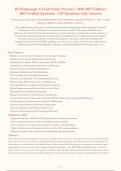
RN Endoscopy GI Lab Study Practice | 2026/2027 Edition |
200 Verified Questions - 159 Questions with Answers
RN Endoscopy GI Lab Exam 2026-159 QUESTIONS AND ANSWERS ALREADY GRADED A+. 100% Verified
Solutions | Updated Per Latest Guidelines | Graded A+
This comprehensive study guide is meticulously crafted for nursing professionals preparing for the RN
Endoscopy GI Lab certification or competency exam. It features 200 original clinical-practice
questions that mirror the format and complexity of actual exam items, covering all essential domains of
gastrointestinal endoscopy nursing. Each question is accompanied by a detailed rationale that explains
the correct answer and clarifies common misconceptions, ensuring a deep understanding of the
material. Updated for the 2026/2027 academic year, this resource aligns with the latest evidence-based
guidelines and professional standards, making it an indispensable tool for achieving a top score.
Key Features:
Patient Assessment and Preparation for Endoscopic Procedures
Sedation and Analgesia Management in the GI Lab
Endoscopic Procedures: EGD, Colonoscopy, ERCP, and More
Complications and Emergency Response in Endoscopy
Infection Control and Sterilization Protocols
Equipment Handling and Troubleshooting
Post-Procedure Care and Patient Education
Anatomy and Physiology of the Gastrointestinal Tract
Pharmacology: Medications Used in GI Endoscopy
Legal and Ethical Considerations in Endoscopy Nursing
Quality Improvement and Patient Safety in the GI Lab
Documentation and Reporting Standards
Pediatric and Geriatric Considerations in Endoscopy
Advanced Procedures: Endoscopic Ultrasound (EUS), Enteroscopy, and Capsule Endoscopy
Interdisciplinary Communication and Team Collaboration
Evidence-Based Practice and Research Application
Cultural Competence and Patient-Centered Care
Professional Development and Continuing Education
Updates for 2026:
- Incorporate the latest ASGE and SGNA guidelines for endoscopic practice
- Revise sedation protocols to align with updated safety standards
- Add new questions on advanced endoscopic techniques and technologies
- Update infection control measures to reflect current CDC recommendations
- Enhance rationales with evidence-based explanations and clinical pearls
Abstract:
This exam preparation document is designed to equip registered nurses with the knowledge and critical thinking
skills necessary to excel in the specialized field of gastrointestinal endoscopy. The content is organized into 18
comprehensive content areas, each addressing a critical aspect of GI lab nursing, from patient assessment and
preparation to advanced procedural support and post-procedure care. With 200 original questions, the guide
offers extensive practice, and each question is paired with a detailed rationale that not only explains the correct
answer but also explores the reasoning behind incorrect options, fostering a deeper understanding of the subject
Page 1
,matter. The material is updated to reflect the 2026/2027 academic year, ensuring alignment with the most recent
clinical guidelines, pharmacological standards, and safety protocols. This resource is ideal for nurses preparing
for certification exams, competency assessments, or simply seeking to enhance their clinical expertise in endoscopy
nursing. By engaging with this practice guide, nurses will build confidence and proficiency, ultimately improving
patient outcomes in the GI lab setting.
Keywords:
Endoscopy nursing, GI lab, RN exam prep, Clinical practice questions, Sedation management, Gastrointestinal
procedures, Patient safety, Evidence-based practice
Answer Format:
Each question is followed by four answer choices. The correct answer is clearly indicated, and a detailed rationale
explains why it is correct. Additionally, each rationale includes a brief explanation of why the other options are
incorrect, providing a comprehensive learning experience.
Compliance Checklist:
Aligns with the latest SGNA and ASGE standards
Reflects current CDC infection control guidelines
Incorporates updated sedation and analgesia protocols
Includes evidence-based rationales for all answers
Covers all major domains of endoscopy nursing practice
Suitable for 2026/2027 academic year preparation
Content Area Overview:
Content Area Questions Key Topics Weight
Patient Assessment and 1-20 Health history, physical exam, bowel 10%
Preparation preparation, informed consent
Sedation and Analgesia 21-40 Moderate sedation, monitoring, reversal 10%
Management agents, complications
Endoscopic Procedures: EGD, 41-60 Procedure indications, techniques, patient 10%
Colonoscopy, ERCP, and More positioning, assistive roles
Complications and Emergency 61-80 Perforation, bleeding, cardiopulmonary 10%
Response events, emergency algorithms
Infection Control and 81-100 High-level disinfection, reprocessing, PPE, 10%
Sterilization environmental safety
Equipment Handling and 101-115 Endoscope care, accessories, light source, 7.5%
Troubleshooting suction, biopsy forceps
Post-Procedure Care and Patient 116-130 Recovery monitoring, discharge criteria, 7.5%
Education dietary instructions, follow-up
Anatomy and Physiology of the 131-145 Esophagus, stomach, small intestine, colon, 7.5%
GI Tract biliary tree
Pharmacology: Medications 146-160 Sedatives, analgesics, antispasmodics, 7.5%
Used in GI Endoscopy hemostatic agents
Legal and Ethical Considerations 161-170 Consent, patient rights, confidentiality, 5%
documentation
Quality Improvement and 171-180 QI initiatives, adverse event reporting, root 5%
Patient Safety cause analysis
Page 2
,Documentation and Reporting 181-190 Procedure notes, nursing notes, incident 5%
Standards reports, coding
Pediatric and Geriatric 191-200 Age-specific care, dosing, communication, 5%
Considerations safety
Page 3
, Q1. A patient on chronic warfarin therapy for atrial fibrillation is scheduled for a
colonoscopy with anticipated polypectomy. The patient's INR is 2.1. Which
periprocedural anticoagulation strategy aligns with current guidelines?
A. Proceed with the procedure without interruption, as the INR is below 2.5.
B. Hold warfarin 5 days prior, bridge with LMWH, and resume warfarin the evening of
the procedure.
C. Delay the procedure until INR is normalized, then perform polypectomy without
bridging.
D. Reverse warfarin with vitamin K and fresh frozen plasma before the procedure.
Correct Answer: B. Hold warfarin 5 days prior, bridge with LMWH, and resume
warfarin the evening of the procedure.
Rationale: For patients on warfarin undergoing high-bleeding-risk procedures like
polypectomy, guidelines recommend holding warfarin 5 days before, bridging with LMWH
for those at high thromboembolic risk, and resuming warfarin after the procedure. An INR
of 2.1 is not safe for polypectomy, so proceeding is incorrect. Delaying indefinitely or
routine reversal is not standard.
Why Wrong:
A - Polypectomy is high-risk; even an INR of 2.1 increases bleeding risk, so
interruption is required.
C - Simply delaying and then performing without bridging ignores thromboembolic
risk and is not the recommended protocol.
D - Reversal is reserved for emergencies; elective procedures should use planned
interruption and bridging.
Reference: ASGE Standards of Practice Committee. (2022). Management of
antithrombotic agents for endoscopic procedures. Gastrointestinal Endoscopy,
95(1), 1-14.
Q2. During a routine upper endoscopy under moderate sedation, the patient's
capnography shows a sudden loss of the waveform despite no change in SpO2. What
is the most appropriate immediate nursing action?
A. Increase the oxygen flow rate and continue the procedure.
B. Stimulate the patient and assess airway patency.
C. Administer a reversal agent such as flumazenil.
D. Reposition the capnography sampling line and wait.
Correct Answer: B. Stimulate the patient and assess airway patency.
Rationale: Loss of capnography waveform may indicate hypoventilation or apnea. The
immediate action is to assess the patient, stimulate, and ensure airway patency. SpO2 may
lag behind, so waiting or adjusting equipment is insufficient. Reversal agents are used if
respirations are depressed despite stimulation.
Page 4
200 Verified Questions - 159 Questions with Answers
RN Endoscopy GI Lab Exam 2026-159 QUESTIONS AND ANSWERS ALREADY GRADED A+. 100% Verified
Solutions | Updated Per Latest Guidelines | Graded A+
This comprehensive study guide is meticulously crafted for nursing professionals preparing for the RN
Endoscopy GI Lab certification or competency exam. It features 200 original clinical-practice
questions that mirror the format and complexity of actual exam items, covering all essential domains of
gastrointestinal endoscopy nursing. Each question is accompanied by a detailed rationale that explains
the correct answer and clarifies common misconceptions, ensuring a deep understanding of the
material. Updated for the 2026/2027 academic year, this resource aligns with the latest evidence-based
guidelines and professional standards, making it an indispensable tool for achieving a top score.
Key Features:
Patient Assessment and Preparation for Endoscopic Procedures
Sedation and Analgesia Management in the GI Lab
Endoscopic Procedures: EGD, Colonoscopy, ERCP, and More
Complications and Emergency Response in Endoscopy
Infection Control and Sterilization Protocols
Equipment Handling and Troubleshooting
Post-Procedure Care and Patient Education
Anatomy and Physiology of the Gastrointestinal Tract
Pharmacology: Medications Used in GI Endoscopy
Legal and Ethical Considerations in Endoscopy Nursing
Quality Improvement and Patient Safety in the GI Lab
Documentation and Reporting Standards
Pediatric and Geriatric Considerations in Endoscopy
Advanced Procedures: Endoscopic Ultrasound (EUS), Enteroscopy, and Capsule Endoscopy
Interdisciplinary Communication and Team Collaboration
Evidence-Based Practice and Research Application
Cultural Competence and Patient-Centered Care
Professional Development and Continuing Education
Updates for 2026:
- Incorporate the latest ASGE and SGNA guidelines for endoscopic practice
- Revise sedation protocols to align with updated safety standards
- Add new questions on advanced endoscopic techniques and technologies
- Update infection control measures to reflect current CDC recommendations
- Enhance rationales with evidence-based explanations and clinical pearls
Abstract:
This exam preparation document is designed to equip registered nurses with the knowledge and critical thinking
skills necessary to excel in the specialized field of gastrointestinal endoscopy. The content is organized into 18
comprehensive content areas, each addressing a critical aspect of GI lab nursing, from patient assessment and
preparation to advanced procedural support and post-procedure care. With 200 original questions, the guide
offers extensive practice, and each question is paired with a detailed rationale that not only explains the correct
answer but also explores the reasoning behind incorrect options, fostering a deeper understanding of the subject
Page 1
,matter. The material is updated to reflect the 2026/2027 academic year, ensuring alignment with the most recent
clinical guidelines, pharmacological standards, and safety protocols. This resource is ideal for nurses preparing
for certification exams, competency assessments, or simply seeking to enhance their clinical expertise in endoscopy
nursing. By engaging with this practice guide, nurses will build confidence and proficiency, ultimately improving
patient outcomes in the GI lab setting.
Keywords:
Endoscopy nursing, GI lab, RN exam prep, Clinical practice questions, Sedation management, Gastrointestinal
procedures, Patient safety, Evidence-based practice
Answer Format:
Each question is followed by four answer choices. The correct answer is clearly indicated, and a detailed rationale
explains why it is correct. Additionally, each rationale includes a brief explanation of why the other options are
incorrect, providing a comprehensive learning experience.
Compliance Checklist:
Aligns with the latest SGNA and ASGE standards
Reflects current CDC infection control guidelines
Incorporates updated sedation and analgesia protocols
Includes evidence-based rationales for all answers
Covers all major domains of endoscopy nursing practice
Suitable for 2026/2027 academic year preparation
Content Area Overview:
Content Area Questions Key Topics Weight
Patient Assessment and 1-20 Health history, physical exam, bowel 10%
Preparation preparation, informed consent
Sedation and Analgesia 21-40 Moderate sedation, monitoring, reversal 10%
Management agents, complications
Endoscopic Procedures: EGD, 41-60 Procedure indications, techniques, patient 10%
Colonoscopy, ERCP, and More positioning, assistive roles
Complications and Emergency 61-80 Perforation, bleeding, cardiopulmonary 10%
Response events, emergency algorithms
Infection Control and 81-100 High-level disinfection, reprocessing, PPE, 10%
Sterilization environmental safety
Equipment Handling and 101-115 Endoscope care, accessories, light source, 7.5%
Troubleshooting suction, biopsy forceps
Post-Procedure Care and Patient 116-130 Recovery monitoring, discharge criteria, 7.5%
Education dietary instructions, follow-up
Anatomy and Physiology of the 131-145 Esophagus, stomach, small intestine, colon, 7.5%
GI Tract biliary tree
Pharmacology: Medications 146-160 Sedatives, analgesics, antispasmodics, 7.5%
Used in GI Endoscopy hemostatic agents
Legal and Ethical Considerations 161-170 Consent, patient rights, confidentiality, 5%
documentation
Quality Improvement and 171-180 QI initiatives, adverse event reporting, root 5%
Patient Safety cause analysis
Page 2
,Documentation and Reporting 181-190 Procedure notes, nursing notes, incident 5%
Standards reports, coding
Pediatric and Geriatric 191-200 Age-specific care, dosing, communication, 5%
Considerations safety
Page 3
, Q1. A patient on chronic warfarin therapy for atrial fibrillation is scheduled for a
colonoscopy with anticipated polypectomy. The patient's INR is 2.1. Which
periprocedural anticoagulation strategy aligns with current guidelines?
A. Proceed with the procedure without interruption, as the INR is below 2.5.
B. Hold warfarin 5 days prior, bridge with LMWH, and resume warfarin the evening of
the procedure.
C. Delay the procedure until INR is normalized, then perform polypectomy without
bridging.
D. Reverse warfarin with vitamin K and fresh frozen plasma before the procedure.
Correct Answer: B. Hold warfarin 5 days prior, bridge with LMWH, and resume
warfarin the evening of the procedure.
Rationale: For patients on warfarin undergoing high-bleeding-risk procedures like
polypectomy, guidelines recommend holding warfarin 5 days before, bridging with LMWH
for those at high thromboembolic risk, and resuming warfarin after the procedure. An INR
of 2.1 is not safe for polypectomy, so proceeding is incorrect. Delaying indefinitely or
routine reversal is not standard.
Why Wrong:
A - Polypectomy is high-risk; even an INR of 2.1 increases bleeding risk, so
interruption is required.
C - Simply delaying and then performing without bridging ignores thromboembolic
risk and is not the recommended protocol.
D - Reversal is reserved for emergencies; elective procedures should use planned
interruption and bridging.
Reference: ASGE Standards of Practice Committee. (2022). Management of
antithrombotic agents for endoscopic procedures. Gastrointestinal Endoscopy,
95(1), 1-14.
Q2. During a routine upper endoscopy under moderate sedation, the patient's
capnography shows a sudden loss of the waveform despite no change in SpO2. What
is the most appropriate immediate nursing action?
A. Increase the oxygen flow rate and continue the procedure.
B. Stimulate the patient and assess airway patency.
C. Administer a reversal agent such as flumazenil.
D. Reposition the capnography sampling line and wait.
Correct Answer: B. Stimulate the patient and assess airway patency.
Rationale: Loss of capnography waveform may indicate hypoventilation or apnea. The
immediate action is to assess the patient, stimulate, and ensure airway patency. SpO2 may
lag behind, so waiting or adjusting equipment is insufficient. Reversal agents are used if
respirations are depressed despite stimulation.
Page 4


