

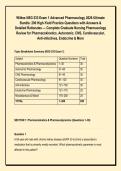
Wilkes NSG 533 Exam 1 Advanced Pharmacology 2026 Ultimate
Bundle: 200 High-Yield Practice Questions with Answers &
Detailed Rationales — Complete Graduate Nursing Pharmacology
Review for Pharmacokinetics, Autonomic, CNS, Cardiovascular,
Anti-infectives, Endocrine & More
Topic Breakdown Summary (NSG 533 Exam 1)
Subject Question Numbers Total
Pharmacokinetics & Pharmacodynamics 1–30 30
Autonomic Pharmacology 31–60 30
CNS Pharmacology 61–90 30
Cardiovascular Pharmacology 91–120 30
Anti-infectives 121–150 30
Endocrine Pharmacology 151–175 25
Miscellaneous & Mixed 176–200 25
TOTAL 1–200 200
SECTION 1: Pharmacokinetics & Pharmacodynamics (Questions 1–30)
Question 1
A 65-year-old male with chronic kidney disease (eGFR 30 mL/min) is prescribed a
medication that is primarily renally excreted. Which pharmacokinetic parameter is most
affected in this patient?
,A) Bioavailability
B) Volume of distribution
C) Half-life
D) Onset of action
E) Protein binding
Answer: C) Half-life
Rationale: In renal impairment, drug elimination is reduced, leading to a prolonged half-life
and accumulation of renally excreted drugs. Bioavailability is primarily affected by first-pass
metabolism. Volume of distribution is affected by body composition changes. Protein
binding can be affected by hypoalbuminemia but half-life is the most directly affected
parameter for renally cleared drugs.
Question 2
A 45-year-old female is started on a new medication. The drug has a half-life of 12 hours.
Approximately how long will it take to reach steady-state concentration?
A) 12 hours
B) 24 hours
C) 48 hours
D) 60 hours
E) 72 hours
Answer: D) 60 hours
Rationale: Steady-state is reached after approximately 5 half-lives. 5 × 12 hours = 60
hours. At 5 half-lives, ~97% of steady-state is achieved. This is a fundamental
pharmacokinetic principle for chronic dosing.
,Question 3
A drug has a high first-pass effect. Which route of administration would most effectively
bypass this effect?
A) Oral
B) Sublingual
C) Rectal
D) Intramuscular
E) Subcutaneous
Answer: B) Sublingual
Rationale: Sublingual administration bypasses first-pass hepatic metabolism because the
drug is absorbed directly into the systemic circulation via the sublingual veins, avoiding the
portal circulation. Oral administration undergoes significant first-pass metabolism. Rectal
administration partially bypasses but not completely.
Question 4
A 72-year-old female with heart failure is prescribed digoxin. Her serum creatinine is 1.8
mg/dL. Which statement best describes the effect of her renal function on digoxin dosing?
A) The loading dose should be decreased
B) The maintenance dose should be decreased
C) The half-life will be shortened
D) The volume of distribution will be decreased
E) No dosing adjustment is needed
Answer: B) The maintenance dose should be decreased
, Rationale: Digoxin is primarily renally excreted. In renal impairment, the maintenance dose
must be reduced to prevent toxicity. The loading dose is based on volume of distribution,
which is not significantly altered by renal function. Half-life will be prolonged, not shortened.
Question 5
A drug has a therapeutic index of 2. This indicates:
A) The drug is very safe
B) The drug has a narrow margin of safety
C) The drug has a wide margin of safety
D) The drug is not effective
E) The drug has no side effects
Answer: B) The drug has a narrow margin of safety
Rationale: Therapeutic index = TD50/ED50 (or LD50/ED50). A low therapeutic index (e.g.,
2) indicates a narrow margin of safety, meaning the toxic dose is close to the therapeutic
dose. Drugs with narrow therapeutic indices (digoxin, lithium, warfarin) require careful
monitoring.
Question 6
A 55-year-old male is prescribed a drug that is 98% protein-bound. Which condition would
most significantly increase the free fraction of this drug?
A) Renal failure
B) Hepatic cirrhosis with hypoalbuminemia
C) Obesity
Bundle: 200 High-Yield Practice Questions with Answers &
Detailed Rationales — Complete Graduate Nursing Pharmacology
Review for Pharmacokinetics, Autonomic, CNS, Cardiovascular,
Anti-infectives, Endocrine & More
Topic Breakdown Summary (NSG 533 Exam 1)
Subject Question Numbers Total
Pharmacokinetics & Pharmacodynamics 1–30 30
Autonomic Pharmacology 31–60 30
CNS Pharmacology 61–90 30
Cardiovascular Pharmacology 91–120 30
Anti-infectives 121–150 30
Endocrine Pharmacology 151–175 25
Miscellaneous & Mixed 176–200 25
TOTAL 1–200 200
SECTION 1: Pharmacokinetics & Pharmacodynamics (Questions 1–30)
Question 1
A 65-year-old male with chronic kidney disease (eGFR 30 mL/min) is prescribed a
medication that is primarily renally excreted. Which pharmacokinetic parameter is most
affected in this patient?
,A) Bioavailability
B) Volume of distribution
C) Half-life
D) Onset of action
E) Protein binding
Answer: C) Half-life
Rationale: In renal impairment, drug elimination is reduced, leading to a prolonged half-life
and accumulation of renally excreted drugs. Bioavailability is primarily affected by first-pass
metabolism. Volume of distribution is affected by body composition changes. Protein
binding can be affected by hypoalbuminemia but half-life is the most directly affected
parameter for renally cleared drugs.
Question 2
A 45-year-old female is started on a new medication. The drug has a half-life of 12 hours.
Approximately how long will it take to reach steady-state concentration?
A) 12 hours
B) 24 hours
C) 48 hours
D) 60 hours
E) 72 hours
Answer: D) 60 hours
Rationale: Steady-state is reached after approximately 5 half-lives. 5 × 12 hours = 60
hours. At 5 half-lives, ~97% of steady-state is achieved. This is a fundamental
pharmacokinetic principle for chronic dosing.
,Question 3
A drug has a high first-pass effect. Which route of administration would most effectively
bypass this effect?
A) Oral
B) Sublingual
C) Rectal
D) Intramuscular
E) Subcutaneous
Answer: B) Sublingual
Rationale: Sublingual administration bypasses first-pass hepatic metabolism because the
drug is absorbed directly into the systemic circulation via the sublingual veins, avoiding the
portal circulation. Oral administration undergoes significant first-pass metabolism. Rectal
administration partially bypasses but not completely.
Question 4
A 72-year-old female with heart failure is prescribed digoxin. Her serum creatinine is 1.8
mg/dL. Which statement best describes the effect of her renal function on digoxin dosing?
A) The loading dose should be decreased
B) The maintenance dose should be decreased
C) The half-life will be shortened
D) The volume of distribution will be decreased
E) No dosing adjustment is needed
Answer: B) The maintenance dose should be decreased
, Rationale: Digoxin is primarily renally excreted. In renal impairment, the maintenance dose
must be reduced to prevent toxicity. The loading dose is based on volume of distribution,
which is not significantly altered by renal function. Half-life will be prolonged, not shortened.
Question 5
A drug has a therapeutic index of 2. This indicates:
A) The drug is very safe
B) The drug has a narrow margin of safety
C) The drug has a wide margin of safety
D) The drug is not effective
E) The drug has no side effects
Answer: B) The drug has a narrow margin of safety
Rationale: Therapeutic index = TD50/ED50 (or LD50/ED50). A low therapeutic index (e.g.,
2) indicates a narrow margin of safety, meaning the toxic dose is close to the therapeutic
dose. Drugs with narrow therapeutic indices (digoxin, lithium, warfarin) require careful
monitoring.
Question 6
A 55-year-old male is prescribed a drug that is 98% protein-bound. Which condition would
most significantly increase the free fraction of this drug?
A) Renal failure
B) Hepatic cirrhosis with hypoalbuminemia
C) Obesity


