

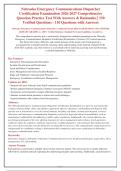
Nebraska Emergency Communications Dispatcher
Certification Examination 2026-2027 Comprehensive
Question Practice Test With Answers & Rationales | 150
Verified Questions - 110 Questions with Answers
Nebraska Emergency Communications Dispatcher Certification Exam 2026-110 QUESTIONS AND ANSWERS
ALREADY GRADED A+. 100% Verified Solutions | Updated Per Latest Guidelines | Graded A+
This comprehensive practice test is meticulously designed for candidates preparing for the Nebraska
Emergency Communications Dispatcher Certification Examination. It features 150 verified questions
that mirror the format, difficulty, and content domains of the actual exam. Each question is
accompanied by a detailed rationale, ensuring a deep understanding of the material. Updated for the
2026-2027 academic year, this resource is an essential tool for achieving a passing score and becoming
a certified dispatcher in Nebraska.
Key Features:
Emergency Telecommunication Procedures
Incident Classification and Prioritization
Legal and Ethical Considerations
Stress Management and Critical Incident Response
Radio and Telephony Communication Protocols
Interagency Coordination and Resource Management
Updates for 2026:
- Integrate the latest Nebraska State Patrol communication guidelines
- Reflect updated National Emergency Number Association (NENA) standards
- Incorporate recent legislative changes affecting emergency dispatch
- Enhance scenario-based questions to mirror real-world challenges
- Expand rationales with evidence-based best practices
Abstract:
The Nebraska Emergency Communications Dispatcher Certification Examination is a rigorous assessment that
evaluates the knowledge, skills, and abilities required for effective emergency call handling and dispatch. This
practice test is structured to cover all critical domains, including call intake, incident prioritization, resource
allocation, and interagency communication. Emphasis is placed on legal and ethical responsibilities, such as
maintaining confidentiality and adhering to public safety regulations. Additionally, the content addresses the
psychological demands of the role, offering strategies for stress management and resilience. Each question is
crafted to reflect the cognitive complexity expected of a certified dispatcher, with rationales that explain not only
the correct answer but also why the distractors are plausible yet incorrect. This comprehensive preparation tool is
indispensable for candidates seeking to demonstrate their competency and secure certification in Nebraska's
emergency communication centers.
Keywords:
Emergency dispatch, Nebraska certification, Communication protocols, Incident prioritization, Legal ethics, Stress
management, 911 call handling
Answer Format:
Each question is presented in multiple-choice format with four options. The correct answer is clearly indicated,
followed by a detailed rationale explaining the underlying principles and reasoning. Additionally, each distractor is
Page 1
,analyzed to clarify common misconceptions, ensuring a thorough grasp of the subject matter.
Compliance Checklist:
Aligned with the Nebraska State Patrol's minimum training standards
Covers all topics listed in the official exam blueprint
Includes questions on recent updates to NENA standards
Incorporates ethical and legal requirements as per Nebraska Revised Statutes
Provides rationales that cite authoritative sources and best practices
Content Area Overview:
Content Area Questions Key Topics Weight
Call Taking and Incident 1-30 Call classification, Priority dispatch 20%
Prioritization protocols, Gathering critical information,
Handling non-emergency calls
Communication Systems and 31-60 Radio operations, CAD systems, Telephony 20%
Technology and 911 infrastructure, Data entry and
retrieval
Legal and Ethical 61-90 Confidentiality, Liability issues, Nebraska 20%
Responsibilities public records law, Ethical decision-making
Emergency Response 91-120 Resource allocation, Interagency 20%
Coordination communication, Incident command system,
Multi-agency response
Stress Management and 121-150 Critical incident stress, Coping strategies, 20%
Professional Development Continuing education, Team dynamics
Page 2
,Q1. During a multi-agency response to a hazardous materials incident, a dispatcher
receives conflicting reports about the chemical involved. One source identifies it as a
flammable liquid, another as a corrosive gas. Which action best aligns with the
NIMS/ICS principle of unified command and ensures accurate public safety
information?
A. Relay both reports to responding units and let the on-scene commander decide
B. Immediately broadcast the most recent report to all units and the public
C. Consult the Emergency Response Guidebook (ERG) and use the most hazardous
classification
D. Forward both reports to the incident commander and public information officer for
verification before dissemination
Correct Answer: D. Forward both reports to the incident commander and public
information officer for verification before dissemination
Rationale: Unified command requires coordinated decision-making. The dispatcher's role
is to support the incident commander and PIO, not to independently interpret or broadcast
unverified information. Forwarding to the IC/PIO ensures accurate, consistent public
messaging and avoids conflicting directives.
Why Wrong:
A - Relaying conflicting reports without resolution can cause confusion and unsafe
actions.
B - Broadcasting unverified information violates the principle of information accuracy
and could cause panic or inappropriate response.
C - Using the ERG is appropriate for initial response guidance, but the dispatcher
should not unilaterally decide the hazard classification over the IC's authority.
Reference: FEMA NIMS ICS-300, Unit 3: Unified Command; Nebraska State Emergency
Operations Plan
Q2. A dispatcher receives a call from a resident reporting a downed power line that is
sparking and blocking a roadway. The caller is frantic and mentions that a car is
trapped under the line. Which set of instructions is most appropriate for the
dispatcher to give?
A. Tell the caller to stay inside and wait for emergency services
B. Instruct the caller to keep everyone at least 30 feet away and await trained personnel
C. Advise the caller to use a non-conductive object to move the wire off the car
D. Ask the caller to direct traffic away from the area
Correct Answer: B. Instruct the caller to keep everyone at least 30 feet away and
await trained personnel
Rationale: For downed power lines, the standard safety distance is at least 30 feet (or one
bus length). Untrained individuals should not approach or attempt to move the wire.
Page 3
, Directing traffic or moving the wire would put the caller at risk. The priority is to maintain
safe distance and wait for utility crews.
Why Wrong:
A - Telling the caller to stay inside may be insufficient if they are near the hazard, and
does not address the need to keep others away.
C - Using a non-conductive object is extremely dangerous; even non-conductive
materials can become conductive when wet or contaminated.
D - Directing traffic places the caller in the hazard zone and is not a safe task for an
untrained civilian.
Reference: National Fire Protection Association (NFPA) 70E; utility safety guidelines
Q3. A dispatcher is handling a call from a person who is suicidal and has access to a
firearm. The caller is calm but refuses to give their location. Using the principles of
crisis negotiation and call prioritization, which action should the dispatcher take
FIRST?
A. Keep the caller engaged while attempting to trace the call and gather location clues
B. Transfer the call to a crisis counselor immediately
C. End the call and dispatch officers to the last known address
D. Threaten legal consequences to force the caller to reveal their location
Correct Answer: A. Keep the caller engaged while attempting to trace the call and
gather location clues
Rationale: In crisis negotiation, maintaining contact is paramount to ensure safety and
allow time for tracing. Dispatchers should use active listening and ask open-ended
questions to elicit location information. Transferring the call could break rapport, ending
the call loses the connection, and threats escalate the crisis.
Why Wrong:
B - Transferring may lose the caller and delay the emergency response; dispatchers are
trained to handle initial crisis calls.
C - Ending the call breaks the lifeline and may lead to immediate self-harm; the
location is unknown.
D - Threats are counterproductive and can escalate the situation, increasing risk.
Reference: APCO/NENA Emergency Medical Dispatch Standards; Crisis Negotiation
Training (NENA 2025)
Q4. A law enforcement officer requests a wanted person check on a vehicle occupant
during a traffic stop. The dispatcher runs the query and receives a hit with an active
felony warrant. According to NCIC/NE state policy, what is the dispatcher's
immediate responsibility?
A. Advise the officer of the warrant and any known hazards, then confirm the warrant
Page 4
Certification Examination 2026-2027 Comprehensive
Question Practice Test With Answers & Rationales | 150
Verified Questions - 110 Questions with Answers
Nebraska Emergency Communications Dispatcher Certification Exam 2026-110 QUESTIONS AND ANSWERS
ALREADY GRADED A+. 100% Verified Solutions | Updated Per Latest Guidelines | Graded A+
This comprehensive practice test is meticulously designed for candidates preparing for the Nebraska
Emergency Communications Dispatcher Certification Examination. It features 150 verified questions
that mirror the format, difficulty, and content domains of the actual exam. Each question is
accompanied by a detailed rationale, ensuring a deep understanding of the material. Updated for the
2026-2027 academic year, this resource is an essential tool for achieving a passing score and becoming
a certified dispatcher in Nebraska.
Key Features:
Emergency Telecommunication Procedures
Incident Classification and Prioritization
Legal and Ethical Considerations
Stress Management and Critical Incident Response
Radio and Telephony Communication Protocols
Interagency Coordination and Resource Management
Updates for 2026:
- Integrate the latest Nebraska State Patrol communication guidelines
- Reflect updated National Emergency Number Association (NENA) standards
- Incorporate recent legislative changes affecting emergency dispatch
- Enhance scenario-based questions to mirror real-world challenges
- Expand rationales with evidence-based best practices
Abstract:
The Nebraska Emergency Communications Dispatcher Certification Examination is a rigorous assessment that
evaluates the knowledge, skills, and abilities required for effective emergency call handling and dispatch. This
practice test is structured to cover all critical domains, including call intake, incident prioritization, resource
allocation, and interagency communication. Emphasis is placed on legal and ethical responsibilities, such as
maintaining confidentiality and adhering to public safety regulations. Additionally, the content addresses the
psychological demands of the role, offering strategies for stress management and resilience. Each question is
crafted to reflect the cognitive complexity expected of a certified dispatcher, with rationales that explain not only
the correct answer but also why the distractors are plausible yet incorrect. This comprehensive preparation tool is
indispensable for candidates seeking to demonstrate their competency and secure certification in Nebraska's
emergency communication centers.
Keywords:
Emergency dispatch, Nebraska certification, Communication protocols, Incident prioritization, Legal ethics, Stress
management, 911 call handling
Answer Format:
Each question is presented in multiple-choice format with four options. The correct answer is clearly indicated,
followed by a detailed rationale explaining the underlying principles and reasoning. Additionally, each distractor is
Page 1
,analyzed to clarify common misconceptions, ensuring a thorough grasp of the subject matter.
Compliance Checklist:
Aligned with the Nebraska State Patrol's minimum training standards
Covers all topics listed in the official exam blueprint
Includes questions on recent updates to NENA standards
Incorporates ethical and legal requirements as per Nebraska Revised Statutes
Provides rationales that cite authoritative sources and best practices
Content Area Overview:
Content Area Questions Key Topics Weight
Call Taking and Incident 1-30 Call classification, Priority dispatch 20%
Prioritization protocols, Gathering critical information,
Handling non-emergency calls
Communication Systems and 31-60 Radio operations, CAD systems, Telephony 20%
Technology and 911 infrastructure, Data entry and
retrieval
Legal and Ethical 61-90 Confidentiality, Liability issues, Nebraska 20%
Responsibilities public records law, Ethical decision-making
Emergency Response 91-120 Resource allocation, Interagency 20%
Coordination communication, Incident command system,
Multi-agency response
Stress Management and 121-150 Critical incident stress, Coping strategies, 20%
Professional Development Continuing education, Team dynamics
Page 2
,Q1. During a multi-agency response to a hazardous materials incident, a dispatcher
receives conflicting reports about the chemical involved. One source identifies it as a
flammable liquid, another as a corrosive gas. Which action best aligns with the
NIMS/ICS principle of unified command and ensures accurate public safety
information?
A. Relay both reports to responding units and let the on-scene commander decide
B. Immediately broadcast the most recent report to all units and the public
C. Consult the Emergency Response Guidebook (ERG) and use the most hazardous
classification
D. Forward both reports to the incident commander and public information officer for
verification before dissemination
Correct Answer: D. Forward both reports to the incident commander and public
information officer for verification before dissemination
Rationale: Unified command requires coordinated decision-making. The dispatcher's role
is to support the incident commander and PIO, not to independently interpret or broadcast
unverified information. Forwarding to the IC/PIO ensures accurate, consistent public
messaging and avoids conflicting directives.
Why Wrong:
A - Relaying conflicting reports without resolution can cause confusion and unsafe
actions.
B - Broadcasting unverified information violates the principle of information accuracy
and could cause panic or inappropriate response.
C - Using the ERG is appropriate for initial response guidance, but the dispatcher
should not unilaterally decide the hazard classification over the IC's authority.
Reference: FEMA NIMS ICS-300, Unit 3: Unified Command; Nebraska State Emergency
Operations Plan
Q2. A dispatcher receives a call from a resident reporting a downed power line that is
sparking and blocking a roadway. The caller is frantic and mentions that a car is
trapped under the line. Which set of instructions is most appropriate for the
dispatcher to give?
A. Tell the caller to stay inside and wait for emergency services
B. Instruct the caller to keep everyone at least 30 feet away and await trained personnel
C. Advise the caller to use a non-conductive object to move the wire off the car
D. Ask the caller to direct traffic away from the area
Correct Answer: B. Instruct the caller to keep everyone at least 30 feet away and
await trained personnel
Rationale: For downed power lines, the standard safety distance is at least 30 feet (or one
bus length). Untrained individuals should not approach or attempt to move the wire.
Page 3
, Directing traffic or moving the wire would put the caller at risk. The priority is to maintain
safe distance and wait for utility crews.
Why Wrong:
A - Telling the caller to stay inside may be insufficient if they are near the hazard, and
does not address the need to keep others away.
C - Using a non-conductive object is extremely dangerous; even non-conductive
materials can become conductive when wet or contaminated.
D - Directing traffic places the caller in the hazard zone and is not a safe task for an
untrained civilian.
Reference: National Fire Protection Association (NFPA) 70E; utility safety guidelines
Q3. A dispatcher is handling a call from a person who is suicidal and has access to a
firearm. The caller is calm but refuses to give their location. Using the principles of
crisis negotiation and call prioritization, which action should the dispatcher take
FIRST?
A. Keep the caller engaged while attempting to trace the call and gather location clues
B. Transfer the call to a crisis counselor immediately
C. End the call and dispatch officers to the last known address
D. Threaten legal consequences to force the caller to reveal their location
Correct Answer: A. Keep the caller engaged while attempting to trace the call and
gather location clues
Rationale: In crisis negotiation, maintaining contact is paramount to ensure safety and
allow time for tracing. Dispatchers should use active listening and ask open-ended
questions to elicit location information. Transferring the call could break rapport, ending
the call loses the connection, and threats escalate the crisis.
Why Wrong:
B - Transferring may lose the caller and delay the emergency response; dispatchers are
trained to handle initial crisis calls.
C - Ending the call breaks the lifeline and may lead to immediate self-harm; the
location is unknown.
D - Threats are counterproductive and can escalate the situation, increasing risk.
Reference: APCO/NENA Emergency Medical Dispatch Standards; Crisis Negotiation
Training (NENA 2025)
Q4. A law enforcement officer requests a wanted person check on a vehicle occupant
during a traffic stop. The dispatcher runs the query and receives a hit with an active
felony warrant. According to NCIC/NE state policy, what is the dispatcher's
immediate responsibility?
A. Advise the officer of the warrant and any known hazards, then confirm the warrant
Page 4


