
Portage Pathophysiology Module 7 (S+CH) , portage pathophysiology exam
7, Module 7 exam practice questions
Study online at https://quizlet.com/_ipkz24
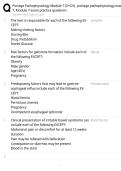
1. The liver is responsible for each of the following EX- Storing bile
CEPT:
Making clotting factors
Storing Bile
Drug metabolism
Stores Glucose
2. Risk factors for gallstone formation include each of Male sex
the following EXCEPT:
Obesity
Male gender
Age (40's)
Pregnancy
3. Predisposing factors that may lead to gastroe- Pernicious anemia
sophageal reflux include each of the following EX-
CEPT:
Hiatal hernia
Pernicious anemia
Pregnancy
Incompetent esophageal sphincter
4. Clinical presentation of irritable bowel syndrome can Blood in the stool
include each of the following EXCEPT:
Abdominal pain or discomfort for at least 12 weeks
duration
Pain may be relieved with defecation
Constipation or diarrhea may be present
Blood in the stool
5.
, Portage Pathophysiology Module 7 (S+CH) , portage pathophysiology exam
7, Module 7 exam practice questions
Study online at https://quizlet.com/_ipkz24
What are risk factors for the development of peptic Aspirin Therapy
ulcer? Pylori infection
Stress
NSAID use
6. Gastric ulcers are worsened by ________. Duodenal ul- Eating; not eating
cers are worsened by _______.
7. Each of the following are charcteristics of ulcerative Granulomatous lesions
colitis EXCEPT:
Granulomatous lesions
Blood diarrhea
Pseudopolyps
Risk of toxic megacolon
Crypt abscess formation
8. Each of the following are characteristics of Crohn dis- Increased risk of malig-
ease EXCEPT: nancy
Affects any part of the GI tract
Increased risk of malignancy
Skip lesions
Cobblestone appearance
Granulomatous inflammation
9. The _________ controls the rate of stomach contents Pyloric sphincter
into the small intestine.
10. (T/F) The GI tract produces both enzymes and hor- True
mones
11. The double layer of peritoneum that holds the organs Mesentery
in place and stores fat is called what?
, Portage Pathophysiology Module 7 (S+CH) , portage pathophysiology exam
7, Module 7 exam practice questions
Study online at https://quizlet.com/_ipkz24
12. A unique feature of the liver is that it has a dual blood True
supply. (T/F)
13. What are intermittent contractions that help to mix Rhythmic movements
and move food along?
14. Activation of the peripheral nervous system decreases False
or stops the amplitude of the slow waves. (T/F)
15. _________ lies between the mucosal and muscle layers Submucosal (Meissner)
of the intestinal wall, and is involved with controlling plexus
secretions, absorption, and contraction of each seg-
ment of the intestinal tract.
16. Food is converted in the stomach into a creamy mix- Chyme
ture called?
17. What are rhythmic movements. designed to propel Peristaltic movements
the chyme alone the small intestine toward the large
intestine?
18. What is the purpose of propulsive mass movements? A large segment of the
colon contracts as a unit,
moving the fecal con-
tents forward. These mass
movements last about
30 seconds, followed by
a 2-3-minute period of
relaxation, then another
contraction. This is what
triggers the need for a
bowel movement.
7, Module 7 exam practice questions
Study online at https://quizlet.com/_ipkz24
1. The liver is responsible for each of the following EX- Storing bile
CEPT:
Making clotting factors
Storing Bile
Drug metabolism
Stores Glucose
2. Risk factors for gallstone formation include each of Male sex
the following EXCEPT:
Obesity
Male gender
Age (40's)
Pregnancy
3. Predisposing factors that may lead to gastroe- Pernicious anemia
sophageal reflux include each of the following EX-
CEPT:
Hiatal hernia
Pernicious anemia
Pregnancy
Incompetent esophageal sphincter
4. Clinical presentation of irritable bowel syndrome can Blood in the stool
include each of the following EXCEPT:
Abdominal pain or discomfort for at least 12 weeks
duration
Pain may be relieved with defecation
Constipation or diarrhea may be present
Blood in the stool
5.
, Portage Pathophysiology Module 7 (S+CH) , portage pathophysiology exam
7, Module 7 exam practice questions
Study online at https://quizlet.com/_ipkz24
What are risk factors for the development of peptic Aspirin Therapy
ulcer? Pylori infection
Stress
NSAID use
6. Gastric ulcers are worsened by ________. Duodenal ul- Eating; not eating
cers are worsened by _______.
7. Each of the following are charcteristics of ulcerative Granulomatous lesions
colitis EXCEPT:
Granulomatous lesions
Blood diarrhea
Pseudopolyps
Risk of toxic megacolon
Crypt abscess formation
8. Each of the following are characteristics of Crohn dis- Increased risk of malig-
ease EXCEPT: nancy
Affects any part of the GI tract
Increased risk of malignancy
Skip lesions
Cobblestone appearance
Granulomatous inflammation
9. The _________ controls the rate of stomach contents Pyloric sphincter
into the small intestine.
10. (T/F) The GI tract produces both enzymes and hor- True
mones
11. The double layer of peritoneum that holds the organs Mesentery
in place and stores fat is called what?
, Portage Pathophysiology Module 7 (S+CH) , portage pathophysiology exam
7, Module 7 exam practice questions
Study online at https://quizlet.com/_ipkz24
12. A unique feature of the liver is that it has a dual blood True
supply. (T/F)
13. What are intermittent contractions that help to mix Rhythmic movements
and move food along?
14. Activation of the peripheral nervous system decreases False
or stops the amplitude of the slow waves. (T/F)
15. _________ lies between the mucosal and muscle layers Submucosal (Meissner)
of the intestinal wall, and is involved with controlling plexus
secretions, absorption, and contraction of each seg-
ment of the intestinal tract.
16. Food is converted in the stomach into a creamy mix- Chyme
ture called?
17. What are rhythmic movements. designed to propel Peristaltic movements
the chyme alone the small intestine toward the large
intestine?
18. What is the purpose of propulsive mass movements? A large segment of the
colon contracts as a unit,
moving the fecal con-
tents forward. These mass
movements last about
30 seconds, followed by
a 2-3-minute period of
relaxation, then another
contraction. This is what
triggers the need for a
bowel movement.


