

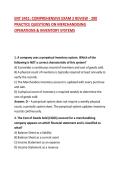
ENT 3451: COMPREHENSIVE EXAM 2 REVIEW - 200
PRACTICE QUESTIONS ON MERCHANDISING
OPERATIONS & INVENTORY SYSTEMS
1. A company uses a perpetual inventory system. Which of the
following is NOT a correct characteristic of this system?
A) It provides a continuous record of inventory and cost of goods sold.
B) A physical count of inventory is typically required at least annually to
verify the records.
C) The Merchandise Inventory account is updated with every purchase
and sale.
D) A physical count of inventory is required weekly to determine the
cost of goods sold.
Answer: D – A perpetual system does not require a weekly physical
count; a periodic system does. The perpetual system updates inventory
records continuously.
2. The Cost of Goods Sold (COGS) account for a merchandising
company appears on which financial statement and is classified as
what?
A) Balance Sheet as a liability
B) Balance Sheet as a current asset
C) Income Statement as an expense
D) Income Statement as a revenue
,Answer: C – COGS is the cost of the merchandise that was sold to
customers and is reported as an expense on the Income Statement.
3. The Merchandise Inventory account for a retailer is properly
classified as what?
A) A contra-revenue account on the Income Statement.
B) A current asset on the Balance Sheet.
C) An expense on the Income Statement.
D) A liability on the Balance Sheet.
Answer: B – Merchandise Inventory represents the cost of goods held
for resale to customers, which is a current asset.
4. Gross profit is a key figure for a merchandiser. How is it calculated?
A) Net Sales Revenue minus Cost of Goods Sold.
B) Net Sales Revenue minus Operating Expenses.
C) Total Sales Revenue minus Sales Returns and Allowances.
D) Total Sales Revenue minus Cost of Goods Sold.
Answer: A – Gross profit (or gross margin) is the difference between net
sales and the cost of goods sold.
**5. Ridge Co. purchased $30,000 of inventory on account on March 1
with terms 3/10, n/30. They paid freight of $400 on March 3. They
returned $5,000 of damaged inventory on March 5. They paid the
amount owed on March 9. What is the net cost of the inventory
purchased?**
A) $25,000
B) $24,250
C) $25,400
D) $24,650
**Answer: D** – The purchase discount is based on the net purchase
,amount: $30,000 – $5,000 = $25,000. The discount is $25,000 * 3% =
$750. The net cost is $25,000 - $750 + $400 freight = $24,650.
6. Which of the following is the correct journal entry for a
merchandiser to record the return of defective inventory to a supplier,
assuming the goods were originally purchased on account?
A) Debit Accounts Payable, Credit Merchandise Inventory
B) Debit Merchandise Inventory, Credit Accounts Payable
C) Debit Accounts Payable, Credit Cash
D) Debit Sales Returns and Allowances, Credit Cash
Answer: A – When a buyer returns inventory, they reduce their liability
(Accounts Payable) and reduce their asset (Merchandise Inventory).
7. A merchandising company using the perpetual inventory system
sells goods on account. The sales transaction includes a debit to
Accounts Receivable and a credit to Sales Revenue. Which of the
following is also required to properly record the cost of this sale?
A) Debit Cost of Goods Sold, Credit Sales Revenue.
B) Debit Cost of Goods Sold, Credit Merchandise Inventory.
C) Debit Merchandise Inventory, Credit Cost of Goods Sold.
D) No other entry is needed, as it is a single-entry system for sales.
Answer: B – Under the perpetual inventory system, two entries are
required for a sale: one to record the sale itself and another to record
the cost of the goods sold and reduce the inventory asset.
8. On June 1, a company sold $50,000 of merchandise on account with
terms 2/15, n/45. The merchandise cost $30,000. The customer pays
the amount due on June 14. What is the total net cash received from
this sale?
A) $50,000
, B) $49,000
C) $30,000
D) $48,000
Answer: B – The customer pays within the discount period (2/15), so
they receive a 2% discount. The cash received is $50,000 * 98% =
$49,000.
9. In a perpetual inventory system, what is the effect of a journal entry
that debits Sales Returns and Allowances and credits Accounts
Receivable?
A) It reduces the amount of net sales revenue.
B) It increases the amount of the Merchandise Inventory account.
C) It increases the amount of Cost of Goods Sold.
D) It records the cost of goods returned to inventory.
Answer: A – Sales Returns and Allowances is a contra-revenue account.
Its normal balance is a debit, and it is subtracted from Sales Revenue to
arrive at Net Sales.
10. What is the primary purpose of taking a physical count of
inventory in a company using a perpetual inventory system?
A) To determine the cost of goods sold for the period.
B) To establish the initial inventory balance.
C) To verify the accuracy of the perpetual inventory records and adjust
for theft, loss, or errors.
D) To calculate the gross profit percentage.
Answer: C – While a perpetual system updates records continuously,
physical counts are still necessary to verify record accuracy and identify
shrinkage.
PRACTICE QUESTIONS ON MERCHANDISING
OPERATIONS & INVENTORY SYSTEMS
1. A company uses a perpetual inventory system. Which of the
following is NOT a correct characteristic of this system?
A) It provides a continuous record of inventory and cost of goods sold.
B) A physical count of inventory is typically required at least annually to
verify the records.
C) The Merchandise Inventory account is updated with every purchase
and sale.
D) A physical count of inventory is required weekly to determine the
cost of goods sold.
Answer: D – A perpetual system does not require a weekly physical
count; a periodic system does. The perpetual system updates inventory
records continuously.
2. The Cost of Goods Sold (COGS) account for a merchandising
company appears on which financial statement and is classified as
what?
A) Balance Sheet as a liability
B) Balance Sheet as a current asset
C) Income Statement as an expense
D) Income Statement as a revenue
,Answer: C – COGS is the cost of the merchandise that was sold to
customers and is reported as an expense on the Income Statement.
3. The Merchandise Inventory account for a retailer is properly
classified as what?
A) A contra-revenue account on the Income Statement.
B) A current asset on the Balance Sheet.
C) An expense on the Income Statement.
D) A liability on the Balance Sheet.
Answer: B – Merchandise Inventory represents the cost of goods held
for resale to customers, which is a current asset.
4. Gross profit is a key figure for a merchandiser. How is it calculated?
A) Net Sales Revenue minus Cost of Goods Sold.
B) Net Sales Revenue minus Operating Expenses.
C) Total Sales Revenue minus Sales Returns and Allowances.
D) Total Sales Revenue minus Cost of Goods Sold.
Answer: A – Gross profit (or gross margin) is the difference between net
sales and the cost of goods sold.
**5. Ridge Co. purchased $30,000 of inventory on account on March 1
with terms 3/10, n/30. They paid freight of $400 on March 3. They
returned $5,000 of damaged inventory on March 5. They paid the
amount owed on March 9. What is the net cost of the inventory
purchased?**
A) $25,000
B) $24,250
C) $25,400
D) $24,650
**Answer: D** – The purchase discount is based on the net purchase
,amount: $30,000 – $5,000 = $25,000. The discount is $25,000 * 3% =
$750. The net cost is $25,000 - $750 + $400 freight = $24,650.
6. Which of the following is the correct journal entry for a
merchandiser to record the return of defective inventory to a supplier,
assuming the goods were originally purchased on account?
A) Debit Accounts Payable, Credit Merchandise Inventory
B) Debit Merchandise Inventory, Credit Accounts Payable
C) Debit Accounts Payable, Credit Cash
D) Debit Sales Returns and Allowances, Credit Cash
Answer: A – When a buyer returns inventory, they reduce their liability
(Accounts Payable) and reduce their asset (Merchandise Inventory).
7. A merchandising company using the perpetual inventory system
sells goods on account. The sales transaction includes a debit to
Accounts Receivable and a credit to Sales Revenue. Which of the
following is also required to properly record the cost of this sale?
A) Debit Cost of Goods Sold, Credit Sales Revenue.
B) Debit Cost of Goods Sold, Credit Merchandise Inventory.
C) Debit Merchandise Inventory, Credit Cost of Goods Sold.
D) No other entry is needed, as it is a single-entry system for sales.
Answer: B – Under the perpetual inventory system, two entries are
required for a sale: one to record the sale itself and another to record
the cost of the goods sold and reduce the inventory asset.
8. On June 1, a company sold $50,000 of merchandise on account with
terms 2/15, n/45. The merchandise cost $30,000. The customer pays
the amount due on June 14. What is the total net cash received from
this sale?
A) $50,000
, B) $49,000
C) $30,000
D) $48,000
Answer: B – The customer pays within the discount period (2/15), so
they receive a 2% discount. The cash received is $50,000 * 98% =
$49,000.
9. In a perpetual inventory system, what is the effect of a journal entry
that debits Sales Returns and Allowances and credits Accounts
Receivable?
A) It reduces the amount of net sales revenue.
B) It increases the amount of the Merchandise Inventory account.
C) It increases the amount of Cost of Goods Sold.
D) It records the cost of goods returned to inventory.
Answer: A – Sales Returns and Allowances is a contra-revenue account.
Its normal balance is a debit, and it is subtracted from Sales Revenue to
arrive at Net Sales.
10. What is the primary purpose of taking a physical count of
inventory in a company using a perpetual inventory system?
A) To determine the cost of goods sold for the period.
B) To establish the initial inventory balance.
C) To verify the accuracy of the perpetual inventory records and adjust
for theft, loss, or errors.
D) To calculate the gross profit percentage.
Answer: C – While a perpetual system updates records continuously,
physical counts are still necessary to verify record accuracy and identify
shrinkage.


