
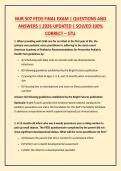
NUR 507 PEDS FINAL EXAM | QUESTIONS AND
ANSWERS | 2026 UPDATED | SOLVED 100%
CORRECT – STU.
1. When providing well child care for an infant in the first year of life, the
primary care pediatric nurse practitioner is adhering to the most recent
American Academy of Pediatrics Recommendations for Preventive Pediatric
Health Care guidelines by:
• A) Scheduling well-baby visits to coincide with key developmental
milestones
• B) Following guidelines established by the Bright Futures publication
• C) Seeing the infant at ages 2, 4, 6, and 12 months when immunizations are
due
• D) Focusing less on development and more on illness prevention and
nutrition
Answer: B) Following guidelines established by the Bright Futures publication
Rationale: Bright Futures provides the evidence-based national standards for
pediatric preventive care and is the foundation for the AAP's Periodicity Schedule.
It addresses comprehensive health supervision beyond just immunizations .
2. A 12-month-old infant who was 6 weeks premature uses a raking motion to
pick up small objects. The PEDS questionnaire completed by the parent did not
show significant developmental delays. What will the nurse practitioner do first?
• A) Reassure the parent that this is normal for a premature infant
• B) Perform an in-depth developmental assessment
• C) Refer the infant to a developmental specialist
, • D) Suggest activities to improve fine motor skills
Answer: B) Perform an in-depth developmental assessment
Rationale: A raking motion at 12 months (adjusted age should be considered) may
indicate a fine motor delay. When a screening tool suggests potential concerns, a
more comprehensive developmental assessment is warranted before reassurance
or referral .
3. The mother of a 3-month-old infant tells the primary care pediatric nurse
practitioner that it is "so much fun" now that her infant coos and smiles and
wants to play. What is important for the nurse practitioner to teach this mother?
• A) Appropriate ways to stimulate and entertain the infant
• B) How to read the infant's cues for overstimulation
• C) To provide musical toys to engage the infant
• D) The importance of scheduling "play dates" with other infants
Answer: B) How to read the infant's cues for overstimulation
Rationale: While social interaction is important, teaching parents to recognize
signs of overstimulation (turning away, crying, fussiness) is crucial for healthy
social-emotional development and prevents overstimulation in young infants .
4. The parent of a newborn infant asks the primary care pediatric nurse
practitioner when to intervene to help the infant's future intellectual growth.
The nurse practitioner will tell the parent that:
• A) Cognitive learning begins during the toddler years
• B) Intellectual growth begins when speech develops
• C) Language and literacy skills begin at birth
• D) Preschool is an optimal time to begin general learning
,Answer: C) Language and literacy skills begin at birth
Rationale: Language and literacy development begins immediately after birth.
Reading, talking, and singing to infants from birth promotes brain development
and future literacy skills .
5. The parent of a 6-year-old child expresses concern that the child may have
ADHD. Which screening tool will the primary care pediatric nurse practitioner
use to evaluate this possibility?
• A) Behavioral Assessment for Children - 2nd ed. (BASC-2)
• B) Behavioral and Emotional Screening System for Children (BESS-2)
• C) Pediatric Symptom Checklist (PSC)
• D) Conner's 3 Parent and Teacher Rating Scale
Answer: D) Conner's 3 Parent and Teacher Rating Scale
Rationale: The Conner's 3 Parent and Teacher Rating Scale is a validated,
commonly used screening tool specifically designed to evaluate symptoms of
ADHD in children. It assesses both home and school behaviors .
6. The mother of a 6-month-old infant is distressed because the infant can say
"dada" but not "mama" and asks the primary care pediatric nurse practitioner
why this is when she is the one who spends more time with the infant. How will
the nurse practitioner respond?
• A) This may mean that your baby doesn't hear well
• B) At this age, your baby does not understand the meaning of sounds
• C) Most sounds made by babies at this age are accidental
• D) Babies at this age cannot make the 'ma' sound
Answer: B) At this age, your baby does not understand the meaning of sounds
, Rationale: At 6 months, infants are in the babbling stage and produce sounds
without understanding their meaning. "Dada" is often easier to produce than
"mama" due to the mouth movements required .
7. A 20-month-old child who was 4 weeks premature has achieved milestones
for a 15-month-old infant according to a parent-completed developmental
questionnaire. What is the most appropriate action?
• A) Reassure the parents that this is normal for adjusted age
• B) Refer for early intervention services
• C) Schedule a follow-up in 3 months
• D) Perform a comprehensive developmental assessment
Answer: D) Perform a comprehensive developmental assessment
Rationale: A 4-week premature infant at 20 months has an adjusted age of
approximately 19 months. Being at a 15-month level represents a significant delay,
warranting a comprehensive developmental assessment .
8. A 12-year-old girl has not yet experienced thelarche. What might this suggest
about her potential timeline for menarche?
• A) Menarche is likely to occur within the next few months
• B) Menarche is not related to thelarche at all
• C) Menarche will likely be delayed until after thelarche occurs
• D) Menarche will happen regardless of thelarche
Answer: C) Menarche will likely be delayed until after thelarche occurs
Rationale: Thelarche (breast development) typically precedes menarche by
approximately 2-2.5 years. If thelarche has not occurred by age 12, menarche is
expected to be delayed .
ANSWERS | 2026 UPDATED | SOLVED 100%
CORRECT – STU.
1. When providing well child care for an infant in the first year of life, the
primary care pediatric nurse practitioner is adhering to the most recent
American Academy of Pediatrics Recommendations for Preventive Pediatric
Health Care guidelines by:
• A) Scheduling well-baby visits to coincide with key developmental
milestones
• B) Following guidelines established by the Bright Futures publication
• C) Seeing the infant at ages 2, 4, 6, and 12 months when immunizations are
due
• D) Focusing less on development and more on illness prevention and
nutrition
Answer: B) Following guidelines established by the Bright Futures publication
Rationale: Bright Futures provides the evidence-based national standards for
pediatric preventive care and is the foundation for the AAP's Periodicity Schedule.
It addresses comprehensive health supervision beyond just immunizations .
2. A 12-month-old infant who was 6 weeks premature uses a raking motion to
pick up small objects. The PEDS questionnaire completed by the parent did not
show significant developmental delays. What will the nurse practitioner do first?
• A) Reassure the parent that this is normal for a premature infant
• B) Perform an in-depth developmental assessment
• C) Refer the infant to a developmental specialist
, • D) Suggest activities to improve fine motor skills
Answer: B) Perform an in-depth developmental assessment
Rationale: A raking motion at 12 months (adjusted age should be considered) may
indicate a fine motor delay. When a screening tool suggests potential concerns, a
more comprehensive developmental assessment is warranted before reassurance
or referral .
3. The mother of a 3-month-old infant tells the primary care pediatric nurse
practitioner that it is "so much fun" now that her infant coos and smiles and
wants to play. What is important for the nurse practitioner to teach this mother?
• A) Appropriate ways to stimulate and entertain the infant
• B) How to read the infant's cues for overstimulation
• C) To provide musical toys to engage the infant
• D) The importance of scheduling "play dates" with other infants
Answer: B) How to read the infant's cues for overstimulation
Rationale: While social interaction is important, teaching parents to recognize
signs of overstimulation (turning away, crying, fussiness) is crucial for healthy
social-emotional development and prevents overstimulation in young infants .
4. The parent of a newborn infant asks the primary care pediatric nurse
practitioner when to intervene to help the infant's future intellectual growth.
The nurse practitioner will tell the parent that:
• A) Cognitive learning begins during the toddler years
• B) Intellectual growth begins when speech develops
• C) Language and literacy skills begin at birth
• D) Preschool is an optimal time to begin general learning
,Answer: C) Language and literacy skills begin at birth
Rationale: Language and literacy development begins immediately after birth.
Reading, talking, and singing to infants from birth promotes brain development
and future literacy skills .
5. The parent of a 6-year-old child expresses concern that the child may have
ADHD. Which screening tool will the primary care pediatric nurse practitioner
use to evaluate this possibility?
• A) Behavioral Assessment for Children - 2nd ed. (BASC-2)
• B) Behavioral and Emotional Screening System for Children (BESS-2)
• C) Pediatric Symptom Checklist (PSC)
• D) Conner's 3 Parent and Teacher Rating Scale
Answer: D) Conner's 3 Parent and Teacher Rating Scale
Rationale: The Conner's 3 Parent and Teacher Rating Scale is a validated,
commonly used screening tool specifically designed to evaluate symptoms of
ADHD in children. It assesses both home and school behaviors .
6. The mother of a 6-month-old infant is distressed because the infant can say
"dada" but not "mama" and asks the primary care pediatric nurse practitioner
why this is when she is the one who spends more time with the infant. How will
the nurse practitioner respond?
• A) This may mean that your baby doesn't hear well
• B) At this age, your baby does not understand the meaning of sounds
• C) Most sounds made by babies at this age are accidental
• D) Babies at this age cannot make the 'ma' sound
Answer: B) At this age, your baby does not understand the meaning of sounds
, Rationale: At 6 months, infants are in the babbling stage and produce sounds
without understanding their meaning. "Dada" is often easier to produce than
"mama" due to the mouth movements required .
7. A 20-month-old child who was 4 weeks premature has achieved milestones
for a 15-month-old infant according to a parent-completed developmental
questionnaire. What is the most appropriate action?
• A) Reassure the parents that this is normal for adjusted age
• B) Refer for early intervention services
• C) Schedule a follow-up in 3 months
• D) Perform a comprehensive developmental assessment
Answer: D) Perform a comprehensive developmental assessment
Rationale: A 4-week premature infant at 20 months has an adjusted age of
approximately 19 months. Being at a 15-month level represents a significant delay,
warranting a comprehensive developmental assessment .
8. A 12-year-old girl has not yet experienced thelarche. What might this suggest
about her potential timeline for menarche?
• A) Menarche is likely to occur within the next few months
• B) Menarche is not related to thelarche at all
• C) Menarche will likely be delayed until after thelarche occurs
• D) Menarche will happen regardless of thelarche
Answer: C) Menarche will likely be delayed until after thelarche occurs
Rationale: Thelarche (breast development) typically precedes menarche by
approximately 2-2.5 years. If thelarche has not occurred by age 12, menarche is
expected to be delayed .


