

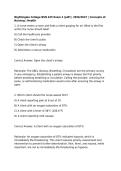
Nightingale College BSN 225 Exam 2 (pdf) | 2026/2027 | Concepts of
Nursing | Health
1. A nurse enters a room and finds a client gasping for air. What is the first
action the nurse should take?
A) Call the healthcare provider
B) Check the client's pulse
C) Open the client's airway
D) Administer a rescue medication
Correct Answer: Open the client's airway
Rationale: The ABCs (Airway, Breathing, Circulation) are the primary survey
in any emergency. Establishing a patent airway is always the first priority
before assessing breathing or circulation. Calling the provider, checking the
pulse, or administering medication would come after ensuring the airway is
open.
2. Which client should the nurse assess first?
A) A client reporting pain at 6 out of 10
B) A client with an oxygen saturation of 87%
C) A client with a fever of 38°C (100.4°F)
D) A client reporting mild nausea
Correct Answer: A client with an oxygen saturation of 87%
Rationale: An oxygen saturation of 87% indicates hypoxia, which is
immediately life-threatening. This client requires priority assessment and
intervention to prevent further deterioration. Pain, fever, and nausea, while
important, are not as immediately life-threatening as hypoxia.
,3. Which finding requires immediate intervention by the nurse?
A) Heart rate of 78 beats per minute
B) Respiratory rate of 10 breaths per minute
C) Blood pressure of 120/80 mmHg
D) Temperature of 37°C (98.6°F)
Correct Answer: Respiratory rate of 10 breaths per minute
Rationale: A respiratory rate of 10 breaths per minute is below the normal
range (12-20) and indicates respiratory depression, which is a critical finding.
The other vital signs are within normal limits and do not require immediate
intervention.
4. After a patient falls, what should the nurse do first?
A) Document the fall in the patient's chart
B) Notify the healthcare provider
C) Assess the patient for injuries
D) Complete an incident report
Correct Answer: Assess the patient for injuries
Rationale: The priority after a fall is to assess the patient for any injuries,
such as fractures or head trauma. Documentation, notifying the provider,
and completing an incident report are important but secondary to ensuring
patient safety and assessing for harm.
5. Which client is the highest priority for the nurse to assess?
A) A client reporting constipation
B) A client experiencing chest pain
,C) A client expressing anxiety
D) A client reporting difficulty sleeping
Correct Answer: A client experiencing chest pain
Rationale: Chest pain is a classic sign of a possible cardiac emergency, such
as a myocardial infarction. This is a life-threatening condition that requires
immediate assessment and intervention. Constipation, anxiety, and insomnia
are important but do not pose an immediate threat to life.
6. The nurse is preparing to perform a sterile procedure. What is the first
step?
A) Put on sterile gloves
B) Perform hand hygiene
C) Open the sterile pack
D) Don a surgical mask
Correct Answer: Perform hand hygiene
Rationale: Hand hygiene is the most critical first step before any sterile
procedure to reduce the number of microorganisms. Gloves, opening the
sterile pack, and masking are important but should follow hand hygiene.
7. A sterile field is considered contaminated if:
A) It is kept dry
B) It is touched by a sterile glove
C) It is reached over
D) It is kept above the waist
, Correct Answer: It is reached over
Rationale: Reaching over a sterile field introduces contamination from non-
sterile areas, such as the nurse's body or clothing. Sterile fields must be kept
dry and above the waist, and touching them with sterile gloves is
appropriate.
8. What is the primary purpose of performing hand hygiene?
A) To remove visible dirt from the hands
B) To prevent the transmission of infection
C) To improve the overall health of the skin
D) To meet hospital policy requirements
Correct Answer: To prevent the transmission of infection
Rationale: Hand hygiene is the single most effective method for preventing
the transmission of healthcare-associated infections. While it removes dirt
and is a policy requirement, its primary purpose is infection control.
9. A nurse is assessing a patient's respiratory rate. Which technique is
correct?
A) Tell the patient to breathe normally while counting
B) Observe chest rise without informing the patient
C) Ask the patient to take deep breaths
D) Count for 10 seconds and multiply by 4
Correct Answer: Observe chest rise without informing the patient
Nursing | Health
1. A nurse enters a room and finds a client gasping for air. What is the first
action the nurse should take?
A) Call the healthcare provider
B) Check the client's pulse
C) Open the client's airway
D) Administer a rescue medication
Correct Answer: Open the client's airway
Rationale: The ABCs (Airway, Breathing, Circulation) are the primary survey
in any emergency. Establishing a patent airway is always the first priority
before assessing breathing or circulation. Calling the provider, checking the
pulse, or administering medication would come after ensuring the airway is
open.
2. Which client should the nurse assess first?
A) A client reporting pain at 6 out of 10
B) A client with an oxygen saturation of 87%
C) A client with a fever of 38°C (100.4°F)
D) A client reporting mild nausea
Correct Answer: A client with an oxygen saturation of 87%
Rationale: An oxygen saturation of 87% indicates hypoxia, which is
immediately life-threatening. This client requires priority assessment and
intervention to prevent further deterioration. Pain, fever, and nausea, while
important, are not as immediately life-threatening as hypoxia.
,3. Which finding requires immediate intervention by the nurse?
A) Heart rate of 78 beats per minute
B) Respiratory rate of 10 breaths per minute
C) Blood pressure of 120/80 mmHg
D) Temperature of 37°C (98.6°F)
Correct Answer: Respiratory rate of 10 breaths per minute
Rationale: A respiratory rate of 10 breaths per minute is below the normal
range (12-20) and indicates respiratory depression, which is a critical finding.
The other vital signs are within normal limits and do not require immediate
intervention.
4. After a patient falls, what should the nurse do first?
A) Document the fall in the patient's chart
B) Notify the healthcare provider
C) Assess the patient for injuries
D) Complete an incident report
Correct Answer: Assess the patient for injuries
Rationale: The priority after a fall is to assess the patient for any injuries,
such as fractures or head trauma. Documentation, notifying the provider,
and completing an incident report are important but secondary to ensuring
patient safety and assessing for harm.
5. Which client is the highest priority for the nurse to assess?
A) A client reporting constipation
B) A client experiencing chest pain
,C) A client expressing anxiety
D) A client reporting difficulty sleeping
Correct Answer: A client experiencing chest pain
Rationale: Chest pain is a classic sign of a possible cardiac emergency, such
as a myocardial infarction. This is a life-threatening condition that requires
immediate assessment and intervention. Constipation, anxiety, and insomnia
are important but do not pose an immediate threat to life.
6. The nurse is preparing to perform a sterile procedure. What is the first
step?
A) Put on sterile gloves
B) Perform hand hygiene
C) Open the sterile pack
D) Don a surgical mask
Correct Answer: Perform hand hygiene
Rationale: Hand hygiene is the most critical first step before any sterile
procedure to reduce the number of microorganisms. Gloves, opening the
sterile pack, and masking are important but should follow hand hygiene.
7. A sterile field is considered contaminated if:
A) It is kept dry
B) It is touched by a sterile glove
C) It is reached over
D) It is kept above the waist
, Correct Answer: It is reached over
Rationale: Reaching over a sterile field introduces contamination from non-
sterile areas, such as the nurse's body or clothing. Sterile fields must be kept
dry and above the waist, and touching them with sterile gloves is
appropriate.
8. What is the primary purpose of performing hand hygiene?
A) To remove visible dirt from the hands
B) To prevent the transmission of infection
C) To improve the overall health of the skin
D) To meet hospital policy requirements
Correct Answer: To prevent the transmission of infection
Rationale: Hand hygiene is the single most effective method for preventing
the transmission of healthcare-associated infections. While it removes dirt
and is a policy requirement, its primary purpose is infection control.
9. A nurse is assessing a patient's respiratory rate. Which technique is
correct?
A) Tell the patient to breathe normally while counting
B) Observe chest rise without informing the patient
C) Ask the patient to take deep breaths
D) Count for 10 seconds and multiply by 4
Correct Answer: Observe chest rise without informing the patient


