

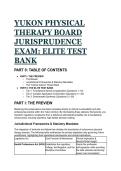
YUKON PHYSICAL
THERAPY BOARD
JURISPRUDENCE
EXAM: ELITE TEST
BANK
PART 0: TABLE OF CONTENTS
● PART I: THE PREVIEW
○ The Mission
○ Jurisdictional Frameworks & Statutory Mandates
○ The "Critical Axioms" Cheat Sheet
● PART II: THE ELITE TEST BANK
○ Tier 1: Foundational Syntax & Application (Questions 1–10)
○ Tier 2: Complex Application & Simulation (Questions 11–20)
○ Tier 3: Grandmaster Synthesis (Questions 21–30)
PART I: THE PREVIEW
Mastering this jurisprudence test bank translates directly to clinical invulnerability and elite
professional practice within the Yukon territory. By internalizing these statutory frameworks, you
transform regulatory compliance from a defensive administrative liability into a foundational
clinical asset, ensuring seamless, high-stakes decision-making.
Jurisdictional Frameworks & Statutory Mandates
The integration of territorial and federal law dictates the boundaries of autonomous physical
therapy practice. The following table synthesizes the primary legislative acts governing Yukon
practitioners, highlighting their operational mechanisms and clinical implications.
Legislative Act Core Function & Mechanism Clinical Implication &
Second-Order Insight
Health Professions Act (HPA) Establishes the regulatory Grants the profession
College, the Registrar, and the self-regulation while providing
Discipline Committee. the state ultimate sanctioning
power over incompetent
,Legislative Act Core Function & Mechanism Clinical Implication &
Second-Order Insight
practice.
Health Information Privacy Governs the collection, use, Defines the physical therapist
and Management Act retention, and disclosure of as a "Health Information
(HIPMA) personal health information. Custodian," holding them
permanently liable for data
breaches, even by third-party
agents.
Care Consent Act Mandates the presumption of Prohibits medical paternalism;
capability for all adults and patients maintain the absolute
mature minors regarding right to refuse life-saving care
healthcare decisions. on moral or religious grounds.
Child and Family Services Enforces the mandatory duty to Strips all privacy protections the
Act report suspected abuse or moment a clinician forms a
neglect of minors. "reasonable suspicion" of
abuse; overrides all institutional
protocols.
Adult Protection and Provides a framework for Balances adult autonomy with
Decision Making Act discretionary reporting of abuse protection; reporting is an
or neglect of vulnerable adults. ethical option, not a mandatory
legal duty, unless the adult is
entirely incapable of seeking
help.
The "Critical Axioms" Cheat Sheet
● HIPMA Custodianship: The Health Information Privacy and Management Act dictates
that a health information custodian remains absolutely responsible for personal health
information collected by their agents; privacy breaches cross jurisdictional lines via
PIPEDA.
● Mandatory vs. Discretionary Reporting: Under the Child and Family Services Act,
reporting suspected child abuse is a mandatory legal duty that immediately breaches
confidentiality. Conversely, under the Adult Protection and Decision Making Act, reporting
suspected elder abuse to a designated agency is largely discretionary and carries no
mandatory universal public duty.
● Presumption of Capability: The Care Consent Act and Decision-Making Support and
Protection to Adults Act mandate that all adults (19+) are presumed capable of making
their own healthcare decisions until legally proven otherwise.
● Cross-Border Telerehabilitation: When treating a patient across borders, you must
strictly comply with the legislative, regulatory, and privacy requirements of BOTH the
jurisdiction where you are located and the jurisdiction where the patient physically resides.
● The HPA Disciplinary Protocol: Under the Health Professions Act, the Registrar holds
the authority to investigate and seek informal resolution, but only the Discipline
Committee possesses the legal authority to revoke, suspend, or severely restrict a clinical
license following a formal hearing.
, PART II: THE ELITE TEST BANK
Tier 1: Foundational Syntax & Application
Q1: An applicant educated outside of Canada is finalizing their provisional registration for the
Yukon Physical Therapy Board. They submit a valid, unexpired passport to verify their legal
identity. The document has been verified and stamped by a licensed pharmacist. Based on the
principles of the Yukon physical therapy licensing regulations, which action/conclusion is the
MOST ACCURATE? A) The application is valid because pharmacists are recognized health
professionals authorized to act as guarantors for identity documents under Canadian federal
law. B) The application is incomplete but can be processed conditionally while the applicant
seeks a secondary guarantor from the Canadian Alliance of Physiotherapy Regulators. C) The
application is unequivocally invalid because identification documents must be notarized and
verified in their original form strictly by a notary public or a lawyer. D) The application is valid
provided the applicant also uploads a $5,000 professional liability surety bond alongside the
pharmacist-verified passport.
● Answer: C (The application is unequivocally invalid because identification documents
must be notarized and verified in their original form strictly by a notary public or a lawyer.)
● Distractor Analysis:
○ A is incorrect: While pharmacists are historically recognized as guarantors for
federal passports, territorial physical therapy licensure regulations are intentionally
restrictive to prevent fraudulent credentialing. The statute explicitly limits verification
to lawyers and notary publics.
○ B is incorrect: There is no conditional processing for invalid identification. The
Canadian Alliance of Physiotherapy Regulators (CAPR) handles academic
credentialing and national examinations, not the direct notarization of identity for
territorial licensure.
○ D is incorrect: A $5,000 surety bond is a requirement for insurance brokers in the
Yukon, not physical therapists. Furthermore, a bond does not cure the fundamental
defect of improper identity notarization.
The Mentor's Analysis: Administrative precision is the ultimate barrier to entry in professional
regulation. When facing licensure credentialing, the immediate priority is strict, literal adherence
to statutory language. By utilizing a notary public or lawyer exclusively, you bypass the common
trap of assuming federal passport guarantor rules apply to territorial professional licensure.
Professional/Academic Intuition: Statutory exclusions are absolute; if a territorial
regulation specifies "lawyer or notary public," the inclusion of all other recognized
professionals is legally void.
Q2: A physical therapist practicing in a multidisciplinary long-term care facility in Whitehorse is
audited by the board. The auditor reviews a shared electronic medical record where
interventions from nursing, occupational therapy, and physical therapy are blended into a single
daily progress note without distinct authorship indicators. Based on the principles of
multidisciplinary charting standards, which action/conclusion is the MOST ACCURATE? A) The
physical therapist is compliant because the Health Information Privacy and Management Act
(HIPMA) prioritizes holistic care continuity over individual provider attribution. B) The physical
therapist is compliant as long as the facility's internal workplace policies explicitly permit blended
chronological charting for administrative efficiency. C) The physical therapist is non-compliant
THERAPY BOARD
JURISPRUDENCE
EXAM: ELITE TEST
BANK
PART 0: TABLE OF CONTENTS
● PART I: THE PREVIEW
○ The Mission
○ Jurisdictional Frameworks & Statutory Mandates
○ The "Critical Axioms" Cheat Sheet
● PART II: THE ELITE TEST BANK
○ Tier 1: Foundational Syntax & Application (Questions 1–10)
○ Tier 2: Complex Application & Simulation (Questions 11–20)
○ Tier 3: Grandmaster Synthesis (Questions 21–30)
PART I: THE PREVIEW
Mastering this jurisprudence test bank translates directly to clinical invulnerability and elite
professional practice within the Yukon territory. By internalizing these statutory frameworks, you
transform regulatory compliance from a defensive administrative liability into a foundational
clinical asset, ensuring seamless, high-stakes decision-making.
Jurisdictional Frameworks & Statutory Mandates
The integration of territorial and federal law dictates the boundaries of autonomous physical
therapy practice. The following table synthesizes the primary legislative acts governing Yukon
practitioners, highlighting their operational mechanisms and clinical implications.
Legislative Act Core Function & Mechanism Clinical Implication &
Second-Order Insight
Health Professions Act (HPA) Establishes the regulatory Grants the profession
College, the Registrar, and the self-regulation while providing
Discipline Committee. the state ultimate sanctioning
power over incompetent
,Legislative Act Core Function & Mechanism Clinical Implication &
Second-Order Insight
practice.
Health Information Privacy Governs the collection, use, Defines the physical therapist
and Management Act retention, and disclosure of as a "Health Information
(HIPMA) personal health information. Custodian," holding them
permanently liable for data
breaches, even by third-party
agents.
Care Consent Act Mandates the presumption of Prohibits medical paternalism;
capability for all adults and patients maintain the absolute
mature minors regarding right to refuse life-saving care
healthcare decisions. on moral or religious grounds.
Child and Family Services Enforces the mandatory duty to Strips all privacy protections the
Act report suspected abuse or moment a clinician forms a
neglect of minors. "reasonable suspicion" of
abuse; overrides all institutional
protocols.
Adult Protection and Provides a framework for Balances adult autonomy with
Decision Making Act discretionary reporting of abuse protection; reporting is an
or neglect of vulnerable adults. ethical option, not a mandatory
legal duty, unless the adult is
entirely incapable of seeking
help.
The "Critical Axioms" Cheat Sheet
● HIPMA Custodianship: The Health Information Privacy and Management Act dictates
that a health information custodian remains absolutely responsible for personal health
information collected by their agents; privacy breaches cross jurisdictional lines via
PIPEDA.
● Mandatory vs. Discretionary Reporting: Under the Child and Family Services Act,
reporting suspected child abuse is a mandatory legal duty that immediately breaches
confidentiality. Conversely, under the Adult Protection and Decision Making Act, reporting
suspected elder abuse to a designated agency is largely discretionary and carries no
mandatory universal public duty.
● Presumption of Capability: The Care Consent Act and Decision-Making Support and
Protection to Adults Act mandate that all adults (19+) are presumed capable of making
their own healthcare decisions until legally proven otherwise.
● Cross-Border Telerehabilitation: When treating a patient across borders, you must
strictly comply with the legislative, regulatory, and privacy requirements of BOTH the
jurisdiction where you are located and the jurisdiction where the patient physically resides.
● The HPA Disciplinary Protocol: Under the Health Professions Act, the Registrar holds
the authority to investigate and seek informal resolution, but only the Discipline
Committee possesses the legal authority to revoke, suspend, or severely restrict a clinical
license following a formal hearing.
, PART II: THE ELITE TEST BANK
Tier 1: Foundational Syntax & Application
Q1: An applicant educated outside of Canada is finalizing their provisional registration for the
Yukon Physical Therapy Board. They submit a valid, unexpired passport to verify their legal
identity. The document has been verified and stamped by a licensed pharmacist. Based on the
principles of the Yukon physical therapy licensing regulations, which action/conclusion is the
MOST ACCURATE? A) The application is valid because pharmacists are recognized health
professionals authorized to act as guarantors for identity documents under Canadian federal
law. B) The application is incomplete but can be processed conditionally while the applicant
seeks a secondary guarantor from the Canadian Alliance of Physiotherapy Regulators. C) The
application is unequivocally invalid because identification documents must be notarized and
verified in their original form strictly by a notary public or a lawyer. D) The application is valid
provided the applicant also uploads a $5,000 professional liability surety bond alongside the
pharmacist-verified passport.
● Answer: C (The application is unequivocally invalid because identification documents
must be notarized and verified in their original form strictly by a notary public or a lawyer.)
● Distractor Analysis:
○ A is incorrect: While pharmacists are historically recognized as guarantors for
federal passports, territorial physical therapy licensure regulations are intentionally
restrictive to prevent fraudulent credentialing. The statute explicitly limits verification
to lawyers and notary publics.
○ B is incorrect: There is no conditional processing for invalid identification. The
Canadian Alliance of Physiotherapy Regulators (CAPR) handles academic
credentialing and national examinations, not the direct notarization of identity for
territorial licensure.
○ D is incorrect: A $5,000 surety bond is a requirement for insurance brokers in the
Yukon, not physical therapists. Furthermore, a bond does not cure the fundamental
defect of improper identity notarization.
The Mentor's Analysis: Administrative precision is the ultimate barrier to entry in professional
regulation. When facing licensure credentialing, the immediate priority is strict, literal adherence
to statutory language. By utilizing a notary public or lawyer exclusively, you bypass the common
trap of assuming federal passport guarantor rules apply to territorial professional licensure.
Professional/Academic Intuition: Statutory exclusions are absolute; if a territorial
regulation specifies "lawyer or notary public," the inclusion of all other recognized
professionals is legally void.
Q2: A physical therapist practicing in a multidisciplinary long-term care facility in Whitehorse is
audited by the board. The auditor reviews a shared electronic medical record where
interventions from nursing, occupational therapy, and physical therapy are blended into a single
daily progress note without distinct authorship indicators. Based on the principles of
multidisciplinary charting standards, which action/conclusion is the MOST ACCURATE? A) The
physical therapist is compliant because the Health Information Privacy and Management Act
(HIPMA) prioritizes holistic care continuity over individual provider attribution. B) The physical
therapist is compliant as long as the facility's internal workplace policies explicitly permit blended
chronological charting for administrative efficiency. C) The physical therapist is non-compliant


