

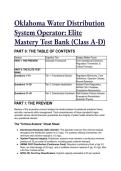
Oklahoma Water Distribution
System Operator: Elite
Mastery Test Bank (Class A-D)
PART 0: THE TABLE OF CONTENTS
Section Cognitive Tier Subject Matter Focus
PART I: THE PREVIEW Axiomatic Framework Core Operational Directives,
Regulatory Thresholds, &
Critical Formulas
PART II: THE ELITE TEST
BANK
Questions 1–10 Tier 1: Foundational Syntax Regulatory Minimums, Core
Definitions, Operator Classes,
Record Retention
Questions 11–20 Tier 2: Complex Application Hydrant Flow Diagnostics,
AWWA C651 Variables,
Compliance Mechanisms
Questions 21–30 Tier 3: Grandmaster Synthesis Multi-System Failure Analysis,
Emergency Remediation,
Hydraulic Physics
PART I: THE PREVIEW
Mastery of this evaluation protocol bridges the divide between foundational academic theory
and elite, real-world utility management. Total comprehension of these standards forges
operators whose clinical precision guarantees the integrity of public health infrastructure under
any operational stressor.
The "Critical Axioms" Cheat Sheet
● Disinfectant Residuals (OAC 252:631): The absolute minimum free chlorine residual
throughout the distribution system is 0.2 mg/L. For systems utilizing chloramines, the
minimum total chlorine residual is 1.0 mg/L.
● System Pressure Integrity: Distribution systems must maintain a continuous minimum
pressure of 25 psi under all conditions, including peak customer demand.
● AWWA C651 Disinfection (Continuous Feed): Requires a preliminary flush at \ge 3.0
ft/sec, an initial dosage of 25 mg/L, and a verifiable minimum residual of \ge 10 mg/L after
a 24-hour contact period.
● NFPA 291 Fire Flow Classification: Hydrant capacity calculated at 20 psi residual
, pressure dictates bonnet and cap color: Class AA (\ge 1500 GPM) is Light Blue; Class A
(1000–1499 GPM) is Green; Class B (500–999 GPM) is Orange; Class C (< 500 GPM) is
Red.
● Hydraulic Flow Calculation (Pitot): Flow is calculated using Q = 29.83 \times c \times
d^2 \times \sqrt{p}, where Q is GPM, c is the coefficient, d is outlet diameter, and p is
velocity pressure.
PART II: THE ELITE TEST BANK
Tier 1 - Foundational Syntax & Application
Q1: A municipal water distribution system utilizes a surface water treatment plant that applies
free chlorine as its primary and secondary disinfectant. Based on the Oklahoma Department of
Environmental Quality (ODEQ) regulations outlined in OAC 252:631, which parameter
represents the ABSOLUTE MINIMUM allowable disinfectant threshold at the most distant point
in the distribution network? A) 0.2 mg/L total chlorine B) 1.0 mg/L free chlorine C) 0.2 mg/L free
chlorine D) 1.0 mg/L total chlorine
● Answer: C (0.2 mg/L free chlorine)
● Distractor Analysis:
○ A is incorrect: The 0.2 mg/L threshold strictly applies to free chlorine, not total
chlorine. Measuring total chlorine in a free chlorine system masks the true
disinfection potential because it includes inactive chloramines and bound halogens.
○ B is incorrect: While 1.0 mg/L is a regulatory threshold, it applies specifically to the
Point of Entry (POE) for systems without documented log inactivation, not the
distant distribution points.
○ D is incorrect: This is the regulatory minimum for systems utilizing chloramines as a
secondary disinfectant. It does not apply to free chlorine systems.
The Mentor's Analysis: Disinfectant decay is inevitable in expansive distribution networks due
to pipe friction, water age, and biological demand. When facing water age and biofilm, the
immediate priority is ensuring biological safety via a baseline free chlorine residual of 0.2 mg/L.
By utilizing free chlorine mapping at the extremities, you bypass the common trap of relying on
plant-effluent numbers to assume system-wide safety. Professional/Academic Intuition:
Residuals validate integrity; any drop below 0.2 mg/L indicates either localized
contamination or excessive water age requiring immediate flushing.
Q2: A Class A water distribution operator is finalizing the annual professional development
training schedule for their entire department. According to OAC 252:710 rules, what is the
EXACT annual requirement for Professional Development Hours (PDH) to maintain a Class A
certification in good standing? A) 12 hours total, with a minimum of 4 hours of classroom
training B) 16 hours total, with a minimum of 8 hours of classroom training C) 16 hours total,
with a minimum of 4 hours of classroom training D) 8 hours total, which can be completed
entirely via approved online modules
● Answer: C (16 hours total, with a minimum of 4 hours of classroom training)
● Distractor Analysis:
○ A is incorrect: This is the exact requirement for a Class B operator, which demands
12 hours total but shares the 4-hour classroom minimum.
○ B is incorrect: While the 16-hour total is accurate for Class A, the mandate for
strictly in-person classroom training remains at 4 hours across all licensing tiers.
, ○ D is incorrect: This applies to Class C operators (8 hours total) and illegally ignores
the mandatory 4-hour in-person classroom requirement applicable to every operator
class.
The Mentor's Analysis: Elite operation requires continuous educational immersion to stay
ahead of evolving environmental regulations and hydrological engineering practices. When
maintaining compliance under OAC 252:710, the immediate priority is fulfilling the specific PDH
load relative to your license tier. By utilizing the PDH framework (16 hours for Class A), you
bypass the common trap of falling out of compliance due to administrative negligence.
Professional/Academic Intuition: Certification dictates capability; a Class A license
demands the highest continual educational investment of 16 annual hours to protect
public health.
Q3: A newly constructed 8-inch PVC water main has just been installed. The contractor elects to
use the Continuous-Feed Method for disinfection per AWWA C651. Which benchmark
represents the CORRECT standard for initial dosage and subsequent 24-hour retention? A)
Initial dose of 50 mg/L; minimum residual of 25 mg/L after 24 hours. B) Initial dose of 25 mg/L;
minimum residual of 10 mg/L after 24 hours. C) Initial dose of 100 mg/L; minimum residual of 50
mg/L after 3 hours. D) Initial dose of 25 mg/L; minimum residual of 0.2 mg/L after 24 hours.
● Answer: B (Initial dose of 25 mg/L; minimum residual of 10 mg/L after 24 hours.)
● Distractor Analysis:
○ A is incorrect: This represents a common legacy parameter or a hybrid
misunderstanding; it is unnecessarily corrosive to certain infrastructure components
and exceeds standard continuous-feed mandates.
○ C is incorrect: This describes the Slug Method of chlorination, which utilizes a much
higher concentration over a highly compressed (3-hour) contact time.
○ D is incorrect: This represents the Tablet Method, which cannot be pre-flushed and
thus only requires the system to hold a standard operational residual rather than the
heavy 10 mg/L verification.
The Mentor's Analysis: Main commissioning requires aggressive, verified sterilization to
eradicate construction-borne pathogens. When facing new infrastructure integration, the
immediate priority is executing the AWWA C651 standards flawlessly. By utilizing the
Continuous-Feed Method's strict 25/10 mg/L parameter, you bypass the common trap of
introducing compromised water into the active grid. Professional/Academic Intuition: A drop
of more than 15 mg/L during the continuous-feed 24-hour test indicates high organic
loading or physical debris, necessitating re-flushing and re-chlorination.
Q4: During an annual fire hydrant maintenance cycle, an operator is tasked with painting
hydrant caps according to NFPA 291 standards. A flow test reveals the hydrant produces
exactly 1,250 GPM when calculated at 20 psi residual pressure. Which color is the MOST
APPROPRIATE for the hydrant top and nozzle caps? A) Light Blue B) Green C) Orange D) Red
● Answer: B (Green)
● Distractor Analysis:
○ A is incorrect: Light Blue denotes a Class AA hydrant, which requires a massive
hydraulic capacity of 1,500 GPM or greater.
○ C is incorrect: Orange denotes a Class B hydrant, limited to 500–999 GPM, which
is insufficient for major multi-story structural firefighting.
○ D is incorrect: Red denotes a Class C hydrant, which delivers less than 500 GPM
and is generally only suitable for minor residential protection.
The Mentor's Analysis: First responders rely entirely on immediate visual data during chaotic
fireground operations. When classifying hydrants, the immediate priority is standardizing flow
System Operator: Elite
Mastery Test Bank (Class A-D)
PART 0: THE TABLE OF CONTENTS
Section Cognitive Tier Subject Matter Focus
PART I: THE PREVIEW Axiomatic Framework Core Operational Directives,
Regulatory Thresholds, &
Critical Formulas
PART II: THE ELITE TEST
BANK
Questions 1–10 Tier 1: Foundational Syntax Regulatory Minimums, Core
Definitions, Operator Classes,
Record Retention
Questions 11–20 Tier 2: Complex Application Hydrant Flow Diagnostics,
AWWA C651 Variables,
Compliance Mechanisms
Questions 21–30 Tier 3: Grandmaster Synthesis Multi-System Failure Analysis,
Emergency Remediation,
Hydraulic Physics
PART I: THE PREVIEW
Mastery of this evaluation protocol bridges the divide between foundational academic theory
and elite, real-world utility management. Total comprehension of these standards forges
operators whose clinical precision guarantees the integrity of public health infrastructure under
any operational stressor.
The "Critical Axioms" Cheat Sheet
● Disinfectant Residuals (OAC 252:631): The absolute minimum free chlorine residual
throughout the distribution system is 0.2 mg/L. For systems utilizing chloramines, the
minimum total chlorine residual is 1.0 mg/L.
● System Pressure Integrity: Distribution systems must maintain a continuous minimum
pressure of 25 psi under all conditions, including peak customer demand.
● AWWA C651 Disinfection (Continuous Feed): Requires a preliminary flush at \ge 3.0
ft/sec, an initial dosage of 25 mg/L, and a verifiable minimum residual of \ge 10 mg/L after
a 24-hour contact period.
● NFPA 291 Fire Flow Classification: Hydrant capacity calculated at 20 psi residual
, pressure dictates bonnet and cap color: Class AA (\ge 1500 GPM) is Light Blue; Class A
(1000–1499 GPM) is Green; Class B (500–999 GPM) is Orange; Class C (< 500 GPM) is
Red.
● Hydraulic Flow Calculation (Pitot): Flow is calculated using Q = 29.83 \times c \times
d^2 \times \sqrt{p}, where Q is GPM, c is the coefficient, d is outlet diameter, and p is
velocity pressure.
PART II: THE ELITE TEST BANK
Tier 1 - Foundational Syntax & Application
Q1: A municipal water distribution system utilizes a surface water treatment plant that applies
free chlorine as its primary and secondary disinfectant. Based on the Oklahoma Department of
Environmental Quality (ODEQ) regulations outlined in OAC 252:631, which parameter
represents the ABSOLUTE MINIMUM allowable disinfectant threshold at the most distant point
in the distribution network? A) 0.2 mg/L total chlorine B) 1.0 mg/L free chlorine C) 0.2 mg/L free
chlorine D) 1.0 mg/L total chlorine
● Answer: C (0.2 mg/L free chlorine)
● Distractor Analysis:
○ A is incorrect: The 0.2 mg/L threshold strictly applies to free chlorine, not total
chlorine. Measuring total chlorine in a free chlorine system masks the true
disinfection potential because it includes inactive chloramines and bound halogens.
○ B is incorrect: While 1.0 mg/L is a regulatory threshold, it applies specifically to the
Point of Entry (POE) for systems without documented log inactivation, not the
distant distribution points.
○ D is incorrect: This is the regulatory minimum for systems utilizing chloramines as a
secondary disinfectant. It does not apply to free chlorine systems.
The Mentor's Analysis: Disinfectant decay is inevitable in expansive distribution networks due
to pipe friction, water age, and biological demand. When facing water age and biofilm, the
immediate priority is ensuring biological safety via a baseline free chlorine residual of 0.2 mg/L.
By utilizing free chlorine mapping at the extremities, you bypass the common trap of relying on
plant-effluent numbers to assume system-wide safety. Professional/Academic Intuition:
Residuals validate integrity; any drop below 0.2 mg/L indicates either localized
contamination or excessive water age requiring immediate flushing.
Q2: A Class A water distribution operator is finalizing the annual professional development
training schedule for their entire department. According to OAC 252:710 rules, what is the
EXACT annual requirement for Professional Development Hours (PDH) to maintain a Class A
certification in good standing? A) 12 hours total, with a minimum of 4 hours of classroom
training B) 16 hours total, with a minimum of 8 hours of classroom training C) 16 hours total,
with a minimum of 4 hours of classroom training D) 8 hours total, which can be completed
entirely via approved online modules
● Answer: C (16 hours total, with a minimum of 4 hours of classroom training)
● Distractor Analysis:
○ A is incorrect: This is the exact requirement for a Class B operator, which demands
12 hours total but shares the 4-hour classroom minimum.
○ B is incorrect: While the 16-hour total is accurate for Class A, the mandate for
strictly in-person classroom training remains at 4 hours across all licensing tiers.
, ○ D is incorrect: This applies to Class C operators (8 hours total) and illegally ignores
the mandatory 4-hour in-person classroom requirement applicable to every operator
class.
The Mentor's Analysis: Elite operation requires continuous educational immersion to stay
ahead of evolving environmental regulations and hydrological engineering practices. When
maintaining compliance under OAC 252:710, the immediate priority is fulfilling the specific PDH
load relative to your license tier. By utilizing the PDH framework (16 hours for Class A), you
bypass the common trap of falling out of compliance due to administrative negligence.
Professional/Academic Intuition: Certification dictates capability; a Class A license
demands the highest continual educational investment of 16 annual hours to protect
public health.
Q3: A newly constructed 8-inch PVC water main has just been installed. The contractor elects to
use the Continuous-Feed Method for disinfection per AWWA C651. Which benchmark
represents the CORRECT standard for initial dosage and subsequent 24-hour retention? A)
Initial dose of 50 mg/L; minimum residual of 25 mg/L after 24 hours. B) Initial dose of 25 mg/L;
minimum residual of 10 mg/L after 24 hours. C) Initial dose of 100 mg/L; minimum residual of 50
mg/L after 3 hours. D) Initial dose of 25 mg/L; minimum residual of 0.2 mg/L after 24 hours.
● Answer: B (Initial dose of 25 mg/L; minimum residual of 10 mg/L after 24 hours.)
● Distractor Analysis:
○ A is incorrect: This represents a common legacy parameter or a hybrid
misunderstanding; it is unnecessarily corrosive to certain infrastructure components
and exceeds standard continuous-feed mandates.
○ C is incorrect: This describes the Slug Method of chlorination, which utilizes a much
higher concentration over a highly compressed (3-hour) contact time.
○ D is incorrect: This represents the Tablet Method, which cannot be pre-flushed and
thus only requires the system to hold a standard operational residual rather than the
heavy 10 mg/L verification.
The Mentor's Analysis: Main commissioning requires aggressive, verified sterilization to
eradicate construction-borne pathogens. When facing new infrastructure integration, the
immediate priority is executing the AWWA C651 standards flawlessly. By utilizing the
Continuous-Feed Method's strict 25/10 mg/L parameter, you bypass the common trap of
introducing compromised water into the active grid. Professional/Academic Intuition: A drop
of more than 15 mg/L during the continuous-feed 24-hour test indicates high organic
loading or physical debris, necessitating re-flushing and re-chlorination.
Q4: During an annual fire hydrant maintenance cycle, an operator is tasked with painting
hydrant caps according to NFPA 291 standards. A flow test reveals the hydrant produces
exactly 1,250 GPM when calculated at 20 psi residual pressure. Which color is the MOST
APPROPRIATE for the hydrant top and nozzle caps? A) Light Blue B) Green C) Orange D) Red
● Answer: B (Green)
● Distractor Analysis:
○ A is incorrect: Light Blue denotes a Class AA hydrant, which requires a massive
hydraulic capacity of 1,500 GPM or greater.
○ C is incorrect: Orange denotes a Class B hydrant, limited to 500–999 GPM, which
is insufficient for major multi-story structural firefighting.
○ D is incorrect: Red denotes a Class C hydrant, which delivers less than 500 GPM
and is generally only suitable for minor residential protection.
The Mentor's Analysis: First responders rely entirely on immediate visual data during chaotic
fireground operations. When classifying hydrants, the immediate priority is standardizing flow


