

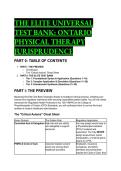
THE ELITE UNIVERSAL
TEST BANK: ONTARIO
PHYSICAL THERAPY
JURISPRUDENCE
PART 0: TABLE OF CONTENTS
1. PART I: THE PREVIEW
○ The Mission
○ The "Critical Axioms" Cheat Sheet
2. PART II: THE ELITE TEST BANK
○ Tier 1: Foundational Syntax & Application (Questions 1–10)
○ Tier 2: Complex Application & Simulation (Questions 11–20)
○ Tier 3: Grandmaster Synthesis (Questions 21–30)
PART I: THE PREVIEW
Mastering this Elite Test Bank translates directly to bulletproof clinical practice, shielding your
license from regulatory reprimand while ensuring unparalleled patient safety. You will not merely
memorize the Regulated Health Professions Act, 1991 (RHPA) or the College of
Physiotherapists of Ontario (CPO) Standards; you will synthesize them to survive the brutal
realities of modern healthcare administration.
The "Critical Axioms" Cheat Sheet
Axiom Domain The Golden Rule Regulatory Application
Controlled Acts & Delegation High-risk acts are strictly You may assign wound care to
non-delegable to support a Physiotherapist Assistant
personnel. (PTA) if rostered and
supervised. You may NEVER
assign acupuncture, spinal
manipulation, or internal pelvic
exams to a PTA.
PHIPA & Circle of Care Assumed implied consent Employers, insurance
exists only among direct companies, and family
healthcare providers. members are permanently
outside the Circle of Care; they
,Axiom Domain The Golden Rule Regulatory Application
require express consent for any
data release.
Boundary Violations Treating a spouse is legally Unless the care is
defined as sexual abuse under minor/emergency in nature and
the RHPA. unbilled, treating a spouse
warrants mandatory revocation.
A strict minimum one-year
"cooling-off" period applies
post-discharge before dating a
patient.
Billing Accountability You possess absolute, Claiming ignorance of a clinic
non-transferable accountability manager's fraudulent billing
for your registration number. practices is an immediate
admission of Professional
Misconduct.
2025 Standard Updates Infection control, collaborative A Point of Care Risk
care, and conflict of interest are Assessment (PoCRA) is
zero-tolerance zones. mandatory before every
encounter. Kickbacks for
referrals are unconditionally
banned, regardless of
disclosure.
PART II: THE ELITE TEST BANK
Tier 1: Foundational Syntax & Application
Q1: A physiotherapist working in a pediatric private clinic discharges a patient who is currently
10 years old. The clinic owner intends to digitize and subsequently purge physical records to
optimize digital storage space. Based on the principles of the CPO Documentation Standard,
which timeline is the MOST ACCURATE for retaining this patient's physical or digitized health
record? A) 10 years from the date of the last patient encounter, regardless of the patient's age.
B) 10 years from the date the patient reached, or would have reached, 18 years of age. C) 5
years from the date the patient reached 18 years of age. D) Records must be kept indefinitely
for any patient treated under the age of 16.
● Answer/Respuesta/Réponse: B (10 years from the date the patient reached, or would
have reached, 18 years of age.)
● Distractor Analysis:
○ A is incorrect: This is the standard rule for adult patients, representing a common
novice trap that fails to account for pediatric legislative exceptions established by
the CPO and the Public Hospitals Act.
○ C is incorrect: This is a fabricated timeframe. While financial records are sometimes
retained for shorter periods in other corporate sectors, clinical health records in
Ontario follow strict 10-year minimums post-adulthood.
○ D is incorrect: There is no legal mandate in Ontario requiring infinite retention of
pediatric records, as this would present unreasonable logistical burdens to health
information custodians without providing measurable clinical benefit.
, The Mentor's Analysis: Regulatory law aggressively protects minors, ensuring they have
access to their childhood medical records well into adulthood to address delayed-onset
conditions or legal claims. When calculating retention for a minor, always anchor the 10-year
clock to their 18th birthday. By utilizing Record Retention Standards, you bypass the common
trap of applying standard adult archival protocols to vulnerable populations.
Professional/Academic Intuition: For pediatric records, the countdown begins at
adulthood. The record must survive until the patient turns 28.
Q2: A physiotherapist is launching a new marketing campaign for their independent practice
and wishes to utilize Google Reviews prominently on their website. Based on the CPO
Advertising and Marketing Standard, which action is the MOST APPROPRIATE? A) The
physiotherapist may link their website directly to their third-party Google Reviews page, provided
they do not edit or manipulate the reviews. B) The physiotherapist may copy and paste 5-star
Google Reviews directly onto their website to demonstrate a claim of clinical superiority over
local competitors. C) The physiotherapist may offer a $10 discount on the next treatment
session to patients who leave a verified positive Google Review. D) The physiotherapist is
strictly forbidden from maintaining a Google Business profile, as it inherently collects prohibited
patient testimonials.
● Answer/Respuesta/Réponse: A (The physiotherapist may link their website directly to
their third-party Google Reviews page, provided they do not edit or manipulate the
reviews.)
● Distractor Analysis:
○ B is incorrect: Copying reviews onto a website constitutes utilizing direct
testimonials, which is strictly prohibited. Furthermore, making "claims of superiority"
(e.g., "better than the competition") is an explicit violation of the Advertising
Standard.
○ C is incorrect: Offering financial incentives in exchange for reviews is a severe
Conflict of Interest, coercing the patient and invalidating the integrity of the review.
○ D is incorrect: CPO standards do not forbid a practitioner from existing on
third-party platforms (like Yelp or Google) where patients organically leave ratings,
so long as the PT does not solicit them directly as marketing testimonials on their
own controlled media.
The Mentor's Analysis: The College mandates that advertising be true, accurate, and
verifiable, devoid of emotional manipulation. Testimonials are inherently subjective and cannot
guarantee future outcomes. While you cannot use testimonials on your own materials, you are
not held liable for organic third-party platforms. By utilizing Objective Verification, you bypass
the common trap of adopting subjective marketing inducements. Professional/Academic
Intuition: If you control the platform, testimonials are banned. If the public controls the
platform, organic reviews are permitted.
Q3: Under the Regulated Health Professions Act, 1991 (RHPA), physiotherapists are authorized
to perform specific controlled acts. Based on the CPO Controlled Acts and Restricted Activities
Standard, which of the following activities requires the physiotherapist to formally add their
name to the College's public roster FIRST? A) Communicating a diagnosis identifying a physical
dysfunction as the cause of a patient's symptoms. B) Performing an assessment of the
peripheral nervous system. C) Administering a substance by inhalation when ordered by an
authorized prescriber. D) Applying a heating modality (e.g., hot pack) to a patient with impaired
sensation.
● Answer/Respuesta/Réponse: C (Administering a substance by inhalation when ordered
by an authorized prescriber.)
TEST BANK: ONTARIO
PHYSICAL THERAPY
JURISPRUDENCE
PART 0: TABLE OF CONTENTS
1. PART I: THE PREVIEW
○ The Mission
○ The "Critical Axioms" Cheat Sheet
2. PART II: THE ELITE TEST BANK
○ Tier 1: Foundational Syntax & Application (Questions 1–10)
○ Tier 2: Complex Application & Simulation (Questions 11–20)
○ Tier 3: Grandmaster Synthesis (Questions 21–30)
PART I: THE PREVIEW
Mastering this Elite Test Bank translates directly to bulletproof clinical practice, shielding your
license from regulatory reprimand while ensuring unparalleled patient safety. You will not merely
memorize the Regulated Health Professions Act, 1991 (RHPA) or the College of
Physiotherapists of Ontario (CPO) Standards; you will synthesize them to survive the brutal
realities of modern healthcare administration.
The "Critical Axioms" Cheat Sheet
Axiom Domain The Golden Rule Regulatory Application
Controlled Acts & Delegation High-risk acts are strictly You may assign wound care to
non-delegable to support a Physiotherapist Assistant
personnel. (PTA) if rostered and
supervised. You may NEVER
assign acupuncture, spinal
manipulation, or internal pelvic
exams to a PTA.
PHIPA & Circle of Care Assumed implied consent Employers, insurance
exists only among direct companies, and family
healthcare providers. members are permanently
outside the Circle of Care; they
,Axiom Domain The Golden Rule Regulatory Application
require express consent for any
data release.
Boundary Violations Treating a spouse is legally Unless the care is
defined as sexual abuse under minor/emergency in nature and
the RHPA. unbilled, treating a spouse
warrants mandatory revocation.
A strict minimum one-year
"cooling-off" period applies
post-discharge before dating a
patient.
Billing Accountability You possess absolute, Claiming ignorance of a clinic
non-transferable accountability manager's fraudulent billing
for your registration number. practices is an immediate
admission of Professional
Misconduct.
2025 Standard Updates Infection control, collaborative A Point of Care Risk
care, and conflict of interest are Assessment (PoCRA) is
zero-tolerance zones. mandatory before every
encounter. Kickbacks for
referrals are unconditionally
banned, regardless of
disclosure.
PART II: THE ELITE TEST BANK
Tier 1: Foundational Syntax & Application
Q1: A physiotherapist working in a pediatric private clinic discharges a patient who is currently
10 years old. The clinic owner intends to digitize and subsequently purge physical records to
optimize digital storage space. Based on the principles of the CPO Documentation Standard,
which timeline is the MOST ACCURATE for retaining this patient's physical or digitized health
record? A) 10 years from the date of the last patient encounter, regardless of the patient's age.
B) 10 years from the date the patient reached, or would have reached, 18 years of age. C) 5
years from the date the patient reached 18 years of age. D) Records must be kept indefinitely
for any patient treated under the age of 16.
● Answer/Respuesta/Réponse: B (10 years from the date the patient reached, or would
have reached, 18 years of age.)
● Distractor Analysis:
○ A is incorrect: This is the standard rule for adult patients, representing a common
novice trap that fails to account for pediatric legislative exceptions established by
the CPO and the Public Hospitals Act.
○ C is incorrect: This is a fabricated timeframe. While financial records are sometimes
retained for shorter periods in other corporate sectors, clinical health records in
Ontario follow strict 10-year minimums post-adulthood.
○ D is incorrect: There is no legal mandate in Ontario requiring infinite retention of
pediatric records, as this would present unreasonable logistical burdens to health
information custodians without providing measurable clinical benefit.
, The Mentor's Analysis: Regulatory law aggressively protects minors, ensuring they have
access to their childhood medical records well into adulthood to address delayed-onset
conditions or legal claims. When calculating retention for a minor, always anchor the 10-year
clock to their 18th birthday. By utilizing Record Retention Standards, you bypass the common
trap of applying standard adult archival protocols to vulnerable populations.
Professional/Academic Intuition: For pediatric records, the countdown begins at
adulthood. The record must survive until the patient turns 28.
Q2: A physiotherapist is launching a new marketing campaign for their independent practice
and wishes to utilize Google Reviews prominently on their website. Based on the CPO
Advertising and Marketing Standard, which action is the MOST APPROPRIATE? A) The
physiotherapist may link their website directly to their third-party Google Reviews page, provided
they do not edit or manipulate the reviews. B) The physiotherapist may copy and paste 5-star
Google Reviews directly onto their website to demonstrate a claim of clinical superiority over
local competitors. C) The physiotherapist may offer a $10 discount on the next treatment
session to patients who leave a verified positive Google Review. D) The physiotherapist is
strictly forbidden from maintaining a Google Business profile, as it inherently collects prohibited
patient testimonials.
● Answer/Respuesta/Réponse: A (The physiotherapist may link their website directly to
their third-party Google Reviews page, provided they do not edit or manipulate the
reviews.)
● Distractor Analysis:
○ B is incorrect: Copying reviews onto a website constitutes utilizing direct
testimonials, which is strictly prohibited. Furthermore, making "claims of superiority"
(e.g., "better than the competition") is an explicit violation of the Advertising
Standard.
○ C is incorrect: Offering financial incentives in exchange for reviews is a severe
Conflict of Interest, coercing the patient and invalidating the integrity of the review.
○ D is incorrect: CPO standards do not forbid a practitioner from existing on
third-party platforms (like Yelp or Google) where patients organically leave ratings,
so long as the PT does not solicit them directly as marketing testimonials on their
own controlled media.
The Mentor's Analysis: The College mandates that advertising be true, accurate, and
verifiable, devoid of emotional manipulation. Testimonials are inherently subjective and cannot
guarantee future outcomes. While you cannot use testimonials on your own materials, you are
not held liable for organic third-party platforms. By utilizing Objective Verification, you bypass
the common trap of adopting subjective marketing inducements. Professional/Academic
Intuition: If you control the platform, testimonials are banned. If the public controls the
platform, organic reviews are permitted.
Q3: Under the Regulated Health Professions Act, 1991 (RHPA), physiotherapists are authorized
to perform specific controlled acts. Based on the CPO Controlled Acts and Restricted Activities
Standard, which of the following activities requires the physiotherapist to formally add their
name to the College's public roster FIRST? A) Communicating a diagnosis identifying a physical
dysfunction as the cause of a patient's symptoms. B) Performing an assessment of the
peripheral nervous system. C) Administering a substance by inhalation when ordered by an
authorized prescriber. D) Applying a heating modality (e.g., hot pack) to a patient with impaired
sensation.
● Answer/Respuesta/Réponse: C (Administering a substance by inhalation when ordered
by an authorized prescriber.)


