

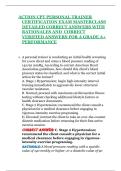
ACTION CPT PERSONAL TRAINER
CERTIFICATION EXAM MASTERCLASS
DETAILED CORRECT ANSWERS WITH
RATIONALES AND CORRECT
VERIFIED ANSWERS FOR A GRADE A+
PERFORMANCE
1. A personal trainer is conducting an initial health screening
for a new client and notes a blood pressure reading of
142/92 mmHg. According to current American Heart
Association guidelines, how should this client's blood
pressure status be classified, and what is the correct initial
action for the trainer?
A. Stage 1 Hypertension; begin high-intensity interval
training immediately to aggressively lower structural
vascular resistance.
B. Normal; proceed with maximum cardiovascular fitness
testing without checking additional lifestyle factors or
health clearance documents.
C. Stage 2 Hypertension; recommend the client consult a
physician for a medical clearance before engaging in
vigorous-intensity exercise programing.
D. Elevated; instruct the client to take an over-the-counter
diuretic medication before returning for their first active
exercise session.
Correct Answer: C. Stage 2 Hypertension;
recommend the client consult a physician for a
medical clearance before engaging in vigorous-
intensity exercise programing.
Rationale: A blood pressure reading with a systolic
value of 140 mmHg or higher, or a diastolic value of 90
, mmHg or higher, is classified as Stage 2 Hypertension.
For client safety, trainers should secure a medical
clearance or guidance before subjecting the individual to
strenuous cardiorespiratory or resistance testing.
2. During an assessment of a client performing a bodyweight
overhead squat, the personal trainer observes that the
client's heels consistently lift off the floor during the
descent phase. What specific muscle tightness and joint
restriction are most likely contributing to this faulty
movement compensation pattern?
A. Tightness in the rectus abdominis and excessive
mobility of the glenohumeral joint structures.
B. Tightness in the gastrocnemius and soleus complex,
alongside a restriction in ankle dorsiflexion mobility.
C. Weakness of the quadriceps femoris and hypermobility
of the sacroiliac joint ligaments.
D. Tightness in the latissimus dorsi and restriction in
shoulder girdle distraction movements.
Correct Answer: B. Tightness in the
gastrocnemius and soleus complex, alongside a
restriction in ankle dorsiflexion mobility.
Rationale: When a client lacks adequate ankle
dorsiflexion range of motion—often caused by overactive
or tight calf muscles (gastrocnemius and soleus)—the
heels will rise off the floor to allow the body's center of
mass to drop during a squat.
3. A trainer designs a resistance training program utilizing a
superset configuration that pairs a barbell bench press
immediately with a cable lat pulldown. What specific
neuromuscular relationship and mechanical classification
define this type of programing arrangement?
A. Compound setting; pairing two distinct exercises that
isolate identical muscle groups consecutively without a
rest interval.
, B. Agonist-antagonist superset; pairing exercises that
target opposing muscle groups around a joint to maximize
blood flow and efficiency.
C. Tri-set sequencing; combining three unilateral exercises
targeting a single distal joint structure to induce severe
metabolic stress.
D. Circuit training; organizing ten or more
cardiorespiratory exercises in a continuous loop to
emphasize aerobic power adaptations.
Correct Answer: B. Agonist-antagonist
superset; pairing exercises that target opposing
muscle groups around a joint to maximize blood
flow and efficiency.
Rationale: Pairing a chest pressing movement
(pectoralis major acting as the agonist) with a back
pulling movement (latissimus dorsi acting as the
antagonist) represents an agonist-antagonist superset,
which optimizes training efficiency and balanced joint
loading.
4. A client is performing a standard standing bicep curl with
dumbbells. During the concentric phase of the movement,
what type of muscle action is occurring in the biceps
brachii, and what is the mechanical role of the triceps
brachii?
A. Eccentric contraction; the triceps brachii acts as the
primary driver to accelerate the elbow flexion movement.
B. Isometric contraction; the triceps brachii serves as a
dynamic stabilizer to prevent shoulder girdle rotation.
C. Concentric contraction; the triceps brachii acts as the
antagonist, stretching or relaxing to allow elbow flexion to
proceed.
D. Isokinetic contraction; the triceps brachii works as a
synergist to assist the brachioradialis muscle.
Correct Answer: C. Concentric contraction; the
, triceps brachii acts as the antagonist, stretching or
relaxing to allow elbow flexion to proceed.
Rationale: During the upward phase of a bicep curl, the
biceps brachii shortens under tension, which is a
concentric contraction. The triceps brachii sits on the
opposite side of the humerus and acts as the antagonist
muscle during elbow flexion.
5. An intermediate client wants to maximize muscular
hypertrophy in their lower body. According to general
exercise science and certified personal trainer guidelines,
what are the most appropriate intensity, repetition, and
rest interval ranges to achieve this goal?
A. 90-100% of 1RM, 1-5 repetitions per set, with 5-7
minutes of rest between sets to prioritize nervous system
recovery.
B. 65-85% of 1RM, 6-12 repetitions per set, with 60-90
seconds of rest between sets to maximize metabolic stress
and mechanical tension.
C. 30-40% of 1RM, 25-30 repetitions per set, with 5
minutes of rest between sets to emphasize aerobic cellular
adaptations.
D. 50% of 1RM, 2 repetitions per set, with 10 seconds of
rest between sets to improve balance and proprioception.
Correct Answer: B. 65-85% of 1RM, 6-12
repetitions per set, with 60-90 seconds of rest
between sets to maximize metabolic stress and
mechanical tension.
Rationale: The hypertrophy training zone is optimally
supported by moderate-to-high workloads (65-85% of 1-
repetition maximum), moderate repetition ranges (6-12
reps), and short-to-moderate recovery phases to
maximize anabolic signaling.
6. During a high-intensity resistance training session, a client
experiences sudden, severe dizziness, profuse sweating,
CERTIFICATION EXAM MASTERCLASS
DETAILED CORRECT ANSWERS WITH
RATIONALES AND CORRECT
VERIFIED ANSWERS FOR A GRADE A+
PERFORMANCE
1. A personal trainer is conducting an initial health screening
for a new client and notes a blood pressure reading of
142/92 mmHg. According to current American Heart
Association guidelines, how should this client's blood
pressure status be classified, and what is the correct initial
action for the trainer?
A. Stage 1 Hypertension; begin high-intensity interval
training immediately to aggressively lower structural
vascular resistance.
B. Normal; proceed with maximum cardiovascular fitness
testing without checking additional lifestyle factors or
health clearance documents.
C. Stage 2 Hypertension; recommend the client consult a
physician for a medical clearance before engaging in
vigorous-intensity exercise programing.
D. Elevated; instruct the client to take an over-the-counter
diuretic medication before returning for their first active
exercise session.
Correct Answer: C. Stage 2 Hypertension;
recommend the client consult a physician for a
medical clearance before engaging in vigorous-
intensity exercise programing.
Rationale: A blood pressure reading with a systolic
value of 140 mmHg or higher, or a diastolic value of 90
, mmHg or higher, is classified as Stage 2 Hypertension.
For client safety, trainers should secure a medical
clearance or guidance before subjecting the individual to
strenuous cardiorespiratory or resistance testing.
2. During an assessment of a client performing a bodyweight
overhead squat, the personal trainer observes that the
client's heels consistently lift off the floor during the
descent phase. What specific muscle tightness and joint
restriction are most likely contributing to this faulty
movement compensation pattern?
A. Tightness in the rectus abdominis and excessive
mobility of the glenohumeral joint structures.
B. Tightness in the gastrocnemius and soleus complex,
alongside a restriction in ankle dorsiflexion mobility.
C. Weakness of the quadriceps femoris and hypermobility
of the sacroiliac joint ligaments.
D. Tightness in the latissimus dorsi and restriction in
shoulder girdle distraction movements.
Correct Answer: B. Tightness in the
gastrocnemius and soleus complex, alongside a
restriction in ankle dorsiflexion mobility.
Rationale: When a client lacks adequate ankle
dorsiflexion range of motion—often caused by overactive
or tight calf muscles (gastrocnemius and soleus)—the
heels will rise off the floor to allow the body's center of
mass to drop during a squat.
3. A trainer designs a resistance training program utilizing a
superset configuration that pairs a barbell bench press
immediately with a cable lat pulldown. What specific
neuromuscular relationship and mechanical classification
define this type of programing arrangement?
A. Compound setting; pairing two distinct exercises that
isolate identical muscle groups consecutively without a
rest interval.
, B. Agonist-antagonist superset; pairing exercises that
target opposing muscle groups around a joint to maximize
blood flow and efficiency.
C. Tri-set sequencing; combining three unilateral exercises
targeting a single distal joint structure to induce severe
metabolic stress.
D. Circuit training; organizing ten or more
cardiorespiratory exercises in a continuous loop to
emphasize aerobic power adaptations.
Correct Answer: B. Agonist-antagonist
superset; pairing exercises that target opposing
muscle groups around a joint to maximize blood
flow and efficiency.
Rationale: Pairing a chest pressing movement
(pectoralis major acting as the agonist) with a back
pulling movement (latissimus dorsi acting as the
antagonist) represents an agonist-antagonist superset,
which optimizes training efficiency and balanced joint
loading.
4. A client is performing a standard standing bicep curl with
dumbbells. During the concentric phase of the movement,
what type of muscle action is occurring in the biceps
brachii, and what is the mechanical role of the triceps
brachii?
A. Eccentric contraction; the triceps brachii acts as the
primary driver to accelerate the elbow flexion movement.
B. Isometric contraction; the triceps brachii serves as a
dynamic stabilizer to prevent shoulder girdle rotation.
C. Concentric contraction; the triceps brachii acts as the
antagonist, stretching or relaxing to allow elbow flexion to
proceed.
D. Isokinetic contraction; the triceps brachii works as a
synergist to assist the brachioradialis muscle.
Correct Answer: C. Concentric contraction; the
, triceps brachii acts as the antagonist, stretching or
relaxing to allow elbow flexion to proceed.
Rationale: During the upward phase of a bicep curl, the
biceps brachii shortens under tension, which is a
concentric contraction. The triceps brachii sits on the
opposite side of the humerus and acts as the antagonist
muscle during elbow flexion.
5. An intermediate client wants to maximize muscular
hypertrophy in their lower body. According to general
exercise science and certified personal trainer guidelines,
what are the most appropriate intensity, repetition, and
rest interval ranges to achieve this goal?
A. 90-100% of 1RM, 1-5 repetitions per set, with 5-7
minutes of rest between sets to prioritize nervous system
recovery.
B. 65-85% of 1RM, 6-12 repetitions per set, with 60-90
seconds of rest between sets to maximize metabolic stress
and mechanical tension.
C. 30-40% of 1RM, 25-30 repetitions per set, with 5
minutes of rest between sets to emphasize aerobic cellular
adaptations.
D. 50% of 1RM, 2 repetitions per set, with 10 seconds of
rest between sets to improve balance and proprioception.
Correct Answer: B. 65-85% of 1RM, 6-12
repetitions per set, with 60-90 seconds of rest
between sets to maximize metabolic stress and
mechanical tension.
Rationale: The hypertrophy training zone is optimally
supported by moderate-to-high workloads (65-85% of 1-
repetition maximum), moderate repetition ranges (6-12
reps), and short-to-moderate recovery phases to
maximize anabolic signaling.
6. During a high-intensity resistance training session, a client
experiences sudden, severe dizziness, profuse sweating,


