

Written by students who passed Immediately available after payment Read online or as PDF Wrong document? Swap it for free 4.6 TrustPilot
logo-home
Document preview thumbnail
Preview 2 out of 6 pages
Exam (elaborations)

NSG 6430 Week 4 Quiz 2023 – South University Women's Health FNP Practice Questions with Verified Answers & Detailed Rationales | Complete Study Guide

Document preview thumbnail
Preview 2 out of 6 pages

Prepare with confidence for the NSG 6430 Week 4 Quiz at South University using this comprehensive study guide and practice test resource. This essential academic resource is specifically designed for Family Nurse Practitioner (FNP) students enrolled in the Women's Health Conditions & Reproductive Health course and covers the key concepts and clinical scenarios tested on the Week 4 quiz. This study guide features exam-style multiple-choice questions with verified correct answers and detailed rationales, based on actual quiz content from the 2023 academic year. It is optimized for students aiming to achieve a passing score by reinforcing core women's health concepts, contraceptive counseling, and reproductive health management. What's Included: Practice questions covering all major women's health topics Verified correct answers with detailed rationales Exam-style questions that mirror the format and rigor of the actual South University NSG 6430 quiz Comprehensive coverage across all major women's health topics: Contraception Methods – Depot medroxyprogesterone acetate (DMPA/Depo-Provera) administration at 12-week intervals; barrier methods and STI protection; copper T IUD contraindications (prior ectopic pregnancy); diaphragm use with spermicidal jelly Menstrual Disorders – Polycystic ovary syndrome (PCOS) manifestations (menstrual irregularity, hirsutism) and associated risks (endometrial cancer); abnormal uterine bleeding (AUB) management with medroxyprogesterone; secondary amenorrhea management; anovulation as most common cause of amenorrhea Premenstrual Disorders – Premenstrual dysphoric disorder (PMDD) symptoms (extreme irritability, mood swings, bloating, fluid retention) Breast Health – Breast mass characteristics NOT linked with carcinoma (well-circumscribed, rubbery, tender lesions) Adolescent Health – HPV vaccine (Gardasil) administration (series of three doses over six months); puberty onset in females (before age 8 requires evaluation); average age of menarche (12 years); psychosocial screening for adolescents Menopause and Perimenopause – Menstrual cycle phases; menstrual cycle regulation Sample Questions Include: The nurse practitioner is prescribing a depot medroxyprogesterone acetate (DMPA) injection for a patient. This medication is given at ___ week intervals. – Answer: 12 weeks Although barrier contraception methods are less effective in preventing pregnancy than more modern methods, the nurse practitioner understands that interest in barrier methods is on the rise because they: – Answer: Can help protect against STIs, including HIV A woman is interested in starting Depo-Provera injections for contraception. What would be the most likely side effect that she should be educated about? – Answer: Irregular bleeding Iris is a thirty-two-year-old married woman with three children. She comes in for information on using the copper T intrauterine device (IUD) for contraception. Which of the following would be a contraindication to using this appliance? – Answer: Prior ectopic pregnancy A female patient has been diagnosed with polycystic ovary syndrome (PCOS) and weighs 250 pounds. In addition to obesity, PCOS is associated with which of the following clinical manifestations? (Select all that apply) – Answer: Menstrual irregularity; Hirsutism Tanisha is a twenty-two-year-old woman who presents with extreme irritability and mood swings, bloating, constipation, fluid retention, and headache. She tearfully tells you, "This happens every month in my cycle... Sometimes, it's so bad. I just want to quit living. I need help!" Tanisha's symptoms are typical of what disorder? – Answer: Premenstrual dysphoric disorder (PMDD) Lenore, fifty-five years old, comes in for evaluation of a breast mass. Which of the following is not usually linked with carcinoma of the breast? – Answer: Well-circumscribed, rubbery and tender lesion The nurse practitioner understands that women with polycystic ovarian syndrome have an increased risk for: – Answer: Endometrial cancer Designed for South University FNP students, women's health nurse practitioner candidates, and advanced practice nursing students, this study guide is an essential tool for course exams, women's health rotations, and NP certification preparation.

Content preview

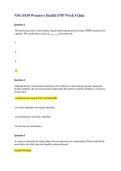
NSG 6430 Women's Health FNP Week 4 Quiz

Question 1

The nurse practitioner is prescribing a depot medroxyprogesterone acetate (DMPA) injection for
a patient. This medication is given at week intervals.


3


6


9


12


Question 2

Although barrier contraception methods are less effective in preventing pregnancy than more
modern methods, the nurse practitioner understands that interest in barrier methods is on the rise
because they:

can help protect against STIs, including HIV


are coitus dependent and require planning


are nonallergenic and male controlled


involve the use of hormones


Question 3

A woman is interested in starting Depo-Provera injections for contraception. What would be the
most likely side effect that she should be educated about?

Irregular bleeding

, Dysmenorrhea

Breast tenderness

Headache

Question 4

Lenore, fifty-five years old, comes in for evaluation of a breast mass. Which of the following
assessment findings is/are associated with carcinoma of the breast? Select all that apply.

Scaly lesions similar to eczema on one areola and nipple

Peau d’orange dimpling of skin over one breast

Unilateral retraction and deviation of nipple

Discrete, smooth, and mobile lesion

Question 5

There are several phases to the menstrual cycle. What phase begins with ovulation and ends with
menstruation?

Ovulatory phase

Follicular phase

Proliferative phase

Luteal phase

Question 6

Tanisha is a twenty-two-year-old woman who presents with extreme irritability and mood
swings, bloating, constipation, fluid retention, and headache. She tearfully tells you, “This
happens every month in my cycle. I get like a crazy woman, lashing out at everyone. I’m afraid
I’ll lose my job if I can’t stop this. Sometimes, it’s so bad. I just want to quit living. I need help!”
Tanisha’s symptoms are typical of what disorder?

Depression

Premenstrual syndrome (PMS)

Bipolar disorder

Document information

Uploaded on
August 9, 2026
Number of pages
6
Written in
2026/2027
Type
Exam (elaborations)
Contains
Questions & answers
$19.49

Wrong document? Swap it for free Within 14 days of purchase and before downloading, you can choose a different document. You can simply spend the amount again.
Written by students who passed
Immediately available after payment
Read online or as PDF

Sold
5
Followers
0
Items
376
Last sold
1 day ago


Why students choose Stuvia

Created by fellow students, verified by reviews

Quality you can trust: written by students who passed their tests and reviewed by others who've used these notes.

Didn't get what you expected? Choose another document

No worries! You can instantly pick a different document that better fits what you're looking for.

Pay as you like, start learning right away

No subscription, no commitments. Pay the way you're used to via credit card and download your PDF document instantly.

Student with book image

“Bought, downloaded, and aced it. It really can be that simple.”

Alisha Student

Working on your references?

Create accurate citations in APA, MLA and Harvard with our free citation generator.

Working on your references?

Frequently asked questions

