

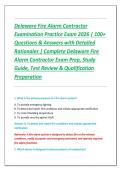
Delaware Fire Alarm Contractor
Examination Practice Exam 2026 | 100+
Questions & Answers with Detailed
Rationales | Complete Delaware Fire
Alarm Contractor Exam Prep, Study
Guide, Test Review & Qualification
Preparation
1. What is the primary purpose of a fire alarm system?
A. To provide emergency lighting
B. To detect and report fire conditions and initiate appropriate notification
C. To control building temperature
D. To provide security against theft
Answer: B. To detect and report fire conditions and initiate appropriate
notification
Rationale: A fire alarm system is designed to detect fire or fire-related
conditions, notify occupants and emergency personnel, and operate required
fire safety functions.
2. Which device is designed to detect products of combustion?
,A. Manual pull station
B. Smoke detector
C. Waterflow switch
D. Tamper switch
Answer: B. Smoke detector
Rationale: A smoke detector senses airborne products of combustion and
initiates an alarm signal when its operating criteria are met.
3. What is the purpose of a manual fire alarm box?
A. To detect sprinkler water pressure
B. To allow a person to manually initiate a fire alarm signal
C. To supervise a fire pump
D. To silence notification appliances
Answer: B. To allow a person to manually initiate a fire alarm signal
Rationale: Manual fire alarm boxes provide occupants with a means of
manually initiating the fire alarm system.
4. Which condition generally indicates that a supervised circuit has been
compromised?
A. Alarm
B. Supervisory
C. Trouble
D. Evacuation
Answer: C. Trouble
Rationale: A trouble signal generally indicates a fault or abnormal condition
affecting the integrity or operation of the fire alarm system.
5. What is the function of a fire alarm control unit?
,A. Store water for sprinklers
B. Process signals and control fire alarm system functions
C. Provide building ventilation only
D. Replace emergency generators
Answer: B. Process signals and control fire alarm system functions
Rationale: The fire alarm control unit receives initiating signals, processes
system conditions, controls notification and other outputs, and provides system
status information.
6. Which device monitors the movement of water in a sprinkler system?
A. Smoke detector
B. Waterflow switch
C. Heat detector
D. Duct detector
Answer: B. Waterflow switch
Rationale: A waterflow switch detects sustained movement of water through a
sprinkler system and can initiate a fire alarm signal.
7. What is the purpose of a sprinkler valve tamper switch?
A. Detect smoke
B. Detect unauthorized closure or movement of a supervised valve
C. Measure room temperature
D. Activate emergency lighting
Answer: B. Detect unauthorized closure or movement of a supervised valve
Rationale: A valve supervisory device monitors the position of a sprinkler control
valve and reports an abnormal position to the fire alarm system.
8. What does NAC commonly stand for in fire alarm terminology?
, A. Network Alarm Circuit
B. Notification Appliance Circuit
C. Normal Alarm Control
D. National Alarm Connector
Answer: B. Notification Appliance Circuit
Rationale: A NAC supplies and supervises notification appliances such as horns,
strobes, and combination horn/strobes.
9. Which appliance commonly provides an audible fire alarm signal?
A. Horn
B. Smoke damper
C. Pull station
D. Heat detector
Answer: A. Horn
Rationale: Horns provide audible notification to occupants when the fire alarm
system is activated.
10. What is the purpose of a visual notification appliance?
A. Detect heat
B. Provide visible notification
C. Monitor sprinkler pressure
D. Detect valve position
Answer: B. Provide visible notification
Rationale: Visual notification appliances, such as strobes, provide a visible
warning to occupants.
11. What does AHJ commonly mean?
A. Alarm Hardware Junction
B. Authority Having Jurisdiction
Examination Practice Exam 2026 | 100+
Questions & Answers with Detailed
Rationales | Complete Delaware Fire
Alarm Contractor Exam Prep, Study
Guide, Test Review & Qualification
Preparation
1. What is the primary purpose of a fire alarm system?
A. To provide emergency lighting
B. To detect and report fire conditions and initiate appropriate notification
C. To control building temperature
D. To provide security against theft
Answer: B. To detect and report fire conditions and initiate appropriate
notification
Rationale: A fire alarm system is designed to detect fire or fire-related
conditions, notify occupants and emergency personnel, and operate required
fire safety functions.
2. Which device is designed to detect products of combustion?
,A. Manual pull station
B. Smoke detector
C. Waterflow switch
D. Tamper switch
Answer: B. Smoke detector
Rationale: A smoke detector senses airborne products of combustion and
initiates an alarm signal when its operating criteria are met.
3. What is the purpose of a manual fire alarm box?
A. To detect sprinkler water pressure
B. To allow a person to manually initiate a fire alarm signal
C. To supervise a fire pump
D. To silence notification appliances
Answer: B. To allow a person to manually initiate a fire alarm signal
Rationale: Manual fire alarm boxes provide occupants with a means of
manually initiating the fire alarm system.
4. Which condition generally indicates that a supervised circuit has been
compromised?
A. Alarm
B. Supervisory
C. Trouble
D. Evacuation
Answer: C. Trouble
Rationale: A trouble signal generally indicates a fault or abnormal condition
affecting the integrity or operation of the fire alarm system.
5. What is the function of a fire alarm control unit?
,A. Store water for sprinklers
B. Process signals and control fire alarm system functions
C. Provide building ventilation only
D. Replace emergency generators
Answer: B. Process signals and control fire alarm system functions
Rationale: The fire alarm control unit receives initiating signals, processes
system conditions, controls notification and other outputs, and provides system
status information.
6. Which device monitors the movement of water in a sprinkler system?
A. Smoke detector
B. Waterflow switch
C. Heat detector
D. Duct detector
Answer: B. Waterflow switch
Rationale: A waterflow switch detects sustained movement of water through a
sprinkler system and can initiate a fire alarm signal.
7. What is the purpose of a sprinkler valve tamper switch?
A. Detect smoke
B. Detect unauthorized closure or movement of a supervised valve
C. Measure room temperature
D. Activate emergency lighting
Answer: B. Detect unauthorized closure or movement of a supervised valve
Rationale: A valve supervisory device monitors the position of a sprinkler control
valve and reports an abnormal position to the fire alarm system.
8. What does NAC commonly stand for in fire alarm terminology?
, A. Network Alarm Circuit
B. Notification Appliance Circuit
C. Normal Alarm Control
D. National Alarm Connector
Answer: B. Notification Appliance Circuit
Rationale: A NAC supplies and supervises notification appliances such as horns,
strobes, and combination horn/strobes.
9. Which appliance commonly provides an audible fire alarm signal?
A. Horn
B. Smoke damper
C. Pull station
D. Heat detector
Answer: A. Horn
Rationale: Horns provide audible notification to occupants when the fire alarm
system is activated.
10. What is the purpose of a visual notification appliance?
A. Detect heat
B. Provide visible notification
C. Monitor sprinkler pressure
D. Detect valve position
Answer: B. Provide visible notification
Rationale: Visual notification appliances, such as strobes, provide a visible
warning to occupants.
11. What does AHJ commonly mean?
A. Alarm Hardware Junction
B. Authority Having Jurisdiction


