

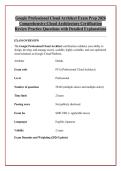
Google Professional Cloud Architect Exam Prep 2026
Comprehensive Cloud Architecture Certification
Review Practice Questions with Detailed Explanations
EXAM OVERVIEW
The Google Professional Cloud Architect certification validates your ability to
design, develop, and manage secure, scalable, highly available, and cost-optimized
cloud solutions on Google Cloud Platform.
Attribute Details
Exam code PCA (Professional Cloud Architect)
Level Professional
Number of questions 50-60 (multiple-choice and multiple-select)
Time limit 2 hours
Passing score Not publicly disclosed
Exam fee $200 USD (+ applicable taxes)
Languages English, Japanese
Validity 2 years
Exam Domains and Weighting (2026 Update)
,Domain Weight
Domain 1: Designing and Planning
~24%
a Cloud Solution Architecture
Domain 2: Managing and
Provisioning a Solution ~15%
Infrastructure
Domain 3: Designing for Security
~18%
and Compliance
Domain 4: Analyzing and
Optimizing Technical and Business ~18%
Processes
Domain 5: Managing
~11%
Implementation
Domain 6: Ensuring Solution and
~14%
Operations Reliability
DOMAIN 1: DESIGNING AND PLANNING A CLOUD SOLUTION
ARCHITECTURE (~24%) — Questions 1-24
Question 1
A multinational financial services company is planning to migrate a mission-
critical trading application to Google Cloud. The application processes real-time
market data and executes trades with sub-second latency requirements. The
company has offices in New York, London, and Tokyo, with users in all three
regions. The application must maintain data residency in the region where the trade
,originates. Which Google Cloud architecture should the Solutions Architect
recommend?
A) Single-region deployment in us-central1 with Cloud CDN for global
distribution
B) Multi-region deployment with regional backends, Cloud Load Balancing, and
data residency controls
C) Global deployment with a single database in one region and read replicas in
other regions
D) Hybrid deployment with on-premises data centers in each region and Google
Cloud for backup
Answer: B
Rationale: A multi-region deployment with regional backends is the optimal
solution. The application requires low-latency processing in each region where
users are located. Cloud Load Balancing can route traffic to the nearest regional
backend, while data residency controls ensure trade data remains in the region of
origin. Option A would introduce unacceptable latency for users outside the US.
Option C would create cross-region latency for database writes. Option D fails to
fully leverage cloud benefits. The architecture must balance performance,
compliance, and cost, which is a core skill tested in Domain 1.
Question 2
A healthcare provider is migrating electronic health records (EHR) to Google
Cloud. The company must comply with HIPAA regulations and ensure that patient
data is encrypted both at rest and in transit. The architecture must also support
auditing of all data access. Which combination of Google Cloud services should
the Solutions Architect recommend?
A) Cloud Storage with default encryption, Cloud VPN, and Cloud Audit Logs
B) Cloud KMS with customer-managed keys, VPC Service Controls, and Cloud
Audit Logs with Data Access logs enabled
C) Cloud Storage with CMEK, Cloud CDN, and IAM policies
D) BigQuery with customer-managed encryption, Cloud Armor, and Stackdriver
Logging
Answer: B
, Rationale: HIPAA compliance requires robust encryption and access controls.
Cloud KMS with customer-managed encryption keys (CMEK) provides control
over encryption keys. VPC Service Controls creates a security perimeter around
sensitive data. Cloud Audit Logs with Data Access logs enabled provides detailed
auditing of who accessed what data and when. This combination meets all HIPAA
requirements for data protection and auditing. Option A lacks customer-managed
keys and perimeter controls. Option C lacks VPC Service Controls. Option D
doesn't address storage of EHR data comprehensively.
Question 3
A retail company is planning to migrate its e-commerce platform to Google Cloud.
The platform experiences significant traffic spikes during holiday seasons, with
peak loads up to 10x normal traffic. The company needs to optimize costs while
ensuring performance during peak periods. Which Google Cloud solution should
the Solutions Architect recommend?
A) Provision sufficient capacity for peak load year-round using committed use
discounts
B) Use preemptible VMs for the web tier and standard VMs for the database tier
C) Deploy on GKE with cluster autoscaling and node auto-provisioning, with
Cloud CDN for static content
D) Use Compute Engine with regional managed instance groups and custom
machine types
Answer: C
Rationale: GKE with cluster autoscaling and node auto-provisioning provides the
most cost-effective solution for variable workloads. During normal traffic, the
cluster scales down to minimum capacity. During peak periods, it automatically
scales up. Cloud CDN offloads static content, reducing backend load. This
approach optimizes costs while maintaining performance. Option A would be
wasteful during non-peak periods. Option B uses preemptible VMs which can be
terminated unexpectedly. Option D lacks the automated scaling sophistication of
GKE.
Question 4
A global media company needs to store and deliver video content to users
Comprehensive Cloud Architecture Certification
Review Practice Questions with Detailed Explanations
EXAM OVERVIEW
The Google Professional Cloud Architect certification validates your ability to
design, develop, and manage secure, scalable, highly available, and cost-optimized
cloud solutions on Google Cloud Platform.
Attribute Details
Exam code PCA (Professional Cloud Architect)
Level Professional
Number of questions 50-60 (multiple-choice and multiple-select)
Time limit 2 hours
Passing score Not publicly disclosed
Exam fee $200 USD (+ applicable taxes)
Languages English, Japanese
Validity 2 years
Exam Domains and Weighting (2026 Update)
,Domain Weight
Domain 1: Designing and Planning
~24%
a Cloud Solution Architecture
Domain 2: Managing and
Provisioning a Solution ~15%
Infrastructure
Domain 3: Designing for Security
~18%
and Compliance
Domain 4: Analyzing and
Optimizing Technical and Business ~18%
Processes
Domain 5: Managing
~11%
Implementation
Domain 6: Ensuring Solution and
~14%
Operations Reliability
DOMAIN 1: DESIGNING AND PLANNING A CLOUD SOLUTION
ARCHITECTURE (~24%) — Questions 1-24
Question 1
A multinational financial services company is planning to migrate a mission-
critical trading application to Google Cloud. The application processes real-time
market data and executes trades with sub-second latency requirements. The
company has offices in New York, London, and Tokyo, with users in all three
regions. The application must maintain data residency in the region where the trade
,originates. Which Google Cloud architecture should the Solutions Architect
recommend?
A) Single-region deployment in us-central1 with Cloud CDN for global
distribution
B) Multi-region deployment with regional backends, Cloud Load Balancing, and
data residency controls
C) Global deployment with a single database in one region and read replicas in
other regions
D) Hybrid deployment with on-premises data centers in each region and Google
Cloud for backup
Answer: B
Rationale: A multi-region deployment with regional backends is the optimal
solution. The application requires low-latency processing in each region where
users are located. Cloud Load Balancing can route traffic to the nearest regional
backend, while data residency controls ensure trade data remains in the region of
origin. Option A would introduce unacceptable latency for users outside the US.
Option C would create cross-region latency for database writes. Option D fails to
fully leverage cloud benefits. The architecture must balance performance,
compliance, and cost, which is a core skill tested in Domain 1.
Question 2
A healthcare provider is migrating electronic health records (EHR) to Google
Cloud. The company must comply with HIPAA regulations and ensure that patient
data is encrypted both at rest and in transit. The architecture must also support
auditing of all data access. Which combination of Google Cloud services should
the Solutions Architect recommend?
A) Cloud Storage with default encryption, Cloud VPN, and Cloud Audit Logs
B) Cloud KMS with customer-managed keys, VPC Service Controls, and Cloud
Audit Logs with Data Access logs enabled
C) Cloud Storage with CMEK, Cloud CDN, and IAM policies
D) BigQuery with customer-managed encryption, Cloud Armor, and Stackdriver
Logging
Answer: B
, Rationale: HIPAA compliance requires robust encryption and access controls.
Cloud KMS with customer-managed encryption keys (CMEK) provides control
over encryption keys. VPC Service Controls creates a security perimeter around
sensitive data. Cloud Audit Logs with Data Access logs enabled provides detailed
auditing of who accessed what data and when. This combination meets all HIPAA
requirements for data protection and auditing. Option A lacks customer-managed
keys and perimeter controls. Option C lacks VPC Service Controls. Option D
doesn't address storage of EHR data comprehensively.
Question 3
A retail company is planning to migrate its e-commerce platform to Google Cloud.
The platform experiences significant traffic spikes during holiday seasons, with
peak loads up to 10x normal traffic. The company needs to optimize costs while
ensuring performance during peak periods. Which Google Cloud solution should
the Solutions Architect recommend?
A) Provision sufficient capacity for peak load year-round using committed use
discounts
B) Use preemptible VMs for the web tier and standard VMs for the database tier
C) Deploy on GKE with cluster autoscaling and node auto-provisioning, with
Cloud CDN for static content
D) Use Compute Engine with regional managed instance groups and custom
machine types
Answer: C
Rationale: GKE with cluster autoscaling and node auto-provisioning provides the
most cost-effective solution for variable workloads. During normal traffic, the
cluster scales down to minimum capacity. During peak periods, it automatically
scales up. Cloud CDN offloads static content, reducing backend load. This
approach optimizes costs while maintaining performance. Option A would be
wasteful during non-peak periods. Option B uses preemptible VMs which can be
terminated unexpectedly. Option D lacks the automated scaling sophistication of
GKE.
Question 4
A global media company needs to store and deliver video content to users


