
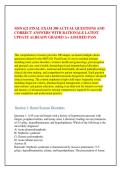
MSN 621 FINAL EXAM 300 ACTUAL QUESTIONS AND
CORRECT ANSWERS WITH RATIONALE LATEST
UPDATE ALREADY GRADED A+ ASSURED PASS
This comprehensive resource provides 300 unique, sectioned multiple-choice
questions tailored for the MSN 621 Final Exam. It covers essential domains
including renal system disorders, women's health and gynecology, preconception
and prenatal care, men's health, hematological and immunological disorders,
respiratory system disorders, maternal and fetal health, advanced pathophysiology,
clinical decision making, and comprehensive patient management. Each question
includes the correct answer and a detailed rationale designed to reinforce advanced
clinical reasoning. The content emphasizes high-yield topics frequently tested,
including diagnostic criteria, pharmacological management, evidence-based
interventions, and patient education, making it an ideal tool for intensive review
and mastery of advanced practice nursing competencies required for successful
exam completion and professional practice.
Section 1: Renal System Disorders
Question 1: A 65-year-old female with a history of hypertension presents with
fatigue, peripheral edema, and foamy urine. Laboratory findings reveal proteinuria
of 4.5 g/day, hypoalbuminemia, and hyperlipidemia. Which of the following is the
most likely diagnosis?
A) Acute glomerulonephritis
B) Nephrotic syndrome
C) Chronic pyelonephritis
D) Acute tubular necrosis
Answer: B
Rationale: Nephrotic syndrome is characterized by massive proteinuria (>3.5
g/day), hypoalbuminemia, edema, and hyperlipidemia. The presentation of foamy
,urine, edema, and proteinuria is classic for this condition, which results from
increased glomerular permeability to proteins.
Question 2: A 72-year-old male with a history of diabetes mellitus type 2 presents
with progressive peripheral edema, fatigue, and nocturia. Laboratory findings show
serum creatinine of 2.8 mg/dL, BUN of 48 mg/dL, and estimated GFR of 25
mL/min/1.73m². Which stage of chronic kidney disease does this represent?
A) Stage 2
B) Stage 3
C) Stage 4
D) Stage 5
Answer: C
Rationale: Chronic kidney disease is staged based on GFR. Stage 4 CKD is defined
as GFR 15-29 mL/min/1.73m². This patient's GFR of 25 mL/min/1.73m² places
them in Stage 4, which represents severe kidney impairment requiring preparation
for renal replacement therapy.
Question 3: A 45-year-old woman presents with sudden onset of flank pain,
nausea, and hematuria. Urinalysis reveals numerous red blood cells and calcium
oxalate crystals. Which of the following is the most likely diagnosis?
A) Urinary tract infection
B) Renal cell carcinoma
C) Nephrolithiasis
D) Glomerulonephritis
Answer: C
Rationale: The classic presentation of nephrolithiasis (kidney stones) includes
acute flank pain (renal colic), nausea, vomiting, and hematuria. The presence of
calcium oxalate crystals on urinalysis is consistent with the most common type of
kidney stone.
Question 4: A 58-year-old male with a history of diabetes presents with worsening
peripheral edema, dyspnea on exertion, and frothy urine. Laboratory findings show
proteinuria of 6.2 g/day and serum albumin of 2.4 g/dL. Which medication is most
appropriate as first-line therapy to reduce proteinuria?
A) Furosemide
B) Lisinopril
C) Metformin
D) Prednisone
Answer: B
,Rationale: ACE inhibitors (like lisinopril) are first-line therapy for diabetic
nephropathy with proteinuria. They reduce intraglomerular pressure, decrease
proteinuria, and slow progression of kidney disease. The mechanism involves
vasodilation of efferent arterioles.
Question 5: A 25-year-old female presents with periorbital edema, tea-colored
urine, and hypertension one week after recovery from a streptococcal pharyngitis.
Laboratory findings show elevated anti-streptolysin O titers and low complement
C3 levels. Which of the following is the most likely diagnosis?
A) IgA nephropathy
B) Post-streptococcal glomerulonephritis
C) Membranous nephropathy
D) Minimal change disease
Answer: B
Rationale: Post-streptococcal glomerulonephritis typically occurs 1-2 weeks after a
group A streptococcal infection, presenting with acute nephritic syndrome
including hematuria (tea-colored urine), edema, hypertension, and decreased urine
output. Low complement C3 levels and elevated ASO titers confirm the diagnosis.
Question 6: A 68-year-old female with a history of polycystic kidney disease
presents with sudden onset of severe headache, nausea, and confusion. Blood
pressure is 210/120 mmHg. Which complication of polycystic kidney disease is
most likely responsible?
A) Subarachnoid hemorrhage
B) Hypertensive encephalopathy
C) Renal failure
D) Migraine
Answer: A
Rationale: Polycystic kidney disease is associated with intracranial berry
aneurysms. Rupture of these aneurysms causes subarachnoid hemorrhage, which
presents with sudden severe headache ("worst headache of life"), nausea, vomiting,
and altered mental status. Hypertension is both a cause and consequence.
Question 7: A 42-year-old male with a history of intravenous drug use presents
with fever, flank pain, and costovertebral angle tenderness. Urinalysis shows WBC
casts and bacteriuria. Which of the following is the most likely diagnosis?
A) Acute cystitis
B) Acute pyelonephritis
C) Glomerulonephritis
D) Nephrolithiasis
, Answer: B
Rationale: Acute pyelonephritis is characterized by fever, flank pain, and
costovertebral angle tenderness. The presence of WBC casts indicates renal
parenchymal involvement. The patient's history of IV drug use increases risk of
hematogenous spread of infection.
Question 8: A 55-year-old female with a history of diabetes and hypertension is
found to have an elevated serum creatinine of 2.2 mg/dL. Her estimated GFR is 32
mL/min. Which of the following medications should be avoided or dose-adjusted?
A) Lisinopril
B) Metformin
C) Atorvastatin
D) Amlodipine
Answer: B
Rationale: Metformin is contraindicated or requires dose adjustment in patients
with renal impairment (GFR < 30 mL/min) due to the risk of lactic acidosis. GFR
of 32 mL/min (Stage 3b CKD) requires reduction in metformin dose and careful
monitoring. ACE inhibitors are actually recommended for renal protection in
CKD.
Question 9: A 30-year-old female presents with acute flank pain, nausea, and
vomiting. She is afebrile. Urinalysis reveals hematuria but no bacteria. Non-
contrast CT shows a 5 mm stone in the proximal ureter. Which of the following is
the most appropriate initial management?
A) Lithotripsy
B) Ureteroscopy with stone extraction
C) Conservative management with hydration and pain control
D) Percutaneous nephrolithotomy
Answer: C
Rationale: Small ureteral stones (<5-6 mm) typically pass spontaneously with
conservative management including adequate hydration, pain control (NSAIDs),
and observation. Alpha-blockers may facilitate passage. Lithotripsy and
ureteroscopy are reserved for larger stones or those that fail to pass.
Question 10: A 70-year-old male with benign prostatic hyperplasia presents with
acute urinary retention. Which of the following is the most appropriate initial
management?
A) Alpha-blocker therapy
B) Urinary catheterization
C) Transurethral resection of the prostate
CORRECT ANSWERS WITH RATIONALE LATEST
UPDATE ALREADY GRADED A+ ASSURED PASS
This comprehensive resource provides 300 unique, sectioned multiple-choice
questions tailored for the MSN 621 Final Exam. It covers essential domains
including renal system disorders, women's health and gynecology, preconception
and prenatal care, men's health, hematological and immunological disorders,
respiratory system disorders, maternal and fetal health, advanced pathophysiology,
clinical decision making, and comprehensive patient management. Each question
includes the correct answer and a detailed rationale designed to reinforce advanced
clinical reasoning. The content emphasizes high-yield topics frequently tested,
including diagnostic criteria, pharmacological management, evidence-based
interventions, and patient education, making it an ideal tool for intensive review
and mastery of advanced practice nursing competencies required for successful
exam completion and professional practice.
Section 1: Renal System Disorders
Question 1: A 65-year-old female with a history of hypertension presents with
fatigue, peripheral edema, and foamy urine. Laboratory findings reveal proteinuria
of 4.5 g/day, hypoalbuminemia, and hyperlipidemia. Which of the following is the
most likely diagnosis?
A) Acute glomerulonephritis
B) Nephrotic syndrome
C) Chronic pyelonephritis
D) Acute tubular necrosis
Answer: B
Rationale: Nephrotic syndrome is characterized by massive proteinuria (>3.5
g/day), hypoalbuminemia, edema, and hyperlipidemia. The presentation of foamy
,urine, edema, and proteinuria is classic for this condition, which results from
increased glomerular permeability to proteins.
Question 2: A 72-year-old male with a history of diabetes mellitus type 2 presents
with progressive peripheral edema, fatigue, and nocturia. Laboratory findings show
serum creatinine of 2.8 mg/dL, BUN of 48 mg/dL, and estimated GFR of 25
mL/min/1.73m². Which stage of chronic kidney disease does this represent?
A) Stage 2
B) Stage 3
C) Stage 4
D) Stage 5
Answer: C
Rationale: Chronic kidney disease is staged based on GFR. Stage 4 CKD is defined
as GFR 15-29 mL/min/1.73m². This patient's GFR of 25 mL/min/1.73m² places
them in Stage 4, which represents severe kidney impairment requiring preparation
for renal replacement therapy.
Question 3: A 45-year-old woman presents with sudden onset of flank pain,
nausea, and hematuria. Urinalysis reveals numerous red blood cells and calcium
oxalate crystals. Which of the following is the most likely diagnosis?
A) Urinary tract infection
B) Renal cell carcinoma
C) Nephrolithiasis
D) Glomerulonephritis
Answer: C
Rationale: The classic presentation of nephrolithiasis (kidney stones) includes
acute flank pain (renal colic), nausea, vomiting, and hematuria. The presence of
calcium oxalate crystals on urinalysis is consistent with the most common type of
kidney stone.
Question 4: A 58-year-old male with a history of diabetes presents with worsening
peripheral edema, dyspnea on exertion, and frothy urine. Laboratory findings show
proteinuria of 6.2 g/day and serum albumin of 2.4 g/dL. Which medication is most
appropriate as first-line therapy to reduce proteinuria?
A) Furosemide
B) Lisinopril
C) Metformin
D) Prednisone
Answer: B
,Rationale: ACE inhibitors (like lisinopril) are first-line therapy for diabetic
nephropathy with proteinuria. They reduce intraglomerular pressure, decrease
proteinuria, and slow progression of kidney disease. The mechanism involves
vasodilation of efferent arterioles.
Question 5: A 25-year-old female presents with periorbital edema, tea-colored
urine, and hypertension one week after recovery from a streptococcal pharyngitis.
Laboratory findings show elevated anti-streptolysin O titers and low complement
C3 levels. Which of the following is the most likely diagnosis?
A) IgA nephropathy
B) Post-streptococcal glomerulonephritis
C) Membranous nephropathy
D) Minimal change disease
Answer: B
Rationale: Post-streptococcal glomerulonephritis typically occurs 1-2 weeks after a
group A streptococcal infection, presenting with acute nephritic syndrome
including hematuria (tea-colored urine), edema, hypertension, and decreased urine
output. Low complement C3 levels and elevated ASO titers confirm the diagnosis.
Question 6: A 68-year-old female with a history of polycystic kidney disease
presents with sudden onset of severe headache, nausea, and confusion. Blood
pressure is 210/120 mmHg. Which complication of polycystic kidney disease is
most likely responsible?
A) Subarachnoid hemorrhage
B) Hypertensive encephalopathy
C) Renal failure
D) Migraine
Answer: A
Rationale: Polycystic kidney disease is associated with intracranial berry
aneurysms. Rupture of these aneurysms causes subarachnoid hemorrhage, which
presents with sudden severe headache ("worst headache of life"), nausea, vomiting,
and altered mental status. Hypertension is both a cause and consequence.
Question 7: A 42-year-old male with a history of intravenous drug use presents
with fever, flank pain, and costovertebral angle tenderness. Urinalysis shows WBC
casts and bacteriuria. Which of the following is the most likely diagnosis?
A) Acute cystitis
B) Acute pyelonephritis
C) Glomerulonephritis
D) Nephrolithiasis
, Answer: B
Rationale: Acute pyelonephritis is characterized by fever, flank pain, and
costovertebral angle tenderness. The presence of WBC casts indicates renal
parenchymal involvement. The patient's history of IV drug use increases risk of
hematogenous spread of infection.
Question 8: A 55-year-old female with a history of diabetes and hypertension is
found to have an elevated serum creatinine of 2.2 mg/dL. Her estimated GFR is 32
mL/min. Which of the following medications should be avoided or dose-adjusted?
A) Lisinopril
B) Metformin
C) Atorvastatin
D) Amlodipine
Answer: B
Rationale: Metformin is contraindicated or requires dose adjustment in patients
with renal impairment (GFR < 30 mL/min) due to the risk of lactic acidosis. GFR
of 32 mL/min (Stage 3b CKD) requires reduction in metformin dose and careful
monitoring. ACE inhibitors are actually recommended for renal protection in
CKD.
Question 9: A 30-year-old female presents with acute flank pain, nausea, and
vomiting. She is afebrile. Urinalysis reveals hematuria but no bacteria. Non-
contrast CT shows a 5 mm stone in the proximal ureter. Which of the following is
the most appropriate initial management?
A) Lithotripsy
B) Ureteroscopy with stone extraction
C) Conservative management with hydration and pain control
D) Percutaneous nephrolithotomy
Answer: C
Rationale: Small ureteral stones (<5-6 mm) typically pass spontaneously with
conservative management including adequate hydration, pain control (NSAIDs),
and observation. Alpha-blockers may facilitate passage. Lithotripsy and
ureteroscopy are reserved for larger stones or those that fail to pass.
Question 10: A 70-year-old male with benign prostatic hyperplasia presents with
acute urinary retention. Which of the following is the most appropriate initial
management?
A) Alpha-blocker therapy
B) Urinary catheterization
C) Transurethral resection of the prostate


