
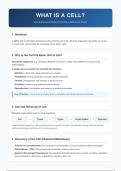
WHAT IS A CELL?
Comprehensive Study & Summary Reference Sheet
1. Definition
A cell is the fundamental structural and functional unit of life. All living organisms are made up of one
or more cells, and all vital life processes occur within cells.
2. Why is the Cell the Basic Unit of Life?
Unicellular organisms (e.g., Amoeba, Bacteria) consist of a single cell capable of carrying out life
independently.
A single cell can perform all essential life functions:
• Nutrition: Intake and intake processing of nutrients
• Respiration: Energy production through cellular processes
• Growth: Development and increase in structural size
• Excretion: Removal of metabolic waste products
• Reproduction: Cell division and passing on genetic information
Key Principle: Any structure smaller than a complete cell cannot survive on its own.
3. Cell and Hierarchy of Life
Biological organization levels in living organisms:
Cell → Tissue → Organ → Organ System → Organism
In multicellular organisms, cells are specialized for specific functions. Coordination among cells ensures the
survival and proper functioning of the entire organism.
4. Discovery of the Cell (Historical Milestones)
• Antonie van Leeuwenhoek: First to observe and describe a living cell using a simple microscope.
• Robert Brown (1831): Discovered and named the nucleus in plant cells.
• Electron Microscope Development: Revealed the detailed ultrastructure of cells, including organelles
like mitochondria, ribosomes, endoplasmic reticulum (ER), etc.
Comprehensive Study & Summary Reference Sheet
1. Definition
A cell is the fundamental structural and functional unit of life. All living organisms are made up of one
or more cells, and all vital life processes occur within cells.
2. Why is the Cell the Basic Unit of Life?
Unicellular organisms (e.g., Amoeba, Bacteria) consist of a single cell capable of carrying out life
independently.
A single cell can perform all essential life functions:
• Nutrition: Intake and intake processing of nutrients
• Respiration: Energy production through cellular processes
• Growth: Development and increase in structural size
• Excretion: Removal of metabolic waste products
• Reproduction: Cell division and passing on genetic information
Key Principle: Any structure smaller than a complete cell cannot survive on its own.
3. Cell and Hierarchy of Life
Biological organization levels in living organisms:
Cell → Tissue → Organ → Organ System → Organism
In multicellular organisms, cells are specialized for specific functions. Coordination among cells ensures the
survival and proper functioning of the entire organism.
4. Discovery of the Cell (Historical Milestones)
• Antonie van Leeuwenhoek: First to observe and describe a living cell using a simple microscope.
• Robert Brown (1831): Discovered and named the nucleus in plant cells.
• Electron Microscope Development: Revealed the detailed ultrastructure of cells, including organelles
like mitochondria, ribosomes, endoplasmic reticulum (ER), etc.



