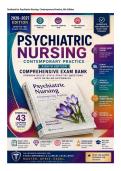
Testbank for Psychiatric Nursing: Contemporary Practice, 8th Edition
, Comprehensive Table of Contents
Psychiatric Nursing: Contemporary Practice, 8th Edition
Comprehensive Exam Bank
860 Premium NCLEX®-Style Practice Questions with Detailed Rationales
Evidence-Based Psychiatric Nursing Review & Clinical Judgment Preparation
Part I — Foundations of Contemporary Psychiatric–Mental Health Nursing
Chapter 1
Psychiatric–Mental Health Nursing and Evidence-Based Practice
Chapter 2
Mental Health and Mental Disorders: Fighting Stigma and Promoting Recovery
Chapter 3
Cultural Communities, Gender, and Spiritual Considerations Related to Mental Health Care
Chapter 4
Nursing Ethics, Patient Rights, and Legal Issues
Chapter 5
Mental Health Care in the Community
Part II — Scientific Foundations of Psychiatric Nursing Practice
Chapter 6
Psychosocial-Spiritual Basis of Psychiatatric Nursing
Chapter 7
Biologic Foundations of Psychiatric Nursing
Chapter 8
Recovery Framework for Psychiatric–Mental Health Nursing
Chapter 9
Communication and the Therapeutic Relationship
Chapter 10
Clinical Judgment Nursing Care Planning in Psychiatric–Mental Health
Part III — Therapeutic Interventions
,Chapter 11
Psychopharmacology and Biologic Interventions
Chapter 12
Cognitive Interventions in Psychiatric Nursing
Chapter 13
Group Intervention
Chapter 14
Family Assessment and Interventions
Part IV — Mental Health Promotion Across the Lifespan
Chapter 15
Mental Health Promotion for Children and Adolescents
Chapter 16
Mental Health Promotion for Young and Middle-Aged Adults
Chapter 17
Mental Health Promotion for Older Adults
Part V — Crisis, Stress, and Safety Management
Chapter 18
Stress and Mental Health
Chapter 19
Management of Anger, Aggression, and Violence
Chapter 20
Crisis Intervention, Loss, Grief, Bereavement, and Disaster Response
Chapter 21
Suicide Prevention: Screening, Assessment, and Intervention
Chapter 22
Mental Health Care for Survivors of Violence
Part VI — Major Psychiatric Disorders
Chapter 23
Schizophrenia Spectrum and Related Disorders
,Chapter 24
Depressive Disorders
Chapter 25
Bipolar and Related Disorders
Chapter 26
Anxiety Disorders
Chapter 27
Obsessive-Compulsive and Related Disorders
Chapter 28
Trauma- and Stressor-Related Disorders
Chapter 29
Personality Disorders and Disruptive, Impulse-Control, and Conduct Disorders
Chapter 30
Substance Use and Addictive Disorders
Chapter 31
Eating Disorders
Chapter 32
Somatic Symptom and Dissociative Disorders
Chapter 33
Sleep–Wake Disorders
Chapter 34
Sexual Disorders and Gender-Related Concerns
Part VII — Psychiatric Nursing Care for Special Populations
Chapter 35
Mental Health Assessment of Children and Adolescents
Chapter 36
Mental Disorders of Childhood and Adolescence
Chapter 37
Mental Health Assessment of Older Adults
Chapter 38
Neurocognitive Disorders
Chapter 39
Mental Health Care for Veterans
,Chapter 40
Caring for Persons Experiencing Homelessness and Mental Illness
Chapter 41
Caring for Persons with Co-Occurring Mental Disorders
Part VIII — Integrated Mental Health Care
Chapter 42
Mental Health Care During Medical Illness
Chapter 43
Caring for Persons with Selected Medical Disorders and Mental Health Needs
Premium Exam Features
• 860 Premium NCLEX®-Style Multiple-Choice Questions (A–D)
• Covers all 43 chapters of Psychiatric Nursing: Contemporary Practice, 8th Edition
• Clinical Judgment and Next-Generation NCLEX® (NGN) style scenarios
• Evidence-Based Practice integrated throughout
• Comprehensive Detailed Rationales for every correct answer
• Explanations of why the remaining options are incorrect
• Clinical Pearl for every question
• Psychiatric Nursing High-Yield Tip included throughout
• Evidence-Based Practice Note with every question
• Critical-thinking question stems with varied openings
• Evenly balanced and randomized A–D answer distribution
• Recovery-oriented, trauma-informed, and culturally responsive nursing emphasis
• Ideal for NCLEX-RN®, HESI®, ATI®, PMH-BC®, psychiatric nursing exams, course examinations, and
comprehensive final review
Exam Specifications
,Feature Details
Edition Psychiatric Nursing: Contemporary Practice, 8th Edition
Total Chapters 43
Total Questions 860
Question Format Multiple Choice (A–D)
Difficulty Level Moderate to Advanced
Question Style NCLEX® & Clinical Judgment
Answer Key Included
Detailed Rationales Included
Clinical Pearls Included
Psychiatric Nursing High-Yield Tips Included
Evidence-Based Practice Notes Included
Coverage Complete Textbook Review
Chapter 1: Psychiatric–Mental Health Nursing and Evidence-Based Practice
Question 1
During an interdisciplinary review, the team considers replacing a long-standing unit intervention with a newer
approach supported by several high-quality studies. One patient, however, strongly prefers the current
intervention because it has worked well in the past. Which action best reflects evidence-based psychiatric
nursing practice?
A. Replace the intervention immediately because research evidence takes priority over individual preferences
B. Continue the older intervention because patient preference should always override research findings
C. Allow the psychiatrist to decide because evidence-based treatment decisions are outside the nursing role
D. Integrate the strongest available evidence with clinical expertise and the patient's informed preferences
Correct Answer: D
Detailed Rationale
Evidence-based practice is not simply the application of research findings. It involves the thoughtful integration
of best current evidence, clinical expertise, and the patient's values, preferences, culture, and individual
,circumstances. In psychiatric nursing, this approach is especially important because therapeutic engagement
and shared decision-making can strongly influence adherence and recovery.
The nurse should help the patient understand the benefits, limitations, and alternatives associated with the
newer intervention while also recognizing the patient's prior positive experience. A collaborative treatment
decision is therefore more consistent with evidence-based and recovery-oriented care than automatically
choosing either the newest research finding or the patient's preference in isolation.
Why the Other Options Are Incorrect
• A: Research evidence is important, but applying it without considering the patient's circumstances and
preferences is not true evidence-based practice.
• B: Patient preferences are essential, but they should be considered alongside safety, clinical expertise,
and available evidence.
• C: Psychiatric nurses play an active role in evidence appraisal, patient education, treatment planning,
implementation, and evaluation.
Clinical Pearl
Evidence-based psychiatric care is a three-part integration: research evidence + clinical expertise + patient
values/preferences.
Psychiatric Nursing High-Yield Tip
When an exam question asks what best represents EBP, choose the response that combines evidence,
professional judgment, and individualized patient preferences.
Evidence-Based Practice Note
Shared decision-making is increasingly emphasized in mental health care because it supports patient
engagement, autonomy, treatment adherence, and recovery-oriented outcomes.
Question 2
While evaluating a newly admitted patient's care plan, a psychiatric nurse notices that one intervention has
been used on the unit for years but cannot identify current evidence supporting it. What is the nurse's best
next action?
A. Continue using the intervention because established routines should not be questioned
B. Formulate a focused clinical question and search for current evidence regarding the intervention
C. Remove the intervention immediately before consulting other clinicians
D. Wait until the hospital administration reviews the practice
Correct Answer: B
Detailed Rationale
,When practice appears to be based primarily on tradition rather than current evidence, the nurse should begin
the evidence-based practice process by identifying the clinical concern and developing a focused, searchable
clinical question. A commonly used method is PICO: Patient/Population, Intervention, Comparison, and
Outcome.
The nurse would then search reliable sources, critically appraise the evidence, and collaborate with the
healthcare team before recommending a change in practice. Psychiatric nursing standards encourage nurses to
question practices that may no longer represent the safest or most effective care.
Why the Other Options Are Incorrect
• A: Longevity of a practice does not establish effectiveness or safety.
• C: Practice changes should not be made abruptly without evaluation, collaboration, and appropriate
approval.
• D: Nurses have professional responsibility for evidence-based improvement and need not wait
passively for administrators.
Clinical Pearl
"That's how we've always done it" is a signal to examine whether a practice remains evidence-based.
Psychiatric Nursing High-Yield Tip
The first EBP step after identifying a clinical problem is usually to develop a focused clinical question.
Evidence-Based Practice Note
Structured clinical questions improve literature searches by narrowing the population, intervention,
comparison, and desired outcome.
Question 3
Following several weeks of treatment, a patient with a serious mental illness continues to experience some
symptoms but has returned to school, manages medications independently, and reports feeling hopeful about
the future. Which interpretation by the psychiatric nurse is most appropriate?
A. The patient is demonstrating meaningful recovery despite persistent symptoms
B. Recovery cannot occur until all psychiatric symptoms disappear
C. The treatment plan has failed because symptoms remain
D. Independence should be discouraged until complete remission occurs
Correct Answer: A
Detailed Rationale
,Contemporary psychiatric nursing defines recovery more broadly than symptom elimination. Recovery is a
personal process of developing hope, meaning, self-direction, functioning, and participation in valued life
roles, even when some symptoms remain.
Returning to school, managing medications, and expressing hope indicate improved functioning and self-
efficacy. These are important recovery outcomes. The psychiatric nurse should reinforce these strengths while
continuing to monitor symptoms and support further progress.
Why the Other Options Are Incorrect
• B: Symptom remission may occur, but it is not required for a person to experience meaningful recovery.
• C: Persistent symptoms alone do not prove treatment failure when functioning and quality of life have
improved.
• D: Recovery-oriented care promotes appropriate independence rather than unnecessary dependency.
Clinical Pearl
Recovery asks, "How can this person live a meaningful life?" rather than only, "Have all symptoms
disappeared?"
Psychiatric Nursing High-Yield Tip
On psychiatric exams, recovery = hope + autonomy + meaningful functioning, not necessarily total symptom
elimination.
Evidence-Based Practice Note
Recovery-oriented mental health systems emphasize personal goals, strengths, community participation, self-
management, and shared decision-making.
Question 4
A quality-improvement committee reports that patients on an inpatient psychiatric unit frequently experience
distress during restrictive interventions. Which proposed change most closely reflects contemporary evidence-
based psychiatric care?
A. Increase use of restraints before aggressive behavior develops
B. Use seclusion whenever verbal de-escalation takes more than several minutes
C. Strengthen trauma-informed prevention, early de-escalation, and least-restrictive interventions
D. Restrict patient participation in treatment planning during periods of agitation
Correct Answer: C
Detailed Rationale
, Contemporary psychiatric nursing emphasizes prevention of coercive interventions through trauma-informed
care, early recognition of escalation, therapeutic communication, environmental modification, collaborative
safety planning, and verbal de-escalation.
Restrictive interventions such as restraint and seclusion should generally be reserved for situations involving
immediate safety concerns when less restrictive measures have failed or are inappropriate. Because restrictive
interventions can contribute to psychological distress and potential physical harm, psychiatric nurses should
prioritize the least restrictive effective intervention.
Why the Other Options Are Incorrect
• A: Preventive restraint is inconsistent with least-restrictive practice and may increase distress or
trauma.
• B: Seclusion should not be used simply because de-escalation requires time.
• D: Whenever clinically feasible, patient participation should be preserved because collaboration can
reduce conflict and support recovery.
Clinical Pearl
The safest psychiatric intervention is usually the least restrictive intervention capable of maintaining safety.
Psychiatric Nursing High-Yield Tip
For questions involving escalating behavior, think: assess → reduce stimulation → communicate calmly → de-
escalate → use restrictive measures only when necessary for safety.
Evidence-Based Practice Note
Programs emphasizing trauma-informed care, staff education, individualized crisis planning, and structured de-
escalation have been associated with reductions in restrictive intervention use.
Question 5
Before adopting a new screening instrument for depression, the nurse manager asks staff to determine
whether the tool consistently measures depressive symptoms and accurately identifies the condition it claims
to assess. Which characteristics are being evaluated?
A. Feasibility and cost
B. Sensitivity and staffing requirements only
C. Reliability and validity
D. Patient satisfaction and reimbursement
Correct Answer: C
Detailed Rationale
, Comprehensive Table of Contents
Psychiatric Nursing: Contemporary Practice, 8th Edition
Comprehensive Exam Bank
860 Premium NCLEX®-Style Practice Questions with Detailed Rationales
Evidence-Based Psychiatric Nursing Review & Clinical Judgment Preparation
Part I — Foundations of Contemporary Psychiatric–Mental Health Nursing
Chapter 1
Psychiatric–Mental Health Nursing and Evidence-Based Practice
Chapter 2
Mental Health and Mental Disorders: Fighting Stigma and Promoting Recovery
Chapter 3
Cultural Communities, Gender, and Spiritual Considerations Related to Mental Health Care
Chapter 4
Nursing Ethics, Patient Rights, and Legal Issues
Chapter 5
Mental Health Care in the Community
Part II — Scientific Foundations of Psychiatric Nursing Practice
Chapter 6
Psychosocial-Spiritual Basis of Psychiatatric Nursing
Chapter 7
Biologic Foundations of Psychiatric Nursing
Chapter 8
Recovery Framework for Psychiatric–Mental Health Nursing
Chapter 9
Communication and the Therapeutic Relationship
Chapter 10
Clinical Judgment Nursing Care Planning in Psychiatric–Mental Health
Part III — Therapeutic Interventions
,Chapter 11
Psychopharmacology and Biologic Interventions
Chapter 12
Cognitive Interventions in Psychiatric Nursing
Chapter 13
Group Intervention
Chapter 14
Family Assessment and Interventions
Part IV — Mental Health Promotion Across the Lifespan
Chapter 15
Mental Health Promotion for Children and Adolescents
Chapter 16
Mental Health Promotion for Young and Middle-Aged Adults
Chapter 17
Mental Health Promotion for Older Adults
Part V — Crisis, Stress, and Safety Management
Chapter 18
Stress and Mental Health
Chapter 19
Management of Anger, Aggression, and Violence
Chapter 20
Crisis Intervention, Loss, Grief, Bereavement, and Disaster Response
Chapter 21
Suicide Prevention: Screening, Assessment, and Intervention
Chapter 22
Mental Health Care for Survivors of Violence
Part VI — Major Psychiatric Disorders
Chapter 23
Schizophrenia Spectrum and Related Disorders
,Chapter 24
Depressive Disorders
Chapter 25
Bipolar and Related Disorders
Chapter 26
Anxiety Disorders
Chapter 27
Obsessive-Compulsive and Related Disorders
Chapter 28
Trauma- and Stressor-Related Disorders
Chapter 29
Personality Disorders and Disruptive, Impulse-Control, and Conduct Disorders
Chapter 30
Substance Use and Addictive Disorders
Chapter 31
Eating Disorders
Chapter 32
Somatic Symptom and Dissociative Disorders
Chapter 33
Sleep–Wake Disorders
Chapter 34
Sexual Disorders and Gender-Related Concerns
Part VII — Psychiatric Nursing Care for Special Populations
Chapter 35
Mental Health Assessment of Children and Adolescents
Chapter 36
Mental Disorders of Childhood and Adolescence
Chapter 37
Mental Health Assessment of Older Adults
Chapter 38
Neurocognitive Disorders
Chapter 39
Mental Health Care for Veterans
,Chapter 40
Caring for Persons Experiencing Homelessness and Mental Illness
Chapter 41
Caring for Persons with Co-Occurring Mental Disorders
Part VIII — Integrated Mental Health Care
Chapter 42
Mental Health Care During Medical Illness
Chapter 43
Caring for Persons with Selected Medical Disorders and Mental Health Needs
Premium Exam Features
• 860 Premium NCLEX®-Style Multiple-Choice Questions (A–D)
• Covers all 43 chapters of Psychiatric Nursing: Contemporary Practice, 8th Edition
• Clinical Judgment and Next-Generation NCLEX® (NGN) style scenarios
• Evidence-Based Practice integrated throughout
• Comprehensive Detailed Rationales for every correct answer
• Explanations of why the remaining options are incorrect
• Clinical Pearl for every question
• Psychiatric Nursing High-Yield Tip included throughout
• Evidence-Based Practice Note with every question
• Critical-thinking question stems with varied openings
• Evenly balanced and randomized A–D answer distribution
• Recovery-oriented, trauma-informed, and culturally responsive nursing emphasis
• Ideal for NCLEX-RN®, HESI®, ATI®, PMH-BC®, psychiatric nursing exams, course examinations, and
comprehensive final review
Exam Specifications
,Feature Details
Edition Psychiatric Nursing: Contemporary Practice, 8th Edition
Total Chapters 43
Total Questions 860
Question Format Multiple Choice (A–D)
Difficulty Level Moderate to Advanced
Question Style NCLEX® & Clinical Judgment
Answer Key Included
Detailed Rationales Included
Clinical Pearls Included
Psychiatric Nursing High-Yield Tips Included
Evidence-Based Practice Notes Included
Coverage Complete Textbook Review
Chapter 1: Psychiatric–Mental Health Nursing and Evidence-Based Practice
Question 1
During an interdisciplinary review, the team considers replacing a long-standing unit intervention with a newer
approach supported by several high-quality studies. One patient, however, strongly prefers the current
intervention because it has worked well in the past. Which action best reflects evidence-based psychiatric
nursing practice?
A. Replace the intervention immediately because research evidence takes priority over individual preferences
B. Continue the older intervention because patient preference should always override research findings
C. Allow the psychiatrist to decide because evidence-based treatment decisions are outside the nursing role
D. Integrate the strongest available evidence with clinical expertise and the patient's informed preferences
Correct Answer: D
Detailed Rationale
Evidence-based practice is not simply the application of research findings. It involves the thoughtful integration
of best current evidence, clinical expertise, and the patient's values, preferences, culture, and individual
,circumstances. In psychiatric nursing, this approach is especially important because therapeutic engagement
and shared decision-making can strongly influence adherence and recovery.
The nurse should help the patient understand the benefits, limitations, and alternatives associated with the
newer intervention while also recognizing the patient's prior positive experience. A collaborative treatment
decision is therefore more consistent with evidence-based and recovery-oriented care than automatically
choosing either the newest research finding or the patient's preference in isolation.
Why the Other Options Are Incorrect
• A: Research evidence is important, but applying it without considering the patient's circumstances and
preferences is not true evidence-based practice.
• B: Patient preferences are essential, but they should be considered alongside safety, clinical expertise,
and available evidence.
• C: Psychiatric nurses play an active role in evidence appraisal, patient education, treatment planning,
implementation, and evaluation.
Clinical Pearl
Evidence-based psychiatric care is a three-part integration: research evidence + clinical expertise + patient
values/preferences.
Psychiatric Nursing High-Yield Tip
When an exam question asks what best represents EBP, choose the response that combines evidence,
professional judgment, and individualized patient preferences.
Evidence-Based Practice Note
Shared decision-making is increasingly emphasized in mental health care because it supports patient
engagement, autonomy, treatment adherence, and recovery-oriented outcomes.
Question 2
While evaluating a newly admitted patient's care plan, a psychiatric nurse notices that one intervention has
been used on the unit for years but cannot identify current evidence supporting it. What is the nurse's best
next action?
A. Continue using the intervention because established routines should not be questioned
B. Formulate a focused clinical question and search for current evidence regarding the intervention
C. Remove the intervention immediately before consulting other clinicians
D. Wait until the hospital administration reviews the practice
Correct Answer: B
Detailed Rationale
,When practice appears to be based primarily on tradition rather than current evidence, the nurse should begin
the evidence-based practice process by identifying the clinical concern and developing a focused, searchable
clinical question. A commonly used method is PICO: Patient/Population, Intervention, Comparison, and
Outcome.
The nurse would then search reliable sources, critically appraise the evidence, and collaborate with the
healthcare team before recommending a change in practice. Psychiatric nursing standards encourage nurses to
question practices that may no longer represent the safest or most effective care.
Why the Other Options Are Incorrect
• A: Longevity of a practice does not establish effectiveness or safety.
• C: Practice changes should not be made abruptly without evaluation, collaboration, and appropriate
approval.
• D: Nurses have professional responsibility for evidence-based improvement and need not wait
passively for administrators.
Clinical Pearl
"That's how we've always done it" is a signal to examine whether a practice remains evidence-based.
Psychiatric Nursing High-Yield Tip
The first EBP step after identifying a clinical problem is usually to develop a focused clinical question.
Evidence-Based Practice Note
Structured clinical questions improve literature searches by narrowing the population, intervention,
comparison, and desired outcome.
Question 3
Following several weeks of treatment, a patient with a serious mental illness continues to experience some
symptoms but has returned to school, manages medications independently, and reports feeling hopeful about
the future. Which interpretation by the psychiatric nurse is most appropriate?
A. The patient is demonstrating meaningful recovery despite persistent symptoms
B. Recovery cannot occur until all psychiatric symptoms disappear
C. The treatment plan has failed because symptoms remain
D. Independence should be discouraged until complete remission occurs
Correct Answer: A
Detailed Rationale
,Contemporary psychiatric nursing defines recovery more broadly than symptom elimination. Recovery is a
personal process of developing hope, meaning, self-direction, functioning, and participation in valued life
roles, even when some symptoms remain.
Returning to school, managing medications, and expressing hope indicate improved functioning and self-
efficacy. These are important recovery outcomes. The psychiatric nurse should reinforce these strengths while
continuing to monitor symptoms and support further progress.
Why the Other Options Are Incorrect
• B: Symptom remission may occur, but it is not required for a person to experience meaningful recovery.
• C: Persistent symptoms alone do not prove treatment failure when functioning and quality of life have
improved.
• D: Recovery-oriented care promotes appropriate independence rather than unnecessary dependency.
Clinical Pearl
Recovery asks, "How can this person live a meaningful life?" rather than only, "Have all symptoms
disappeared?"
Psychiatric Nursing High-Yield Tip
On psychiatric exams, recovery = hope + autonomy + meaningful functioning, not necessarily total symptom
elimination.
Evidence-Based Practice Note
Recovery-oriented mental health systems emphasize personal goals, strengths, community participation, self-
management, and shared decision-making.
Question 4
A quality-improvement committee reports that patients on an inpatient psychiatric unit frequently experience
distress during restrictive interventions. Which proposed change most closely reflects contemporary evidence-
based psychiatric care?
A. Increase use of restraints before aggressive behavior develops
B. Use seclusion whenever verbal de-escalation takes more than several minutes
C. Strengthen trauma-informed prevention, early de-escalation, and least-restrictive interventions
D. Restrict patient participation in treatment planning during periods of agitation
Correct Answer: C
Detailed Rationale
, Contemporary psychiatric nursing emphasizes prevention of coercive interventions through trauma-informed
care, early recognition of escalation, therapeutic communication, environmental modification, collaborative
safety planning, and verbal de-escalation.
Restrictive interventions such as restraint and seclusion should generally be reserved for situations involving
immediate safety concerns when less restrictive measures have failed or are inappropriate. Because restrictive
interventions can contribute to psychological distress and potential physical harm, psychiatric nurses should
prioritize the least restrictive effective intervention.
Why the Other Options Are Incorrect
• A: Preventive restraint is inconsistent with least-restrictive practice and may increase distress or
trauma.
• B: Seclusion should not be used simply because de-escalation requires time.
• D: Whenever clinically feasible, patient participation should be preserved because collaboration can
reduce conflict and support recovery.
Clinical Pearl
The safest psychiatric intervention is usually the least restrictive intervention capable of maintaining safety.
Psychiatric Nursing High-Yield Tip
For questions involving escalating behavior, think: assess → reduce stimulation → communicate calmly → de-
escalate → use restrictive measures only when necessary for safety.
Evidence-Based Practice Note
Programs emphasizing trauma-informed care, staff education, individualized crisis planning, and structured de-
escalation have been associated with reductions in restrictive intervention use.
Question 5
Before adopting a new screening instrument for depression, the nurse manager asks staff to determine
whether the tool consistently measures depressive symptoms and accurately identifies the condition it claims
to assess. Which characteristics are being evaluated?
A. Feasibility and cost
B. Sensitivity and staffing requirements only
C. Reliability and validity
D. Patient satisfaction and reimbursement
Correct Answer: C
Detailed Rationale