Page 1 of 116
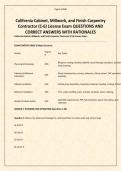
California Cabinet, Millwork, and Finish Carpentry
Contractor (C-6) License Exam QUESTIONS AND
CORRECT ANSWERS WITH RATIONALES
California Cabinet, Millwork, and Finish Carpentry Contractor (C-6) License Exam –
EXAM CONTENT AREAS (5 Major Sections)
Approx.
Section Key Topics
%
Blueprint reading, material takeoffs, board footage calculation, job plan
Planning & Estimating 20%
shop drawings
Cabinetry & Millwork Wood characteristics, joinery, adhesives, 32mm system, CNC operations
24%
Fabrication assembly
Cabinet Installation 25% Jobsite prep, demolition, hazardous materials, leveling, scribing, finishin
Millwork Installation 16% Trim, crown molding, stairs, mantels, windows, doors, refacing
Cal/OSHA requirements, PPE, fall protection, power tool safety, dust
Worker & Jobsite Safety 15%
collection
DOMAIN 1: PLANNING AND ESTIMATING (Questions 1-50)
Question 1: What is the total board footage for a 4/4 board that is 6 inches wide and 12 feet long?
A) 4 bd. ft.
B) 6 bd. ft.
C) 8 bd. ft.
D) 12 bd. ft.
, Page 2 of 116
Correct Answer: B
Rationale: Board footage = (Thickness in inches × Width in inches × Length in feet) ÷ 12. For 4/4 = 1 inch
thick: (1 × 6 × 12) ÷ 12 = 6 board feet.
Question 2: A contractor needs to estimate the cost of 15 custom drawers. Each drawer requires two
pairs of slides at $12.00 per pair and one pull at $4.50. What is the total hardware cost for all drawers?
A) $247.50
B) $360.00
C) $427.50
D) $495.00
Correct Answer: C
Rationale: Per drawer: 2 pairs × $12 = $24 + $4.50 = $28.50. 15 drawers × $28.50 = $427.50.
Question 3: When estimating labor for cabinet installation, what is the most important factor to
consider?
A) The number of cabinets
B) The complexity of the installation and site conditions
C) The color of the cabinets
D) The brand of hardware specified
, Page 3 of 116
Correct Answer: B
Rationale: Installation labor is most affected by complexity—including wall conditions, accessibility,
custom features, and required adjustments—not simply the quantity of cabinets.
Question 4: Which document provides the dimensional layout for cabinet placement?
A) Specification sheet
B) Shop drawing
C) Material safety data sheet (MSDS)
D) Warranty certificate
Correct Answer: B
Rationale: Shop drawings detail the exact dimensions, elevations, and locations for cabinets, guiding
both fabrication and installation.
Question 5: What is the standard allowance for waste when estimating sheet goods like plywood?
A) 0-5%
B) 10-15%
C) 25-30%
D) 50%
, Page 4 of 116
Correct Answer: B
Rationale: Industry standard waste allowance for sheet goods is typically 10-15% to account for defects,
cutting errors, and grain matching requirements.
Question 6: A project requires 3/4" × 3" oak trim for 85 linear feet. The trim costs $2.75 per linear foot.
What is the material cost before tax?
A) $187.50
B) $233.75
C) $255.00
D) $280.50
Correct Answer: B
Rationale: 85 linear feet × $2.75 = $233.75.
Question 7: What does the term "allowance" mean in a construction contract?
A) An amount the contractor is allowed to spend without approval
B) A budgeted amount for items not yet selected
C) A discount given to the owner
D) The time allowed for completion
California Cabinet, Millwork, and Finish Carpentry
Contractor (C-6) License Exam QUESTIONS AND
CORRECT ANSWERS WITH RATIONALES
California Cabinet, Millwork, and Finish Carpentry Contractor (C-6) License Exam –
EXAM CONTENT AREAS (5 Major Sections)
Approx.
Section Key Topics
%
Blueprint reading, material takeoffs, board footage calculation, job plan
Planning & Estimating 20%
shop drawings
Cabinetry & Millwork Wood characteristics, joinery, adhesives, 32mm system, CNC operations
24%
Fabrication assembly
Cabinet Installation 25% Jobsite prep, demolition, hazardous materials, leveling, scribing, finishin
Millwork Installation 16% Trim, crown molding, stairs, mantels, windows, doors, refacing
Cal/OSHA requirements, PPE, fall protection, power tool safety, dust
Worker & Jobsite Safety 15%
collection
DOMAIN 1: PLANNING AND ESTIMATING (Questions 1-50)
Question 1: What is the total board footage for a 4/4 board that is 6 inches wide and 12 feet long?
A) 4 bd. ft.
B) 6 bd. ft.
C) 8 bd. ft.
D) 12 bd. ft.
, Page 2 of 116
Correct Answer: B
Rationale: Board footage = (Thickness in inches × Width in inches × Length in feet) ÷ 12. For 4/4 = 1 inch
thick: (1 × 6 × 12) ÷ 12 = 6 board feet.
Question 2: A contractor needs to estimate the cost of 15 custom drawers. Each drawer requires two
pairs of slides at $12.00 per pair and one pull at $4.50. What is the total hardware cost for all drawers?
A) $247.50
B) $360.00
C) $427.50
D) $495.00
Correct Answer: C
Rationale: Per drawer: 2 pairs × $12 = $24 + $4.50 = $28.50. 15 drawers × $28.50 = $427.50.
Question 3: When estimating labor for cabinet installation, what is the most important factor to
consider?
A) The number of cabinets
B) The complexity of the installation and site conditions
C) The color of the cabinets
D) The brand of hardware specified
, Page 3 of 116
Correct Answer: B
Rationale: Installation labor is most affected by complexity—including wall conditions, accessibility,
custom features, and required adjustments—not simply the quantity of cabinets.
Question 4: Which document provides the dimensional layout for cabinet placement?
A) Specification sheet
B) Shop drawing
C) Material safety data sheet (MSDS)
D) Warranty certificate
Correct Answer: B
Rationale: Shop drawings detail the exact dimensions, elevations, and locations for cabinets, guiding
both fabrication and installation.
Question 5: What is the standard allowance for waste when estimating sheet goods like plywood?
A) 0-5%
B) 10-15%
C) 25-30%
D) 50%
, Page 4 of 116
Correct Answer: B
Rationale: Industry standard waste allowance for sheet goods is typically 10-15% to account for defects,
cutting errors, and grain matching requirements.
Question 6: A project requires 3/4" × 3" oak trim for 85 linear feet. The trim costs $2.75 per linear foot.
What is the material cost before tax?
A) $187.50
B) $233.75
C) $255.00
D) $280.50
Correct Answer: B
Rationale: 85 linear feet × $2.75 = $233.75.
Question 7: What does the term "allowance" mean in a construction contract?
A) An amount the contractor is allowed to spend without approval
B) A budgeted amount for items not yet selected
C) A discount given to the owner
D) The time allowed for completion