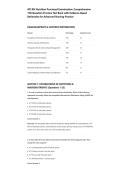
ATI RN Nutrition Proctored Examination: Comprehensive
150-Question Practice Test Bank with Evidence-Based
Rationales for Advanced Nursing Practice
EXAM BLUEPRINT & CONTENT DISTRIBUTION
Domain Percentage Question Count
Foundations of Nutrition & Macronutrients 15% 23
Vitamins, Minerals & Deficiencies 15% 23
Therapeutic Diets & Chronic Disease Management 20% 30
Enteral & Parenteral Nutrition 10% 15
Nutrition Across the Lifespan 15% 22
Fluid & Electrolyte Balance 10% 15
Medication & Nutrient Interactions 8% 12
Cultural, Religious & Ethical Dietary Considerations 7% 10
SECTION 1: FOUNDATIONS OF NUTRITION &
MACRONUTRIENTS (Questions 1-23)
1. A nurse is teaching a client about macronutrient distribution. Which of the following
statements accurately reflects the Acceptable Macronutrient Distribution Range (AMDR) for
carbohydrates?
A) 10-20% of total daily calories
B) 25-35% of total daily calories
C) 45-65% of total daily calories
D) 70-80% of total daily calories
Correct Answer: C
Rationale: The Acceptable Macronutrient Distribution Range (AMDR) for carbohydrates is 45-
65% of total daily calories. Carbohydrates are the body's primary energy source. The AMDR for
protein is 10-35%, and for fats is 20-35% of total daily calories.
2. A client asks the nurse which macronutrient provides the most energy per gram. How
should the nurse respond?
A) "Carbohydrates provide 4 kcal per gram."
B) "Proteins provide 4 kcal per gram."
C) "Fats provide 9 kcal per gram."
D) "Alcohol provides 7 kcal per gram."
Correct Answer: C
,Rationale: Fats provide 9 kcal/g, the highest energy density among macronutrients.
Carbohydrates and proteins provide 4 kcal/g each. Although alcohol provides 7 kcal/g, it is not
considered a nutrient and provides empty calories.
3. A nurse is educating a client about the difference between simple and complex
carbohydrates. Which statement by the client indicates understanding?
A) "Simple carbohydrates provide more energy than complex carbohydrates."
B) "Complex carbohydrates are digested more slowly and provide sustained energy."
C) "Simple carbohydrates contain more fiber than complex carbohydrates."
D) "Complex carbohydrates are found primarily in fruits and milk."
Correct Answer: B
Rationale: Complex carbohydrates (starches and fiber) are digested more slowly than simple
carbohydrates, leading to a gradual rise in blood glucose and sustained energy. Simple
carbohydrates are found in fruits, milk, and refined sugars and are digested rapidly.
4. A nurse is calculating the total carbohydrate intake for a client with diabetes who
consumed 1 cup of cooked pasta (40g carbs), 1/2 cup of tomato sauce (10g carbs), and 1 slice
of whole wheat bread (15g carbs). What is the total carbohydrate intake?
A) 55g
B) 60g
C) 65g
D) 70g
Correct Answer: C
Rationale: Total carbohydrate intake = 40g + 10g + 15g = 65g. Accurate carbohydrate
counting is essential for diabetes management to match insulin dosing and maintain glycemic
control.
5. A nurse is teaching a client about dietary fats. Which of the following statements about
unsaturated fats is correct?
A) Unsaturated fats are solid at room temperature.
B) Unsaturated fats are found primarily in animal products.
C) Unsaturated fats are liquid at room temperature.
D) Unsaturated fats increase LDL cholesterol levels.
Correct Answer: C
Rationale: Unsaturated fats (monounsaturated and polyunsaturated) are liquid at room
temperature and are found primarily in plant sources such as olive oil, avocados, and nuts.
They are considered "heart-healthy" fats that can help lower LDL cholesterol when used to
replace saturated fats.
,6. A nurse is assessing a client's dietary protein intake. Which of the following foods is a
source of complete protein?
A) Rice
B) Beans
C) Eggs
D) Pasta
Correct Answer: C
Rationale: Complete proteins contain all nine essential amino acids and are found in animal
sources such as eggs, meat, poultry, fish, and dairy products. Incomplete proteins lack one or
more essential amino acids and are found in plant sources such as rice, beans, and pasta.
7. A client with type 2 diabetes mellitus asks the nurse about carbohydrate intake. Which of
the following responses is most appropriate?
A) "You should avoid all carbohydrates in your diet."
B) "You can eat unlimited amounts of protein and fat."
C) "You should consume carbohydrates that are high in fiber."
D) "You should eat all your carbohydrates in one meal."
Correct Answer: C
Rationale: Clients with type 2 diabetes should consume carbohydrates that are high in fiber,
such as whole grains, legumes, and vegetables, because fiber helps slow glucose absorption
and improve glycemic control. Carbohydrates should not be completely eliminated but should
be balanced throughout the day.
8. A nurse is teaching about the functions of protein in the body. Which of the following is a
primary function of protein?
A) Primary energy source
B) Tissue repair and growth
C) Insulation and protection
D) Vitamin absorption
Correct Answer: B
Rationale: Protein's primary functions include tissue repair and growth, enzyme and hormone
production, and immune function. Carbohydrates serve as the primary energy source. Fats
provide insulation and aid in vitamin absorption.
9. A nurse is calculating the protein needs of a client who weighs 70 kg. The recommended
daily protein intake for this healthy adult is:
A) 28-35 g/day
B) 42-56 g/day
C) 56-70 g/day
D) 84-98 g/day
, Correct Answer: C
Rationale: The Recommended Dietary Allowance (RDA) for protein for healthy adults is 0.8
g/kg of body weight. For a 70 kg client: 70 kg × 0.8 g/kg = 56 g/day. The range of 56-70 g/day
accounts for individual variation and activity levels.
10. A nurse is teaching a client about the glycemic index. Which of the following statements
is correct?
A) Foods with a high glycemic index cause a slow rise in blood glucose.
B) Foods with a low glycemic index are digested and absorbed slowly.
C) The glycemic index measures the protein content of foods.
D) All carbohydrates have the same glycemic index.
Correct Answer: B
Rationale: The glycemic index ranks carbohydrate-containing foods based on how quickly they
raise blood glucose levels. Low glycemic index foods are digested and absorbed slowly,
causing a gradual rise in blood glucose.
11. A nurse is assessing a client's dietary fat intake. Which type of fat should the nurse
recommend limiting to reduce cardiovascular risk?
A) Monounsaturated fats
B) Polyunsaturated fats
C) Trans fats
D) Omega-3 fatty acids
Correct Answer: C
Rationale: Trans fats are the most harmful type of dietary fat and should be limited or avoided
entirely. They raise LDL cholesterol and lower HDL cholesterol, significantly increasing
cardiovascular disease risk.
12. A nurse is teaching a client about dietary fiber. Which of the following is a benefit of
soluble fiber?
A) Adds bulk to stool
B) Lowers blood cholesterol levels
C) Provides quick energy
D) Increases blood glucose rapidly
Correct Answer: B
Rationale: Soluble fiber dissolves in water and forms a gel-like substance that can help lower
blood cholesterol and glucose levels. Insoluble fiber adds bulk to stool and promotes regular
bowel movements.
150-Question Practice Test Bank with Evidence-Based
Rationales for Advanced Nursing Practice
EXAM BLUEPRINT & CONTENT DISTRIBUTION
Domain Percentage Question Count
Foundations of Nutrition & Macronutrients 15% 23
Vitamins, Minerals & Deficiencies 15% 23
Therapeutic Diets & Chronic Disease Management 20% 30
Enteral & Parenteral Nutrition 10% 15
Nutrition Across the Lifespan 15% 22
Fluid & Electrolyte Balance 10% 15
Medication & Nutrient Interactions 8% 12
Cultural, Religious & Ethical Dietary Considerations 7% 10
SECTION 1: FOUNDATIONS OF NUTRITION &
MACRONUTRIENTS (Questions 1-23)
1. A nurse is teaching a client about macronutrient distribution. Which of the following
statements accurately reflects the Acceptable Macronutrient Distribution Range (AMDR) for
carbohydrates?
A) 10-20% of total daily calories
B) 25-35% of total daily calories
C) 45-65% of total daily calories
D) 70-80% of total daily calories
Correct Answer: C
Rationale: The Acceptable Macronutrient Distribution Range (AMDR) for carbohydrates is 45-
65% of total daily calories. Carbohydrates are the body's primary energy source. The AMDR for
protein is 10-35%, and for fats is 20-35% of total daily calories.
2. A client asks the nurse which macronutrient provides the most energy per gram. How
should the nurse respond?
A) "Carbohydrates provide 4 kcal per gram."
B) "Proteins provide 4 kcal per gram."
C) "Fats provide 9 kcal per gram."
D) "Alcohol provides 7 kcal per gram."
Correct Answer: C
,Rationale: Fats provide 9 kcal/g, the highest energy density among macronutrients.
Carbohydrates and proteins provide 4 kcal/g each. Although alcohol provides 7 kcal/g, it is not
considered a nutrient and provides empty calories.
3. A nurse is educating a client about the difference between simple and complex
carbohydrates. Which statement by the client indicates understanding?
A) "Simple carbohydrates provide more energy than complex carbohydrates."
B) "Complex carbohydrates are digested more slowly and provide sustained energy."
C) "Simple carbohydrates contain more fiber than complex carbohydrates."
D) "Complex carbohydrates are found primarily in fruits and milk."
Correct Answer: B
Rationale: Complex carbohydrates (starches and fiber) are digested more slowly than simple
carbohydrates, leading to a gradual rise in blood glucose and sustained energy. Simple
carbohydrates are found in fruits, milk, and refined sugars and are digested rapidly.
4. A nurse is calculating the total carbohydrate intake for a client with diabetes who
consumed 1 cup of cooked pasta (40g carbs), 1/2 cup of tomato sauce (10g carbs), and 1 slice
of whole wheat bread (15g carbs). What is the total carbohydrate intake?
A) 55g
B) 60g
C) 65g
D) 70g
Correct Answer: C
Rationale: Total carbohydrate intake = 40g + 10g + 15g = 65g. Accurate carbohydrate
counting is essential for diabetes management to match insulin dosing and maintain glycemic
control.
5. A nurse is teaching a client about dietary fats. Which of the following statements about
unsaturated fats is correct?
A) Unsaturated fats are solid at room temperature.
B) Unsaturated fats are found primarily in animal products.
C) Unsaturated fats are liquid at room temperature.
D) Unsaturated fats increase LDL cholesterol levels.
Correct Answer: C
Rationale: Unsaturated fats (monounsaturated and polyunsaturated) are liquid at room
temperature and are found primarily in plant sources such as olive oil, avocados, and nuts.
They are considered "heart-healthy" fats that can help lower LDL cholesterol when used to
replace saturated fats.
,6. A nurse is assessing a client's dietary protein intake. Which of the following foods is a
source of complete protein?
A) Rice
B) Beans
C) Eggs
D) Pasta
Correct Answer: C
Rationale: Complete proteins contain all nine essential amino acids and are found in animal
sources such as eggs, meat, poultry, fish, and dairy products. Incomplete proteins lack one or
more essential amino acids and are found in plant sources such as rice, beans, and pasta.
7. A client with type 2 diabetes mellitus asks the nurse about carbohydrate intake. Which of
the following responses is most appropriate?
A) "You should avoid all carbohydrates in your diet."
B) "You can eat unlimited amounts of protein and fat."
C) "You should consume carbohydrates that are high in fiber."
D) "You should eat all your carbohydrates in one meal."
Correct Answer: C
Rationale: Clients with type 2 diabetes should consume carbohydrates that are high in fiber,
such as whole grains, legumes, and vegetables, because fiber helps slow glucose absorption
and improve glycemic control. Carbohydrates should not be completely eliminated but should
be balanced throughout the day.
8. A nurse is teaching about the functions of protein in the body. Which of the following is a
primary function of protein?
A) Primary energy source
B) Tissue repair and growth
C) Insulation and protection
D) Vitamin absorption
Correct Answer: B
Rationale: Protein's primary functions include tissue repair and growth, enzyme and hormone
production, and immune function. Carbohydrates serve as the primary energy source. Fats
provide insulation and aid in vitamin absorption.
9. A nurse is calculating the protein needs of a client who weighs 70 kg. The recommended
daily protein intake for this healthy adult is:
A) 28-35 g/day
B) 42-56 g/day
C) 56-70 g/day
D) 84-98 g/day
, Correct Answer: C
Rationale: The Recommended Dietary Allowance (RDA) for protein for healthy adults is 0.8
g/kg of body weight. For a 70 kg client: 70 kg × 0.8 g/kg = 56 g/day. The range of 56-70 g/day
accounts for individual variation and activity levels.
10. A nurse is teaching a client about the glycemic index. Which of the following statements
is correct?
A) Foods with a high glycemic index cause a slow rise in blood glucose.
B) Foods with a low glycemic index are digested and absorbed slowly.
C) The glycemic index measures the protein content of foods.
D) All carbohydrates have the same glycemic index.
Correct Answer: B
Rationale: The glycemic index ranks carbohydrate-containing foods based on how quickly they
raise blood glucose levels. Low glycemic index foods are digested and absorbed slowly,
causing a gradual rise in blood glucose.
11. A nurse is assessing a client's dietary fat intake. Which type of fat should the nurse
recommend limiting to reduce cardiovascular risk?
A) Monounsaturated fats
B) Polyunsaturated fats
C) Trans fats
D) Omega-3 fatty acids
Correct Answer: C
Rationale: Trans fats are the most harmful type of dietary fat and should be limited or avoided
entirely. They raise LDL cholesterol and lower HDL cholesterol, significantly increasing
cardiovascular disease risk.
12. A nurse is teaching a client about dietary fiber. Which of the following is a benefit of
soluble fiber?
A) Adds bulk to stool
B) Lowers blood cholesterol levels
C) Provides quick energy
D) Increases blood glucose rapidly
Correct Answer: B
Rationale: Soluble fiber dissolves in water and forms a gel-like substance that can help lower
blood cholesterol and glucose levels. Insoluble fiber adds bulk to stool and promotes regular
bowel movements.