

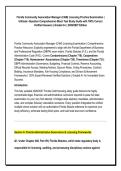
Florida Community Association Manager (CAM) Licensing Practice Examination |
Ultimate -Question Comprehensive Mock Test Study Guide with 100% Correct
Verified Answers | Graded A+ | 2026/2027 Edition
Florida Community Association Manager (CAM) Licensing Examination | Comprehensive
Practice Resource: Explicitly engineered to align with the Florida Department of Business
and Professional Regulation (DBPR) exam matrix, Florida Statutes (F.S.), and the Florida
Administrative Code (FAC). Covers Condominiums (Chapter 718), Cooperatives
(Chapter 719), Homeowners’ Associations (Chapter 720), Timeshares (Chapter 721),
DBPR Administrative Governance, Budgeting, Financial Controls, Reserve Accounting,
Official Records Access, Meeting Notices, Quorum Rules, Voting Procedures, Contract
Bidding, Insurance Mandates, Fair Housing Compliance, and Divison Enforcement
Frameworks | 100% Expert-Reviewed Verified Solutions | Graded A+ for Immediate Exam
Success.
Introduction
This fully updated 2026/2027 Florida CAM licensing study guide delivers the highly
concentrated legal, financial, and administrative curriculum required to pass the state
examination on your very first attempt. It bridges state statutory mandates, administrative
rules, and complex fiduciary calculation scenarios. Every question integrates the verified
multiple-choice solution with an authoritative Florida Statute reference to maximize your
study efficiency, eliminate testing blind spots, and build total test-room confidence.
Section A: Florida Administrative Governance & Licensing Frameworks
Q1. Under Chapter 468, Part VIII, Florida Statutes, which state regulatory body is
responsible for licensing, auditing, and processing disciplinary actions against
,Community Association Managers (CAMs) and CAM firms?
A) Florida Department of Financial Services
B) Florida Department of Business and Professional Regulation (DBPR) - Regulatory
Council of Community Association Managers
C) Florida Department of Agriculture and Consumer Services
D) Florida Real Estate Commission
Answer: B
Explanation: The Regulatory Council of Community Association Managers, housed under
the DBPR, possesses explicit statutory authority to license individuals and firms, establish
continuing education criteria, and enforce professional conduct standards across Florida.
Q2. An individual must secure an active Florida CAM license if they perform
management services for a fee for a community association that exceeds how many
residential units, or operates with an annual budget exceeding what dollar threshold?
A) More than 5 units; budget exceeding $25,000
B) More than 10 units; or an annual budget or budgets exceeding $100,000
C) More than 25 units; budget exceeding $50,000
D) Any association regardless of size or budget
Answer: B
Explanation: Section 468.431, F.S., establishes the thresholds for mandatory licensure. If an
individual provides management services (e.g., controlling funds, preparing budgets,
,coordinating meetings) for hire for an association with more than 10 units or a budget over
$100,000, they must hold a valid CAM license.
Q3. A Florida CAM license expires biennially (every two years) on which designated
calendar date, and what is required to legally renew it?
A) December 31 of every odd-numbered year; paying a fee
B) September 30 of every even-numbered year; paying a fee and completing 15 hours
of approved continuing education (CE) credits
C) May 31 of every even-numbered year; retaking the state exam
D) Two years from the individual’s physical date of birth; completing 20 CE hours
Answer: B
Explanation: DBPR administrative rules dictate that CAM licenses expire on September 30
of even-numbered years. To successfully renew, a licensee must clear renewal fees and
document 15 hours of DBPR-approved continuing education covering legal updates,
insurance, and financial management.
Q4. If a licensed Florida CAM changes their primary home or business address,
within how many days must they formally update their profile coordinates with the
DBPR?
A) Within 48 hours
B) Within 10 days
C) Within 30 days
, D) Address changes are only reported at the biennial renewal cycle
Answer: C
Explanation: Section 455.275, F.S., requires all DBPR licensees to notify the department in
writing of their current mailing address and place of practice within 30 days of any structural
adjustments.
Q5. What is the maximum administrative civil monetary fine that the DBPR or the
Regulatory Council can levy against a CAM per violation for practicing gross
negligence or financial misconduct?
A) $500
B) $1,000
C) $5,000
D) $25,000
Answer: C
Explanation: Section 468.436, F.S., grants the DBPR disciplinary authority. For serious
infractions, including fraud, conversion of funds, or gross negligence, the department can
impose an administrative fine up to $5,000 per count, alongside license suspension or
permanent revocation.
Q6. Under Florida law, which of the following actions can a licensed CAM legally
execute without crossing into the unauthorized practice of law (UPL)?
A) Drafting structural amendments to the association's Declaration of Condominium
Ultimate -Question Comprehensive Mock Test Study Guide with 100% Correct
Verified Answers | Graded A+ | 2026/2027 Edition
Florida Community Association Manager (CAM) Licensing Examination | Comprehensive
Practice Resource: Explicitly engineered to align with the Florida Department of Business
and Professional Regulation (DBPR) exam matrix, Florida Statutes (F.S.), and the Florida
Administrative Code (FAC). Covers Condominiums (Chapter 718), Cooperatives
(Chapter 719), Homeowners’ Associations (Chapter 720), Timeshares (Chapter 721),
DBPR Administrative Governance, Budgeting, Financial Controls, Reserve Accounting,
Official Records Access, Meeting Notices, Quorum Rules, Voting Procedures, Contract
Bidding, Insurance Mandates, Fair Housing Compliance, and Divison Enforcement
Frameworks | 100% Expert-Reviewed Verified Solutions | Graded A+ for Immediate Exam
Success.
Introduction
This fully updated 2026/2027 Florida CAM licensing study guide delivers the highly
concentrated legal, financial, and administrative curriculum required to pass the state
examination on your very first attempt. It bridges state statutory mandates, administrative
rules, and complex fiduciary calculation scenarios. Every question integrates the verified
multiple-choice solution with an authoritative Florida Statute reference to maximize your
study efficiency, eliminate testing blind spots, and build total test-room confidence.
Section A: Florida Administrative Governance & Licensing Frameworks
Q1. Under Chapter 468, Part VIII, Florida Statutes, which state regulatory body is
responsible for licensing, auditing, and processing disciplinary actions against
,Community Association Managers (CAMs) and CAM firms?
A) Florida Department of Financial Services
B) Florida Department of Business and Professional Regulation (DBPR) - Regulatory
Council of Community Association Managers
C) Florida Department of Agriculture and Consumer Services
D) Florida Real Estate Commission
Answer: B
Explanation: The Regulatory Council of Community Association Managers, housed under
the DBPR, possesses explicit statutory authority to license individuals and firms, establish
continuing education criteria, and enforce professional conduct standards across Florida.
Q2. An individual must secure an active Florida CAM license if they perform
management services for a fee for a community association that exceeds how many
residential units, or operates with an annual budget exceeding what dollar threshold?
A) More than 5 units; budget exceeding $25,000
B) More than 10 units; or an annual budget or budgets exceeding $100,000
C) More than 25 units; budget exceeding $50,000
D) Any association regardless of size or budget
Answer: B
Explanation: Section 468.431, F.S., establishes the thresholds for mandatory licensure. If an
individual provides management services (e.g., controlling funds, preparing budgets,
,coordinating meetings) for hire for an association with more than 10 units or a budget over
$100,000, they must hold a valid CAM license.
Q3. A Florida CAM license expires biennially (every two years) on which designated
calendar date, and what is required to legally renew it?
A) December 31 of every odd-numbered year; paying a fee
B) September 30 of every even-numbered year; paying a fee and completing 15 hours
of approved continuing education (CE) credits
C) May 31 of every even-numbered year; retaking the state exam
D) Two years from the individual’s physical date of birth; completing 20 CE hours
Answer: B
Explanation: DBPR administrative rules dictate that CAM licenses expire on September 30
of even-numbered years. To successfully renew, a licensee must clear renewal fees and
document 15 hours of DBPR-approved continuing education covering legal updates,
insurance, and financial management.
Q4. If a licensed Florida CAM changes their primary home or business address,
within how many days must they formally update their profile coordinates with the
DBPR?
A) Within 48 hours
B) Within 10 days
C) Within 30 days
, D) Address changes are only reported at the biennial renewal cycle
Answer: C
Explanation: Section 455.275, F.S., requires all DBPR licensees to notify the department in
writing of their current mailing address and place of practice within 30 days of any structural
adjustments.
Q5. What is the maximum administrative civil monetary fine that the DBPR or the
Regulatory Council can levy against a CAM per violation for practicing gross
negligence or financial misconduct?
A) $500
B) $1,000
C) $5,000
D) $25,000
Answer: C
Explanation: Section 468.436, F.S., grants the DBPR disciplinary authority. For serious
infractions, including fraud, conversion of funds, or gross negligence, the department can
impose an administrative fine up to $5,000 per count, alongside license suspension or
permanent revocation.
Q6. Under Florida law, which of the following actions can a licensed CAM legally
execute without crossing into the unauthorized practice of law (UPL)?
A) Drafting structural amendments to the association's Declaration of Condominium


