

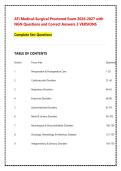
ATI Medical-Surgical Proctored Exam 2026-2027 with
NGN Questions and Correct Answers 3 VERSIONS
Complete Set: Questions
TABLE OF CONTENTS
Section Focus Area Questions
1 Perioperative & Postoperative Care 1-20
2 Cardiovascular Disorders 21-45
3 Respiratory Disorders 46-65
4 Endocrine Disorders 66-80
5 Gastrointestinal Disorders 81-95
6 Renal & Urinary Disorders 96-105
7 Neurological & Musculoskeletal Disorders 106-130
8 Oncology, Hematology & Infectious Diseases 131-155
9 Integumentary & Sensory Disorders 156-170
,Section Focus Area Questions
10 NGN Case Studies & Clinical Judgment 171-200
SECTION 1: PERIOPERATIVE & POSTOPERATIVE CARE
(Questions 1-20)
Question 1
A nurse is caring for a client who is 12 hours postoperative following a colon resection.
Which finding should the nurse report to the surgeon?
A) Temperature of 37.2°C (99.0°F)
B) Heart rate of 88/min
C) Blood pressure 88/52 mm Hg
D) Respiratory rate of 18/min
*Answer: C) Blood pressure 88/52 mm Hg
Rationale: A blood pressure of 88/52 mm Hg indicates hypotension, which may be a sign
of hypovolemia or hemorrhage. This requires immediate notification of the surgeon. The
other vital signs are within normal limits for a postoperative client.
Question 2
,A nurse is preparing a client for surgery. Which action is most important to prevent a
surgical site infection?
A) Administer preoperative antibiotics as prescribed
B) Ensure the client has signed the informed consent
C) Remove all jewelry and piercings
D) Have the client void before surgery
*Answer: A) Administer preoperative antibiotics as prescribed
Rationale: Preoperative antibiotics, administered within 60 minutes of the surgical
incision, are the most important intervention to prevent surgical site infections. Informed
consent, jewelry removal, and voiding are important but do not directly prevent infection.
Question 3
A client is 24 hours postoperative and reports severe pain at the incision site. The nurse
notes the incision is red, swollen, and warm to the touch. Which action should the nurse
take?
A) Apply a warm compress to the incision
B) Administer prescribed pain medication
C) Notify the healthcare provider immediately
D) Document the findings and reassess in 2 hours
*Answer: C) Notify the healthcare provider immediately
Rationale: Redness, swelling, warmth, and severe pain at the incision site suggest a
possible wound infection or dehiscence. The provider should be notified immediately for
further evaluation and possible intervention.
, Question 4
A nurse is caring for a client who has a Jackson-Pratt (JP) drain in place following
abdominal surgery. Which action is correct when emptying the drain?
A) Empty the drain when it is completely full
B) Compress the bulb after emptying to create suction
C) Empty the drain by pulling the plug out of the bulb
D) Wear sterile gloves when emptying the drain
*Answer: B) Compress the bulb after emptying to create suction
Rationale: After emptying the JP drain, the bulb must be compressed to create negative
pressure (suction) for continued drainage. The drain should be emptied when half full or at
least every 8 hours. Clean (not sterile) gloves are appropriate for emptying.
Question 5
A nurse is teaching a client about deep breathing and coughing exercises following
surgery. Which statement indicates the client understands the teaching?
A) "I should cough forcefully to clear my airways."
B) "I will take a deep breath and hold it for 10 seconds."
C) "I should splint my incision when coughing."
D) "I will perform these exercises once a day."
*Answer: C) "I should splint my incision when coughing."
Rationale: Splinting the incision with a pillow or hands reduces pain and pressure during
coughing. Deep breaths should be held for 3-5 seconds, not 10 seconds. Coughing should
be done gently and effectively. Exercises should be performed every 1-2 hours while
awake.
NGN Questions and Correct Answers 3 VERSIONS
Complete Set: Questions
TABLE OF CONTENTS
Section Focus Area Questions
1 Perioperative & Postoperative Care 1-20
2 Cardiovascular Disorders 21-45
3 Respiratory Disorders 46-65
4 Endocrine Disorders 66-80
5 Gastrointestinal Disorders 81-95
6 Renal & Urinary Disorders 96-105
7 Neurological & Musculoskeletal Disorders 106-130
8 Oncology, Hematology & Infectious Diseases 131-155
9 Integumentary & Sensory Disorders 156-170
,Section Focus Area Questions
10 NGN Case Studies & Clinical Judgment 171-200
SECTION 1: PERIOPERATIVE & POSTOPERATIVE CARE
(Questions 1-20)
Question 1
A nurse is caring for a client who is 12 hours postoperative following a colon resection.
Which finding should the nurse report to the surgeon?
A) Temperature of 37.2°C (99.0°F)
B) Heart rate of 88/min
C) Blood pressure 88/52 mm Hg
D) Respiratory rate of 18/min
*Answer: C) Blood pressure 88/52 mm Hg
Rationale: A blood pressure of 88/52 mm Hg indicates hypotension, which may be a sign
of hypovolemia or hemorrhage. This requires immediate notification of the surgeon. The
other vital signs are within normal limits for a postoperative client.
Question 2
,A nurse is preparing a client for surgery. Which action is most important to prevent a
surgical site infection?
A) Administer preoperative antibiotics as prescribed
B) Ensure the client has signed the informed consent
C) Remove all jewelry and piercings
D) Have the client void before surgery
*Answer: A) Administer preoperative antibiotics as prescribed
Rationale: Preoperative antibiotics, administered within 60 minutes of the surgical
incision, are the most important intervention to prevent surgical site infections. Informed
consent, jewelry removal, and voiding are important but do not directly prevent infection.
Question 3
A client is 24 hours postoperative and reports severe pain at the incision site. The nurse
notes the incision is red, swollen, and warm to the touch. Which action should the nurse
take?
A) Apply a warm compress to the incision
B) Administer prescribed pain medication
C) Notify the healthcare provider immediately
D) Document the findings and reassess in 2 hours
*Answer: C) Notify the healthcare provider immediately
Rationale: Redness, swelling, warmth, and severe pain at the incision site suggest a
possible wound infection or dehiscence. The provider should be notified immediately for
further evaluation and possible intervention.
, Question 4
A nurse is caring for a client who has a Jackson-Pratt (JP) drain in place following
abdominal surgery. Which action is correct when emptying the drain?
A) Empty the drain when it is completely full
B) Compress the bulb after emptying to create suction
C) Empty the drain by pulling the plug out of the bulb
D) Wear sterile gloves when emptying the drain
*Answer: B) Compress the bulb after emptying to create suction
Rationale: After emptying the JP drain, the bulb must be compressed to create negative
pressure (suction) for continued drainage. The drain should be emptied when half full or at
least every 8 hours. Clean (not sterile) gloves are appropriate for emptying.
Question 5
A nurse is teaching a client about deep breathing and coughing exercises following
surgery. Which statement indicates the client understands the teaching?
A) "I should cough forcefully to clear my airways."
B) "I will take a deep breath and hold it for 10 seconds."
C) "I should splint my incision when coughing."
D) "I will perform these exercises once a day."
*Answer: C) "I should splint my incision when coughing."
Rationale: Splinting the incision with a pillow or hands reduces pain and pressure during
coughing. Deep breaths should be held for 3-5 seconds, not 10 seconds. Coughing should
be done gently and effectively. Exercises should be performed every 1-2 hours while
awake.


