

Written by students who passed Immediately available after payment Read online or as PDF Wrong document? Swap it for free 4.6 TrustPilot
logo-home
Document preview thumbnail
Preview 2 out of 12 pages
Exam (elaborations)

PNH 301 Test 2 2026/2027 – 30+ Questions & Answers, Heart Failure, CAD, MI, Angina, PAD & PVD

Document preview thumbnail
Preview 2 out of 12 pages

This PNH 301 Test 2 2026/2027 resource is a focused 12-page cardiovascular nursing exam study guide containing 30+ questions, correct answers, clinical scenarios, diagnostic concepts, treatment summaries and patient-education points. The document concentrates on heart failure, coronary artery disease (CAD), myocardial infarction (MI), stable angina, peripheral arterial disease (PAD) and peripheral vascular disease (PVD). It emphasizes clinical judgment by asking students to recognize priority findings, distinguish arterial from venous disease, identify modifiable cardiovascular risks and select appropriate nursing interventions. For example, the opening scenario requires recognition of severe hypotension (88/42 mm Hg) in a patient receiving an ACE inhibitor as the priority finding to report. A major section covers coronary artery disease and chronic stable angina. Students review modifiable and nonmodifiable cardiovascular risk factors, including elevated LDL cholesterol, smoking, hypertension, diabetes, obesity, sedentary lifestyle, diet, age, family history and sex/gender. Clinical manifestations of CAD include angina, dyspnea, fatigue, palpitations, syncope and myocardial infarction. Stable-angina questions reinforce the relationship between symptoms and activity, relief with sublingual nitroglycerin and evaluation of beta-blocker therapy through the patient's ability to perform daily activities without chest discomfort. The myocardial infarction material reviews causes, diagnostic evaluation, acute treatment and secondary prevention. Students study 12-lead ECGs, cardiac biomarkers such as troponin and CK-MB, coronary angiography and stress testing, with troponin identified in the document as the preferred biomarker because of its cardiac specificity and sensitivity. Treatment content includes percutaneous coronary intervention (PCI), angioplasty and stent placement, thrombolytic therapy, CABG/MIDCAB, anticoagulation with IV heparin, nitroglycerin, beta blockers and calcium-channel blockers. The resource also reviews antiplatelet therapy with aspirin and clopidogrel and cholesterol management with statins. Students are also prepared to recognize serious post-MI complications, including left-ventricular dysfunction, cardiogenic shock, ventricular tachycardia, ventricular fibrillation and heart failure. Signs of impaired cardiac output include hypotension, agitation, pallor and urine output below 30 mL/hour. Heart-failure manifestations discussed include pulmonary crackles, edema, jugular venous distention, additional heart sounds, worsening dyspnea and rapid weight gain. The document reinforces daily weight monitoring through a scenario in which an increase from 56 kg to 59 kg over two days should prompt the patient to contact the heart-failure clinic. Another high-yield section differentiates peripheral arterial disease from peripheral venous disease. PAD findings include intermittent claudication, cool or shiny extremities, decreased or absent pulses, delayed capillary refill, loss of hair, ischemic ulcers and severe rest pain with advanced disease. The document uses the mnemonic ARTS to reinforce characteristic arterial findings. Venous disease is contrasted through edema, warm extremities, present pulses, irregularly shaped ulcers and brown or yellow discoloration around the ankles, with leg elevation presented as a strategy to promote venous return. Diagnostic testing for peripheral vascular disease includes the ankle-brachial index (ABI), Doppler ultrasonography and angiography. The ABI section explains comparison of blood pressure in the arm with pressure in the leg to help identify PAD, while Doppler ultrasound evaluates peripheral blood flow and can help reveal stenosis, obstruction or turbulent flow. Angiography is presented as a contrast-based method for visualizing narrowed or blocked arteries and defining vascular anatomy. These concepts support exam questions requiring students to connect vascular assessment findings with appropriate diagnostic procedures. Medication and treatment concepts are integrated throughout the guide. Students review ACE inhibitors, nadolol and other beta blockers, furosemide, bumetanide, nitroglycerin, aspirin, clopidogrel, statins, heparin and protamine sulfate. The material connects each medication with its therapeutic purpose and clinically important monitoring, including hypotension with ACE-inhibitor therapy, anticoagulation and bleeding considerations with heparin, and liver-related considerations with statins. It also presents an OANM sequence—oxygen, aspirin, nitroglycerin and morphine—for acute cardiac treatment as taught in the document. Because contemporary acute coronary syndrome protocols are more individualized, students should compare this course-specific mnemonic with their instructor's current clinical guidelines. For academic cross-reference, these topics correspond closely with Harding et al., Lewis's Medical-Surgical Nursing: Assessment and Management of Clinical Problems, particularly its coverage of coronary artery disease, acute coronary syndromes, heart failure and peripheral vascular disorders. The content can also be compared with current evidence-based cardiovascular guidance from the American Heart Association (AHA) and American College of Cardiology (ACC). These references are useful for verifying clinical concepts, but students should follow their assigned textbook and current course guidance where recommendations differ, particularly for acute MI treatment, thrombolysis, oxygen administration and medication protocols. This resource is especially relevant for PNH 301 students, practical nursing students, PN/LPN students, pre-licensure nursing students, medical-surgical nursing students, adult-health students and learners preparing for cardiovascular nursing examinations. It is particularly useful for students reviewing heart failure, coronary artery disease, angina, myocardial infarction, PCI, CABG, cardiac medications, PAD, PVD, ABI testing, cardiovascular risk factors, patient education and priority nursing interventions. The uploaded document does not identify a specific institution, so University Not Specified is retained rather than assigning an unsupported university. Keywords: PNH 301 Test 2, PNH 301 questions and answers, PNH 301 study guide, PNH , cardiovascular nursing exam, cardiac nursing questions, heart failure nursing, heart failure questions and answers, coronary artery disease nursing, CAD nursing, stable angina nursing, angina questions and answers, myocardial infarction nursing, MI nursing questions, acute myocardial infarction, MI diagnostic tests, troponin myocardial infarction, ECG myocardial infarction, coronary angiography, PCI nursing, angioplasty nursing, CABG nursing, cardiogenic shock nursing, post MI complications, ventricular tachycardia, ventricular fibrillation, ACE inhibitor nursing, beta blocker nursing, nadolol nursing, nitroglycerin nursing, aspirin cardiac nursing, clopidogrel nursing, heparin nursing, statin nursing, peripheral arterial disease, PAD nursing questions, intermittent claudication, peripheral vascular disease, PVD nursing, arterial vs venous disease, ankle brachial index, ABI nursing, Doppler ultrasound vascular, cardiovascular risk factors, modifiable cardiac risk factors, medical surgical nursing cardiovascular, practical nursing cardiac exam, LPN cardiovascular nursing

Content preview

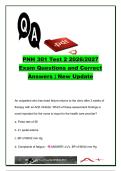
PNH 301 Test 2 2026/2027
Exam Questions and Correct
Answers | New Update


An outpatient who has heart failure returns to the clinic after 2 weeks of

therapy with an ACE inhibitor. Which of these assessment findings is

most important for the nurse to report to the health care provider?

a. Pulse rate of 56

b. 2+ pedal edema

c. BP of 88/42 mm Hg


d. Complaints of fatigue - ANSWER ✔✔c. BP of 88/42 mm Hg

, The nurse is developing a health teaching plan for a 60-year-old man

with the following risk factors for coronary artery disease (CAD). Which

of the following risk factors should the nurse focus on when teaching the

client?

a. Family history of coronary artery disease

b. Increased risk associated with the client's gender

c. High incidence of cardio vascular disease in older people

d. Elevation of the client's serum low density lipoprotein (LDL) level -

ANSWER ✔✔d. Elevation of the client's serum low density lipoprotein

(LDL) level

The nurse is caring for a client with angina who has been prescribed

nadolol. Which of the following parameters should the nurse assess to

determine whether the drug is effective?

a. Decreased blood pressure and apical pulse rate b.

b. Fewer complaints of having cold hands and feet

c. Improvement in the quality of the peripheral pulses

d. The ability to do daily activities without chest discomfort -

ANSWER ✔✔d. The ability to do daily activities without chest

discomfort

Document information

Uploaded on
August 7, 2026
Number of pages
12
Written in
2026/2027
Type
Exam (elaborations)
Contains
Questions & answers
$18.99

Wrong document? Swap it for free Within 14 days of purchase and before downloading, you can choose a different document. You can simply spend the amount again.
Written by students who passed
Immediately available after payment
Read online or as PDF

Seller avatar
Reputation scores are based on the amount of documents a seller has sold for a fee and the reviews they have received for those documents. There are three levels: Bronze, Silver and Gold. The better the reputation, the more your can rely on the quality of the sellers work.
JOSHCLAY
3.5
(83)
Sold
389
Followers
16
Items
20469
Last sold
1 hour ago


Why students choose Stuvia

Created by fellow students, verified by reviews

Quality you can trust: written by students who passed their tests and reviewed by others who've used these notes.

Didn't get what you expected? Choose another document

No worries! You can instantly pick a different document that better fits what you're looking for.

Pay as you like, start learning right away

No subscription, no commitments. Pay the way you're used to via credit card and download your PDF document instantly.

Student with book image

“Bought, downloaded, and aced it. It really can be that simple.”

Alisha Student

Working on your references?

Create accurate citations in APA, MLA and Harvard with our free citation generator.

Working on your references?

Frequently asked questions

