

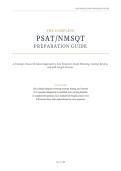
THE COMPLETE PSAT PREPARATION GUIDE
THE COMPLETE
PSAT/NMSQT
P R EP A R A TION G UID E
A Strategic, Research-Based Approach to Test Structure, Study Planning, Content Review,
and Full-Length Practice
INCLUDES
Six in-depth chapters covering strategy, timing, and content
A 20-question diagnostic to establish your starting baseline
A complete 98-question, four-module full-length practice test
Full answer keys with explanations for every question
Page 1 of 55
, THE COMPLETE PSAT PREPARATION GUIDE
Table of Contents
Section One — Understanding the PSAT: What It Is and Why It Matters.............................5
Section Tw o — How Hard Is It, Really? A Research-Based Look at Difficulty......................9
Section Thr ee — Building a Study Plan That Fits Your Timeline.........................................15
Section Four — What to Study: A Full Content Breakdown.................................................21
Section Five — Test-Day Strategy and Tactics......................................................................31
Section Six — Practice Tests: Diagnostic and Full-Length...................................................37
A NOTE ON PAGE NUMB ERS
Page numbers above are approximate and reflect the layout of this guide as designed; use the section
headings and the document outline to navigate directly to any part of the guide.
Page 2 of 55
, THE COMPLETE PSAT PREPARATION GUIDE
Section One
Understanding the PSAT: What It Is and Why It Matters
1.1 — W hat the PSAT Actu ally Measu r es
The PSAT/NMSQT — the Preliminary SAT and National Merit Scholarship Qualifying Test — is not a
lesser version of the SAT. It is built by the same organization, tests the same skills, and follows nearly
the same format. The main difference is stakes and scale: the PSAT is shorter, scores slightly lower on
average because it is calibrated for a younger test-taking population, and carries an additional layer
of consequence for juniors through the National Merit Scholarship Program.
Most students take some version of the PSAT twice before ever sitting for the SAT: once as a
freshman or sophomore (PSAT 8/9 or PSAT 10), and again as a junior (PSAT/NMSQT). Each
administration exists to do one thing well — give you and your school an accurate, low-stakes read on
where you stand against college-readiness benchmarks, long before the results actually count toward
anything.
That framing matters for how you should think about preparation. This is not a test you can talk your
way around with generic "test-taking tips." It rewards the same underlying competencies the SAT
rewards: careful reading, efficient algebra, and comfort working under a clock. Everything in this
guide is built around strengthening those competencies directly, rather than chasing shortcuts.
1.2 — The Thr ee Ver sions of the PSAT
Ver sion Typical Grade Pur pose
Early baseline; identifies growth areas years before
PSAT 8/9 8th or 9th grade
college applications begin.
Sophomore-year checkpoint; same content as the
PSAT 10 10th grade PSAT/NMSQT, used for state testing programs in
many districts.
The only version that counts toward National Merit
PSAT/NMSQT 11th grade (October)
recognition; the version this guide is built around.
The content and format across all three versions are functionally identical — the same skill
categories, the same adaptive design, the same digital delivery through College Board's Bluebook
application. The score scale shifts slightly by grade level, and only the 11th-grade PSAT/NMSQT feeds
into National Merit consideration. If you are preparing as a sophomore for the PSAT 10, everything
in this guide still applies directly to you.
1.3 — For m at at a Glan ce
The digital PSAT/NMSQT is delivered entirely through the Bluebook app, on a laptop, tablet, or
school-issued device. It runs 2 hours and 14 minutes and includes 98 total questions across two
sections.
Page 3 of 55
, THE COMPLETE PSAT PREPARATION GUIDE
Section Modules Question s Tim e
64 minutes (32 per
Reading and Writing 2 modules 54 (27 per module)
module)
70 minutes (35 per
Math 2 modules 44 (22 per module)
module)
— Reading and Writing comes first, followed by a 10-minute break, then Math.
— There is no break between Module 1 and Module 2 within a section — the test moves straight
through.
— Every Math question allows a built-in Desmos graphing calculator, available on-screen for the
entire section.
— Reading and Writing questions are paired one-to-one with short passages — typically 25 to 150
words — rather than the long passages used on paper tests of the past.
K EY STRUCTURAL FACT
The test is adaptive at the module level, not the question level. Every student sees the same Module 1.
Based on how you perform on Module 1, the system routes you to either a harder or an easier Module
2. This single design choice affects strategy more than almost anything else in this guide, and Section
Two breaks down exactly why.
1.4 — Scor in g an d W hat the Nu m ber s Mean
Each section — Reading and Writing, and Math — is scored on a scale of 160 to 760. Add the two
section scores together and you get a composite score between 320 and 1520. That range mirrors the
SAT's 400–1600 scale closely enough that colleges, counselors, and students can translate a PSAT
score into a rough SAT prediction without much guesswork.
Com posite Scor e Ran ge Gen er al In ter pr etation
Exceptionally strong; typically places a student in National Merit
1400–1520
contention in most states.
Strong performance; above the national average by a wide
1200–1390
margin.
1010–1190 Roughly average performance nationally.
Below the national average; signals clear room for targeted
Below 1010
preparation before the SAT.
Composite score is what shows up on your score report and what most people mean when they ask,
"What did you get on the PSAT?" But for juniors chasing National Merit recognition, a second
number matters more: the Selection Index. That number, and how it's calculated, is covered in depth
in Section Two.
Page 4 of 55
THE COMPLETE
PSAT/NMSQT
P R EP A R A TION G UID E
A Strategic, Research-Based Approach to Test Structure, Study Planning, Content Review,
and Full-Length Practice
INCLUDES
Six in-depth chapters covering strategy, timing, and content
A 20-question diagnostic to establish your starting baseline
A complete 98-question, four-module full-length practice test
Full answer keys with explanations for every question
Page 1 of 55
, THE COMPLETE PSAT PREPARATION GUIDE
Table of Contents
Section One — Understanding the PSAT: What It Is and Why It Matters.............................5
Section Tw o — How Hard Is It, Really? A Research-Based Look at Difficulty......................9
Section Thr ee — Building a Study Plan That Fits Your Timeline.........................................15
Section Four — What to Study: A Full Content Breakdown.................................................21
Section Five — Test-Day Strategy and Tactics......................................................................31
Section Six — Practice Tests: Diagnostic and Full-Length...................................................37
A NOTE ON PAGE NUMB ERS
Page numbers above are approximate and reflect the layout of this guide as designed; use the section
headings and the document outline to navigate directly to any part of the guide.
Page 2 of 55
, THE COMPLETE PSAT PREPARATION GUIDE
Section One
Understanding the PSAT: What It Is and Why It Matters
1.1 — W hat the PSAT Actu ally Measu r es
The PSAT/NMSQT — the Preliminary SAT and National Merit Scholarship Qualifying Test — is not a
lesser version of the SAT. It is built by the same organization, tests the same skills, and follows nearly
the same format. The main difference is stakes and scale: the PSAT is shorter, scores slightly lower on
average because it is calibrated for a younger test-taking population, and carries an additional layer
of consequence for juniors through the National Merit Scholarship Program.
Most students take some version of the PSAT twice before ever sitting for the SAT: once as a
freshman or sophomore (PSAT 8/9 or PSAT 10), and again as a junior (PSAT/NMSQT). Each
administration exists to do one thing well — give you and your school an accurate, low-stakes read on
where you stand against college-readiness benchmarks, long before the results actually count toward
anything.
That framing matters for how you should think about preparation. This is not a test you can talk your
way around with generic "test-taking tips." It rewards the same underlying competencies the SAT
rewards: careful reading, efficient algebra, and comfort working under a clock. Everything in this
guide is built around strengthening those competencies directly, rather than chasing shortcuts.
1.2 — The Thr ee Ver sions of the PSAT
Ver sion Typical Grade Pur pose
Early baseline; identifies growth areas years before
PSAT 8/9 8th or 9th grade
college applications begin.
Sophomore-year checkpoint; same content as the
PSAT 10 10th grade PSAT/NMSQT, used for state testing programs in
many districts.
The only version that counts toward National Merit
PSAT/NMSQT 11th grade (October)
recognition; the version this guide is built around.
The content and format across all three versions are functionally identical — the same skill
categories, the same adaptive design, the same digital delivery through College Board's Bluebook
application. The score scale shifts slightly by grade level, and only the 11th-grade PSAT/NMSQT feeds
into National Merit consideration. If you are preparing as a sophomore for the PSAT 10, everything
in this guide still applies directly to you.
1.3 — For m at at a Glan ce
The digital PSAT/NMSQT is delivered entirely through the Bluebook app, on a laptop, tablet, or
school-issued device. It runs 2 hours and 14 minutes and includes 98 total questions across two
sections.
Page 3 of 55
, THE COMPLETE PSAT PREPARATION GUIDE
Section Modules Question s Tim e
64 minutes (32 per
Reading and Writing 2 modules 54 (27 per module)
module)
70 minutes (35 per
Math 2 modules 44 (22 per module)
module)
— Reading and Writing comes first, followed by a 10-minute break, then Math.
— There is no break between Module 1 and Module 2 within a section — the test moves straight
through.
— Every Math question allows a built-in Desmos graphing calculator, available on-screen for the
entire section.
— Reading and Writing questions are paired one-to-one with short passages — typically 25 to 150
words — rather than the long passages used on paper tests of the past.
K EY STRUCTURAL FACT
The test is adaptive at the module level, not the question level. Every student sees the same Module 1.
Based on how you perform on Module 1, the system routes you to either a harder or an easier Module
2. This single design choice affects strategy more than almost anything else in this guide, and Section
Two breaks down exactly why.
1.4 — Scor in g an d W hat the Nu m ber s Mean
Each section — Reading and Writing, and Math — is scored on a scale of 160 to 760. Add the two
section scores together and you get a composite score between 320 and 1520. That range mirrors the
SAT's 400–1600 scale closely enough that colleges, counselors, and students can translate a PSAT
score into a rough SAT prediction without much guesswork.
Com posite Scor e Ran ge Gen er al In ter pr etation
Exceptionally strong; typically places a student in National Merit
1400–1520
contention in most states.
Strong performance; above the national average by a wide
1200–1390
margin.
1010–1190 Roughly average performance nationally.
Below the national average; signals clear room for targeted
Below 1010
preparation before the SAT.
Composite score is what shows up on your score report and what most people mean when they ask,
"What did you get on the PSAT?" But for juniors chasing National Merit recognition, a second
number matters more: the Selection Index. That number, and how it's calculated, is covered in depth
in Section Two.
Page 4 of 55


