
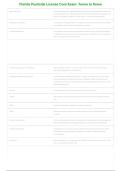
Florida Pesticide License Core Exam- Terms to Know
Applicator class A term indicating the organizational system for certified applicators under the
Florida Pesticide Law. Depending upon the kind of employment engaged in, a
license is classified as either Private, Public, or Commercial applicator.
certification category an individual officially made on a license of where and how the license holder
may legally conduct pesticide applicator activities
Certified applicator An individual who has been recognized (certified) by the Florida Department
of Agriculture and Consumer Services as being competent to use or supervise
the use of restricted-use pesticides.
continuing education units (CEUs) approximately one hour of study credit used to make up the total credits
required for applicator recertification
Extremely Hazardous Substance A classification established by EPA for certain chemicals, some of which are
active ingredients in pesticide products. Storage facilities containing such
substances must be formally reported if there substances are present in more
than certain amounts.
FDACS Florida Department of Agriculture and Consumer Services
FDACS state agency that enforces the provisions of FIFRA and the Florida Pesticide
Law
FIFRA Federal Insecticide, Fungicide, and Rodenticide Act
FIFRA federal law that provides the overall framework for the federal pesticide
program
Florida Pesticide Law The law that governs the use of pesticides in Florida, which is administered by
the Florida Department of Agricultural and Consumer Services (FDACS).
Limited Certification A designation on a license issued under the Structural Pest Control Act that
enables the licensee to apply pesticides only under certain prescribed
circumstances.
ordinance laws developed by local government officials; ordinances are enforced at the
city or county government level
, Florida Pesticide License Core Exam- Terms to Know
Recertification the process by which licensed pesticide applicators accumulate continuing
education units in order to keep the license valid
Restricted use pesticide (RUP) Pesticide for retail sale to, and use by, only certified applicators or persons
under their direct supervision and only for those purposes covered by the
applicator's certification.
Action threshold the pest level at which some type of pest management action must be taken
bioaccumulation the accumulation of substances, such as pesticides, or other chemicals in an
organism- the substance is absorbed at a greater rate than what is lost
biomagnification the tendency for certain pesticides to progressively become more
concentrated in each type of organism when moving from the bottom to the
top organism within a food chain
contact pesticide pesticide that is not absorbed systemically by treated plants or animals. these
pesticides must directly touch the pest or a site the pest frequents to be
effective
economic threshold The level where the economic losses caused by pest damage, if the pest
population continued to grow, would be greater than the cost of controlling
the pests.
eradication one of the three primary pest control goals that refers to the total elimination
of a pest from a designated area
Intergrated Pest Management (IPM) the coordinated use of pest and environmental information and available pest
control methods to prevent unacceptable levels of damage by the most
economical means with the least possible hazard to people, property, and the
environment
key pest a pest that occurs on a regular basis for a given crop
mode of action how the pesticides work- specific system in the pest that are affected by the
pesticide
occasional pest a pest that causes damage only once in a while because of its life cycle or
environmental influences or as a result of human activities
persistence length of time a pesticide remains active to control pests
Applicator class A term indicating the organizational system for certified applicators under the
Florida Pesticide Law. Depending upon the kind of employment engaged in, a
license is classified as either Private, Public, or Commercial applicator.
certification category an individual officially made on a license of where and how the license holder
may legally conduct pesticide applicator activities
Certified applicator An individual who has been recognized (certified) by the Florida Department
of Agriculture and Consumer Services as being competent to use or supervise
the use of restricted-use pesticides.
continuing education units (CEUs) approximately one hour of study credit used to make up the total credits
required for applicator recertification
Extremely Hazardous Substance A classification established by EPA for certain chemicals, some of which are
active ingredients in pesticide products. Storage facilities containing such
substances must be formally reported if there substances are present in more
than certain amounts.
FDACS Florida Department of Agriculture and Consumer Services
FDACS state agency that enforces the provisions of FIFRA and the Florida Pesticide
Law
FIFRA Federal Insecticide, Fungicide, and Rodenticide Act
FIFRA federal law that provides the overall framework for the federal pesticide
program
Florida Pesticide Law The law that governs the use of pesticides in Florida, which is administered by
the Florida Department of Agricultural and Consumer Services (FDACS).
Limited Certification A designation on a license issued under the Structural Pest Control Act that
enables the licensee to apply pesticides only under certain prescribed
circumstances.
ordinance laws developed by local government officials; ordinances are enforced at the
city or county government level
, Florida Pesticide License Core Exam- Terms to Know
Recertification the process by which licensed pesticide applicators accumulate continuing
education units in order to keep the license valid
Restricted use pesticide (RUP) Pesticide for retail sale to, and use by, only certified applicators or persons
under their direct supervision and only for those purposes covered by the
applicator's certification.
Action threshold the pest level at which some type of pest management action must be taken
bioaccumulation the accumulation of substances, such as pesticides, or other chemicals in an
organism- the substance is absorbed at a greater rate than what is lost
biomagnification the tendency for certain pesticides to progressively become more
concentrated in each type of organism when moving from the bottom to the
top organism within a food chain
contact pesticide pesticide that is not absorbed systemically by treated plants or animals. these
pesticides must directly touch the pest or a site the pest frequents to be
effective
economic threshold The level where the economic losses caused by pest damage, if the pest
population continued to grow, would be greater than the cost of controlling
the pests.
eradication one of the three primary pest control goals that refers to the total elimination
of a pest from a designated area
Intergrated Pest Management (IPM) the coordinated use of pest and environmental information and available pest
control methods to prevent unacceptable levels of damage by the most
economical means with the least possible hazard to people, property, and the
environment
key pest a pest that occurs on a regular basis for a given crop
mode of action how the pesticides work- specific system in the pest that are affected by the
pesticide
occasional pest a pest that causes damage only once in a while because of its life cycle or
environmental influences or as a result of human activities
persistence length of time a pesticide remains active to control pests


