

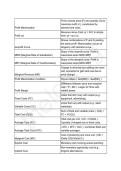
Firms choose price (P) and quantity (Q) to
maximize profit (π), constrained by
Profit Maximization demand and costs.
Revenue minus Cost: pi = R-C In simple
Profit (π) form: pi = (p-c) q
Shows combinations of P and Q yielding
the same profit. Maximization occurs at
Isoprofit Curve tangency with demand curve.
Slope of the isoprofit curve. Profit is
g
MRS (Marginal Rate of Substitution) maximized when MRS=MRT
Slope of the demand curve. Profit is
MRT (Marginal Rate of Transformation) maximized when MRS=MRT
fro
Marginal Revenue (MR)
Profit Maximization Condition
Change in revenue from selling one more
unit. Accounts for gain and loss due to
price change.
Occurs where ( \text{MR} = \text{MC} ).
Difference between price and marginal
cost: ( P - MC ). Larger for firms with
ol
Profit Margin market power.
Costs that don’t vary with output (e.g.,
Fixed Costs (FC) equipment, advertising).
el
Costs that vary with output (e.g., labor,
Variable Costs (VC) materials).
Sum of fixed and variable costs: ( C(Q) =
Total Cost (C(Q)) FC + VC(Q) ).
th
Total cost per unit: ( AC = C(Q)/Q ).
Average Cost (AC) Typically U-shaped due to fixed costs.
( ATC = AFC + AVC ). Combines fixed and
Average Total Cost (ATC) variable averages.
Cost of producing one more unit: ( MC =
Marginal Cost (MC) \Delta C(Q)/\Delta Q ).
Explicit Cost Monetary cost involving actual spending.
Non-monetary opportunity cost (e.g.,
Implicit Cost forgone alternatives).
maximize profit (π), constrained by
Profit Maximization demand and costs.
Revenue minus Cost: pi = R-C In simple
Profit (π) form: pi = (p-c) q
Shows combinations of P and Q yielding
the same profit. Maximization occurs at
Isoprofit Curve tangency with demand curve.
Slope of the isoprofit curve. Profit is
g
MRS (Marginal Rate of Substitution) maximized when MRS=MRT
Slope of the demand curve. Profit is
MRT (Marginal Rate of Transformation) maximized when MRS=MRT
fro
Marginal Revenue (MR)
Profit Maximization Condition
Change in revenue from selling one more
unit. Accounts for gain and loss due to
price change.
Occurs where ( \text{MR} = \text{MC} ).
Difference between price and marginal
cost: ( P - MC ). Larger for firms with
ol
Profit Margin market power.
Costs that don’t vary with output (e.g.,
Fixed Costs (FC) equipment, advertising).
el
Costs that vary with output (e.g., labor,
Variable Costs (VC) materials).
Sum of fixed and variable costs: ( C(Q) =
Total Cost (C(Q)) FC + VC(Q) ).
th
Total cost per unit: ( AC = C(Q)/Q ).
Average Cost (AC) Typically U-shaped due to fixed costs.
( ATC = AFC + AVC ). Combines fixed and
Average Total Cost (ATC) variable averages.
Cost of producing one more unit: ( MC =
Marginal Cost (MC) \Delta C(Q)/\Delta Q ).
Explicit Cost Monetary cost involving actual spending.
Non-monetary opportunity cost (e.g.,
Implicit Cost forgone alternatives).


