
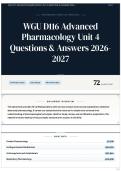
WGU D116 ADVANCED PHARMACOLOGY UNIT 4 QUESTIONS & ANSWERS 2026-… EXAM
P R O F E S S I O N A L P R A C T I C E M AT E R I A L S
WGU D116 Advanced
Pharmacology Unit 4
Questions & Answers 2026-
2027
Verified Answers Exam Ready With Rationales
72 QUESTIONS
DOCUMENT OVERVIEW
This document provides 72 verified questions with correct answers and concise explanations related to
advanced pharmacology. It serves as a comprehensive resource for students to enhance their
understanding of pharmacological principles. Ideal for study, review, and certification preparation, this
material ensures mastery of key concepts necessary for success in the field.
CONTENTS
Cardiac Pharmacology Q1–Q15
Antihypertensive Medications Q16–Q30
Anticoagulants and Antiplatelets Q31–Q44
Respiratory Pharmacology Q45–Q58
Page 1
, Diabetes and Endocrine Pharmacology Q59–Q72
E XA M Q U EST I O N S
Q1 QUESTION 1 OF 72
Which medication class would be prescribed for palpitations?
CORRECT ANSWER
Beta-blockers
Q2 QUESTION 2 OF 72
A patient is taking a drug that interferes with venous constriction.
What should the nurse tell the patient?
CORRECT ANSWER
Ask for assistance when getting out of bed
Drop in venous pressure reduces venous return to the heart which will pool in the extremities and orthostatic
hypotension can happen.
Bradycardia, ha, and SOB are not expected effects
Q3 QUESTION 3 OF 72
A patient is taking a beta1-adrenergic drug to improve the stroke volume of the heart. This drug acts by
increasing __________.
CORRECT ANSWER
Myocardial contractility
Cardiac afterload is determined primarily by the degree of peripheral resistance caused by constriction of
arterioles; increasing afterload would decrease stroke volume
Q4 QUESTION 4 OF 72
You are teaching a nursing student how blood can return to the heart when pressure in the venous capillary
beds is very low.
Page 2
, Which statement by the student indicates a need for further teaching?
CORRECT ANSWER
"Skeletal muscles relax to allow the free flow of blood"
Skeletal muscle CONTRACTION, along with one-way venous valves, help create an "auxiliary" venous pump that
helps drive blood toward the heart
Constriction of small muscles in venous walls helps increase venous pressure
Negative pressure in the left atrium sucks blood toward the heart
Values (one-way) work with the contraction of skeletal muscles to create a venous pump
Q5 QUESTION 5 OF 72
A patient with hypertension is taking furosemide for congestive heart failure. The prescriber orders digoxin
to help increase cardiac output.
What other medication should be ordered for this patient?
CORRECT ANSWER
Spironolactone (Potassium-sparing)
Spironolactone is used in conjunction with furosemide because of being potassium sparing.
Hydrochlorothiazide, bumetanide, chlorothiazide all (potassium-wasting)
Q6 QUESTION 6 OF 72
A patient is admitted with severe hypertensive crisis.
Which medication should the provider order?
CORRECT ANSWER
Sodium nitroprusside IV
Drug of choice for hypertensive emergencies and is given IV.
Q7 QUESTION 7 OF 72
Page 3
P R O F E S S I O N A L P R A C T I C E M AT E R I A L S
WGU D116 Advanced
Pharmacology Unit 4
Questions & Answers 2026-
2027
Verified Answers Exam Ready With Rationales
72 QUESTIONS
DOCUMENT OVERVIEW
This document provides 72 verified questions with correct answers and concise explanations related to
advanced pharmacology. It serves as a comprehensive resource for students to enhance their
understanding of pharmacological principles. Ideal for study, review, and certification preparation, this
material ensures mastery of key concepts necessary for success in the field.
CONTENTS
Cardiac Pharmacology Q1–Q15
Antihypertensive Medications Q16–Q30
Anticoagulants and Antiplatelets Q31–Q44
Respiratory Pharmacology Q45–Q58
Page 1
, Diabetes and Endocrine Pharmacology Q59–Q72
E XA M Q U EST I O N S
Q1 QUESTION 1 OF 72
Which medication class would be prescribed for palpitations?
CORRECT ANSWER
Beta-blockers
Q2 QUESTION 2 OF 72
A patient is taking a drug that interferes with venous constriction.
What should the nurse tell the patient?
CORRECT ANSWER
Ask for assistance when getting out of bed
Drop in venous pressure reduces venous return to the heart which will pool in the extremities and orthostatic
hypotension can happen.
Bradycardia, ha, and SOB are not expected effects
Q3 QUESTION 3 OF 72
A patient is taking a beta1-adrenergic drug to improve the stroke volume of the heart. This drug acts by
increasing __________.
CORRECT ANSWER
Myocardial contractility
Cardiac afterload is determined primarily by the degree of peripheral resistance caused by constriction of
arterioles; increasing afterload would decrease stroke volume
Q4 QUESTION 4 OF 72
You are teaching a nursing student how blood can return to the heart when pressure in the venous capillary
beds is very low.
Page 2
, Which statement by the student indicates a need for further teaching?
CORRECT ANSWER
"Skeletal muscles relax to allow the free flow of blood"
Skeletal muscle CONTRACTION, along with one-way venous valves, help create an "auxiliary" venous pump that
helps drive blood toward the heart
Constriction of small muscles in venous walls helps increase venous pressure
Negative pressure in the left atrium sucks blood toward the heart
Values (one-way) work with the contraction of skeletal muscles to create a venous pump
Q5 QUESTION 5 OF 72
A patient with hypertension is taking furosemide for congestive heart failure. The prescriber orders digoxin
to help increase cardiac output.
What other medication should be ordered for this patient?
CORRECT ANSWER
Spironolactone (Potassium-sparing)
Spironolactone is used in conjunction with furosemide because of being potassium sparing.
Hydrochlorothiazide, bumetanide, chlorothiazide all (potassium-wasting)
Q6 QUESTION 6 OF 72
A patient is admitted with severe hypertensive crisis.
Which medication should the provider order?
CORRECT ANSWER
Sodium nitroprusside IV
Drug of choice for hypertensive emergencies and is given IV.
Q7 QUESTION 7 OF 72
Page 3


