

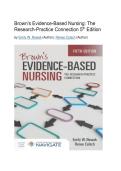
Brown's Evidence-Based Nursing: The
Research-Practice Connection 5th Edition
by Emily W. Nowak (Author), Renee Colsch (Author)
,TABLE OF CONTENTS
Part 1 Nursing Research
Chapter 1 The Research-Practice Connection
Chapter 2 Research Evidence
Chapter 3 Reading Research Articles
Chapter 4 Qualitative Research
Chapter 5 Quantitative Descriptive Research
Chapter 6 Correlational Research
Chapter 7 Experimental Research
Chapter 8 Cohort Research
Chapter 9 Systematic Reviews
Chapter 10 Evidence-Based Clinical Practice Guidelines
Part 2 Evidence-Based Practice
Chapter 11 Asking Clinical Questions
Chapter 12 Searching for Research Evidence
Chapter 13 Appraising Research Evidence
Chapter 14 Appraising Recommendations of Clinical Practice Guidelines
Chapter 15 Appraising Conclusions of Systematic Reviews with Narrative
Synthesis
Chapter 16 Appraising Findings of Original Studies
Chapter 17 Evidence-Based Practice Strategies
Chapter 18 Evidence-Based Practice Participation
Chapter 19 Point-of-Care Adaptations
,Test Bank: Brown's Evidence-Based Nursing: The
Research-Practice Connection, 5th Edition (Nowak, 2024)
Chapters 1–19 | Multiple Choice Questions & Answers
CHAPTER 1: Evidence-Based Nursing Practice
1. Which of the following BEST defines evidence-based practice (EBP) in nursing?
A) Using only the most recent clinical research to guide patient care
B) Integrating the best available research evidence with clinical expertise and
patient preferences
C) Following institutional policies regardless of current research findings
D) Relying primarily on the nurse's personal clinical experience
Answer: B
Rationale: EBP is the integration of the best available research evidence with
clinical expertise and individual patient preferences to optimize patient outcomes.
2. The "three-legged stool" model of EBP includes which THREE primary
components?
A) Research evidence, clinical expertise, and patient preferences/values
B) Qualitative research, quantitative research, and mixed methods
C) Nursing theory, clinical guidelines, and institutional policy
D) Patient safety, cost-effectiveness, and staff satisfaction
, Answer: A
Rationale: The classic model of EBP rests on three equal components: best
research evidence, clinical expertise, and patient values/preferences.
3. A nurse who consults peer-reviewed research articles before implementing a
new wound care protocol is demonstrating which concept?
A) Evidence-based practice
B) Tradition-based practice
C) Authority-based practice
D) Trial-and-error practice
Answer: A
Rationale: Consulting peer-reviewed literature to guide clinical decisions is a
hallmark of EBP.
4. Which of the following is considered the LOWEST level of evidence on most
evidence hierarchies?
A) Systematic review of randomized controlled trials
B) Meta-analysis
C) Expert opinion and anecdotal reports
D) Randomized controlled trial (RCT)
Answer: C
Research-Practice Connection 5th Edition
by Emily W. Nowak (Author), Renee Colsch (Author)
,TABLE OF CONTENTS
Part 1 Nursing Research
Chapter 1 The Research-Practice Connection
Chapter 2 Research Evidence
Chapter 3 Reading Research Articles
Chapter 4 Qualitative Research
Chapter 5 Quantitative Descriptive Research
Chapter 6 Correlational Research
Chapter 7 Experimental Research
Chapter 8 Cohort Research
Chapter 9 Systematic Reviews
Chapter 10 Evidence-Based Clinical Practice Guidelines
Part 2 Evidence-Based Practice
Chapter 11 Asking Clinical Questions
Chapter 12 Searching for Research Evidence
Chapter 13 Appraising Research Evidence
Chapter 14 Appraising Recommendations of Clinical Practice Guidelines
Chapter 15 Appraising Conclusions of Systematic Reviews with Narrative
Synthesis
Chapter 16 Appraising Findings of Original Studies
Chapter 17 Evidence-Based Practice Strategies
Chapter 18 Evidence-Based Practice Participation
Chapter 19 Point-of-Care Adaptations
,Test Bank: Brown's Evidence-Based Nursing: The
Research-Practice Connection, 5th Edition (Nowak, 2024)
Chapters 1–19 | Multiple Choice Questions & Answers
CHAPTER 1: Evidence-Based Nursing Practice
1. Which of the following BEST defines evidence-based practice (EBP) in nursing?
A) Using only the most recent clinical research to guide patient care
B) Integrating the best available research evidence with clinical expertise and
patient preferences
C) Following institutional policies regardless of current research findings
D) Relying primarily on the nurse's personal clinical experience
Answer: B
Rationale: EBP is the integration of the best available research evidence with
clinical expertise and individual patient preferences to optimize patient outcomes.
2. The "three-legged stool" model of EBP includes which THREE primary
components?
A) Research evidence, clinical expertise, and patient preferences/values
B) Qualitative research, quantitative research, and mixed methods
C) Nursing theory, clinical guidelines, and institutional policy
D) Patient safety, cost-effectiveness, and staff satisfaction
, Answer: A
Rationale: The classic model of EBP rests on three equal components: best
research evidence, clinical expertise, and patient values/preferences.
3. A nurse who consults peer-reviewed research articles before implementing a
new wound care protocol is demonstrating which concept?
A) Evidence-based practice
B) Tradition-based practice
C) Authority-based practice
D) Trial-and-error practice
Answer: A
Rationale: Consulting peer-reviewed literature to guide clinical decisions is a
hallmark of EBP.
4. Which of the following is considered the LOWEST level of evidence on most
evidence hierarchies?
A) Systematic review of randomized controlled trials
B) Meta-analysis
C) Expert opinion and anecdotal reports
D) Randomized controlled trial (RCT)
Answer: C


