Part 1 - microscopy
1. Microscopy basics
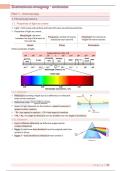
1.1. Properties of light as a wave
❥ Light = both wave and particle and has both wave as particle properties
❥ Properties of light as a wave...
Wavelength: distance
Frequency: number of waves Amplitude: the maximum
between the top of the wave to
produced each second height the wave reaches
the next top
Speed Phase Polarisation
Other properties of light...
1.1.1. Refraction
❥ Refraction: bending of light due to a difference in refractive
index of two mediums
Speed of light in vacuum
❥ Refractive index: speed in medium
❥ Speed of light depends on the medium: speed in vacuum ≠
speed in other medium
❥ ⇡ RI = low speed in medium | ⇣ RI = fast speed in medium
❥ If RI1 < RI2, the angle of refraction will be smaller than the angle of incidence
1.1.2. Dispersion
❥ Each λ diffracts differently (at different angles) which
creates dispersion
❥ Bigger λ (red) know less deviation from the original path than
smaller λ (blue)
❥ Bigger λ = less sensitive to refraction than smaller λ
P a g i n a 1 | 88
,1.1.3. Reflection
❥ When the angle of refraction = angle of incidence ⇢ light reflects
1.1.4. Diffraction
❥ Diffraction: the bending of light around corners such that it spreads out and illuminates areas
where a shadow is expected, this is due to one or multiple openings in the light path
❥ Diffraction changes the way light is perceived
and displayed
❥ ⇣ opening = stronger bending of the light waves
❥ Diffraction generates a characteristic pattern
that depends on the amount of slits
❥ The middle part is undiffracted light that passes
straight through the gap
❥ The patterns surrounding the middle are
diffracted light that either increased or decreased in amplitude based on which interference it
❥ Important formula for diffraction: d ∙ sin θ = mλ | d = size of slit, m = maxima
P a g i n a 2 | 88
,1.1.5. Interference
❥ Interference: phenomenon that takes place when two waves meet and combine
❥ Interference can either increase or decrease the amplitude of the new wave
❥ Constructive Interference: when two waves meet and have an increase in amplitude as a result
❥ Destructive interference: when two waves meet and have a decrease in amplitude as a result
❥ Which interference happens depends on the phase difference of both waves
❣ If the phase difference between both is nπ (with n an even number), the amplitude of the new,
combined wave increases
❣ If the phase difference between both is mπ (with m an odd number), the amplitude of the new,
combined wave decreases
1.2. Lens theory
Imagine: a perfect convex lens with a focal distance f from the lens
We must know 3 rules relating to the light path through this perfect convex lens...
P a g i n a 3 | 88
, 1.2.1. Rule 1: parallel rays converge at the focal point
1.2.2. Rule 2: rays from the focal point exit parallelly
1.2.3. Rule 3: Rays that pass through the centre of the lens remain unaffected
Now let us place an object in front of the lens...
❥ The lens will project us an image based on the object
❥ The distance between the lens and the object is d0
❥ The distance between the lens and the image is di
P a g i n a 4 | 88