

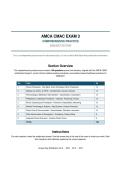
AMCA CMAC EXAM 3
COMPREHENSIVE PRACTICE
2026/2027 EDITION
This is an independent practice exam for educational study; it is not an official Wall Street Prep certification examination.
Section Overview
This comprehensive practice exam contains 100 questions across nine sections, aligned with the AMCA CMAC
certification blueprint, current clinical medical assisting standards, and evidence-based healthcare practices for
2026/2027.
Sec Topic Qs
1 Clinical Procedures - Vital Signs, Exam Techniques, Minor Procedures 15
2 Medical Law, Ethics, & HIPAA - Confidentiality, Consent, Records 12
3 Pharmacology & Medication Administration - Classifications, Calculations 15
4 Phlebotomy & Laboratory Procedures - Collection, Processing, Testing 12
5 EKG & Cardiovascular Procedures - Placement, Interpretation, Monitoring 10
6 Medical Terminology & Anatomy - Body Systems, Disease Processes 12
7 Patient Care & Communication - Documentation, Education, Interaction 10
8 Office Administration & Management - Scheduling, Coding, Billing 8
9 Integrated Clinical Scenarios - Complex Patient Cases 6
TOTAL 100
Instructions
For each question, select the single best answer. Use the answer key at the end of the exam to check your work. Each
item includes a brief rationale explaining the correct response.
Answer Key Distribution: 25 A · 25 B · 25 C · 25 D
, Section 1: Clinical Procedures - Vital Signs, Patient Preparation, and Examination
Techniques
Q1: The most accurate site for measuring core body temperature is:
A. Rectal temperature [CORRECT]
B. Axillary temperature
C. Tympanic in a cold environment only
D. Skin surface
Correct Answer: A
Rationale: Rectal temperature is the most accurate measure of core body temperature. The other sites are less accurate or
peripheral.
Q2: Which pulse site is used to assess circulation to the lower leg/foot?
A. Posterior tibial or dorsalis pedis [CORRECT]
B. Radial
C. Carotid
D. Brachial
Correct Answer: A
Rationale: The posterior tibial and dorsalis pedis pulses assess lower-extremity circulation. The others assess
upper-body/central sites.
Q3: A normal adult pulse oximetry (SpO2) reading is typically:
A. 80-85%
B. 95-100% [CORRECT]
C. 70-75%
D. 60-65%
Correct Answer: B
Rationale: Normal SpO2 is 95-100% on room air. The other ranges indicate hypoxemia.
Q4: Which position is used to assess the rectum or administer an enema?
A. Supine
B. Prone
C. Fowler's
D. Sims' (left lateral) [CORRECT]
Correct Answer: D
Rationale: Sims' (left lateral) position is used for rectal exams and enemas. The other positions are not typical.
Q5: Which position is appropriate for a patient with difficulty breathing?
A. Supine flat
B. Fowler's (semi-upright to upright) [CORRECT]
C. Prone
D. Trendelenburg
Correct Answer: B
Rationale: Fowler's position eases breathing. The other positions may worsen dyspnea.
Q6: When preparing to assist with a minor surgical procedure, the medical assistant should:
A. Skip sterile technique
B. Leave supplies open
C. Ignore hand hygiene
D. Prepare the sterile field and equipment, and follow aseptic technique [CORRECT]
Correct Answer: D
Rationale: Sterile technique and proper setup are essential for minor surgical procedures. The other options are unsafe.
AMCA CMAC Exam 3 - 2026/2027 Page 2
, Q7: Which of the following is a sign of anaphylaxis that requires immediate action?
A. Difficulty breathing and facial swelling [CORRECT]
B. Mild sneezing
C. Slight fatigue
D. A small rash only
Correct Answer: A
Rationale: Difficulty breathing and swelling indicate anaphylaxis, a medical emergency. The other options are not anaphylaxis.
Q8: When measuring respiration, the medical assistant should:
A. Tell the patient to breathe deeply
B. Count only if asked
C. Guess
D. Count breaths without the patient being aware, to get an accurate rate [CORRECT]
Correct Answer: D
Rationale: Counting respirations discreetly avoids the patient altering their breathing. The other options are inaccurate.
Q9: A patient's blood pressure of 150/95 mmHg is classified as:
A. Normal
B. Elevated/hypertensive [CORRECT]
C. Low
D. Optimal
Correct Answer: B
Rationale: 150/95 is in the hypertensive range. The other options are incorrect.
Q10: Which of the following is appropriate PPE when there is risk of splashing?
A. Gloves, gown, mask, and eye protection [CORRECT]
B. Only gloves
C. Only a gown
D. No PPE
Correct Answer: A
Rationale: PPE including eye protection is used when splashing is possible. The other options are insufficient.
Q11: Which vital sign is most useful for monitoring a patient on oxygen therapy?
A. Pulse oximetry (SpO2) [CORRECT]
B. Height
C. Weight
D. Hair color
Correct Answer: A
Rationale: Pulse oximetry measures oxygen saturation, directly relevant to oxygen therapy. The other options are not.
Q12: A patient who is pale, sweaty, and reports feeling lightheaded may be experiencing:
A. A normal state
B. Anxiety only
C. A vasovagal (faint) episode or low blood sugar [CORRECT]
D. No concern
Correct Answer: C
Rationale: Pallor, sweating, and lightheadedness suggest a faint (vasovagal) or hypoglycemia. The other options are not
characteristic.
Q13: Before weighing a patient, the medical assistant should:
A. Calibrate the scale and ensure the patient removes heavy outer items [CORRECT]
B. Skip calibration
C. Weigh with heavy clothing
AMCA CMAC Exam 3 - 2026/2027 Page 3
COMPREHENSIVE PRACTICE
2026/2027 EDITION
This is an independent practice exam for educational study; it is not an official Wall Street Prep certification examination.
Section Overview
This comprehensive practice exam contains 100 questions across nine sections, aligned with the AMCA CMAC
certification blueprint, current clinical medical assisting standards, and evidence-based healthcare practices for
2026/2027.
Sec Topic Qs
1 Clinical Procedures - Vital Signs, Exam Techniques, Minor Procedures 15
2 Medical Law, Ethics, & HIPAA - Confidentiality, Consent, Records 12
3 Pharmacology & Medication Administration - Classifications, Calculations 15
4 Phlebotomy & Laboratory Procedures - Collection, Processing, Testing 12
5 EKG & Cardiovascular Procedures - Placement, Interpretation, Monitoring 10
6 Medical Terminology & Anatomy - Body Systems, Disease Processes 12
7 Patient Care & Communication - Documentation, Education, Interaction 10
8 Office Administration & Management - Scheduling, Coding, Billing 8
9 Integrated Clinical Scenarios - Complex Patient Cases 6
TOTAL 100
Instructions
For each question, select the single best answer. Use the answer key at the end of the exam to check your work. Each
item includes a brief rationale explaining the correct response.
Answer Key Distribution: 25 A · 25 B · 25 C · 25 D
, Section 1: Clinical Procedures - Vital Signs, Patient Preparation, and Examination
Techniques
Q1: The most accurate site for measuring core body temperature is:
A. Rectal temperature [CORRECT]
B. Axillary temperature
C. Tympanic in a cold environment only
D. Skin surface
Correct Answer: A
Rationale: Rectal temperature is the most accurate measure of core body temperature. The other sites are less accurate or
peripheral.
Q2: Which pulse site is used to assess circulation to the lower leg/foot?
A. Posterior tibial or dorsalis pedis [CORRECT]
B. Radial
C. Carotid
D. Brachial
Correct Answer: A
Rationale: The posterior tibial and dorsalis pedis pulses assess lower-extremity circulation. The others assess
upper-body/central sites.
Q3: A normal adult pulse oximetry (SpO2) reading is typically:
A. 80-85%
B. 95-100% [CORRECT]
C. 70-75%
D. 60-65%
Correct Answer: B
Rationale: Normal SpO2 is 95-100% on room air. The other ranges indicate hypoxemia.
Q4: Which position is used to assess the rectum or administer an enema?
A. Supine
B. Prone
C. Fowler's
D. Sims' (left lateral) [CORRECT]
Correct Answer: D
Rationale: Sims' (left lateral) position is used for rectal exams and enemas. The other positions are not typical.
Q5: Which position is appropriate for a patient with difficulty breathing?
A. Supine flat
B. Fowler's (semi-upright to upright) [CORRECT]
C. Prone
D. Trendelenburg
Correct Answer: B
Rationale: Fowler's position eases breathing. The other positions may worsen dyspnea.
Q6: When preparing to assist with a minor surgical procedure, the medical assistant should:
A. Skip sterile technique
B. Leave supplies open
C. Ignore hand hygiene
D. Prepare the sterile field and equipment, and follow aseptic technique [CORRECT]
Correct Answer: D
Rationale: Sterile technique and proper setup are essential for minor surgical procedures. The other options are unsafe.
AMCA CMAC Exam 3 - 2026/2027 Page 2
, Q7: Which of the following is a sign of anaphylaxis that requires immediate action?
A. Difficulty breathing and facial swelling [CORRECT]
B. Mild sneezing
C. Slight fatigue
D. A small rash only
Correct Answer: A
Rationale: Difficulty breathing and swelling indicate anaphylaxis, a medical emergency. The other options are not anaphylaxis.
Q8: When measuring respiration, the medical assistant should:
A. Tell the patient to breathe deeply
B. Count only if asked
C. Guess
D. Count breaths without the patient being aware, to get an accurate rate [CORRECT]
Correct Answer: D
Rationale: Counting respirations discreetly avoids the patient altering their breathing. The other options are inaccurate.
Q9: A patient's blood pressure of 150/95 mmHg is classified as:
A. Normal
B. Elevated/hypertensive [CORRECT]
C. Low
D. Optimal
Correct Answer: B
Rationale: 150/95 is in the hypertensive range. The other options are incorrect.
Q10: Which of the following is appropriate PPE when there is risk of splashing?
A. Gloves, gown, mask, and eye protection [CORRECT]
B. Only gloves
C. Only a gown
D. No PPE
Correct Answer: A
Rationale: PPE including eye protection is used when splashing is possible. The other options are insufficient.
Q11: Which vital sign is most useful for monitoring a patient on oxygen therapy?
A. Pulse oximetry (SpO2) [CORRECT]
B. Height
C. Weight
D. Hair color
Correct Answer: A
Rationale: Pulse oximetry measures oxygen saturation, directly relevant to oxygen therapy. The other options are not.
Q12: A patient who is pale, sweaty, and reports feeling lightheaded may be experiencing:
A. A normal state
B. Anxiety only
C. A vasovagal (faint) episode or low blood sugar [CORRECT]
D. No concern
Correct Answer: C
Rationale: Pallor, sweating, and lightheadedness suggest a faint (vasovagal) or hypoglycemia. The other options are not
characteristic.
Q13: Before weighing a patient, the medical assistant should:
A. Calibrate the scale and ensure the patient removes heavy outer items [CORRECT]
B. Skip calibration
C. Weigh with heavy clothing
AMCA CMAC Exam 3 - 2026/2027 Page 3


