

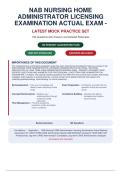
NAB NURSING HOME
ADMINISTRATOR LICENSING
EXAMINATION ACTUAL EXAM -
LATEST MOCK PRACTICE SET
160 Questions with Answers and Detailed Rationales
100 PERCENT GUARANTEED PASS
INSTANT DOWNLOAD ANSWERS INCLUDED
IMPORTANCE OF THIS DOCUMENT
This comprehensive examination preparation guide has been meticulously developed to help you succeed in the
NAB NURSING HOME ADMINISTRATOR LICENSING EXAMINATION ACTUAL EXAM - NATIONAL
ASSOCIATION OF LONG TERM CARE ADMINISTRATOR BOARDS (NAB) - 2026/2027 ACADEMIC YEAR -
VERIFIED QUESTIONS AND ANSWERS FOR PROFESSIONAL LONG-TERM CARE ADMINISTRATION
CANDIDATES. It contains 160 carefully selected questions that reflect the most current exam content and testing
strategies. Each question is accompanied by a correct answer and a detailed rationale that explains the
underlying pathophysiology, pharmacology, or clinical reasoning.
Self-Assessment – Test your knowledge and Exam Preparation – Familiarize yourself with the
identify areas requiring further question format and content
study areas
Concept Reinforcement – Deepen your Confidence Building – Develop test-taking
understanding through strategies and reduce
evidence-based exam anxiety
rationales
Time Management – Practice answering
questions under simulated
exam conditions
Review Summary 160 Questions
Foundations - Application - NAB Nursing HOME Administrator Licensing Examination Actual National
Association OF LONG TERM CARE Administrator Boards NAB 2026/2027 Academic YEAR AND FOR
Professional Long-term CARE Administration Candidates Long-term CARE Administration Graduate
All answers with rationales
,Table of Contents
Section A - Nursing Section B - Administrator
Questions 1 to 40 Questions 41 to 80
Section C - Facility S Section D - Reviewing
Questions 81 to 120 Questions 121 to 160
,Section A - Nursing
Q1.
A nursing home administrator is reviewing the facility's compliance with the
Requirements for Participation under Medicare and Medicaid. Which regulatory change,
effective in 2016, most significantly altered the facility's obligation regarding antibiotic
stewardship?
A. Mandatory vaccination of all staff against B. Establishment of an Infection Prevention
influenza and Control Program with an Antibiotic
Stewardship component
C. Requirement for a designated medical D. Implementation of a resident-centered
director to oversee all clinical care care plan that includes antimicrobial
preferences
Correct: B - Establishment of an Infection Prevention and Control Program with an
Antibiotic Stewardship component
Rationale:The 2016 final rule mandated that facilities have an Infection Prevention and
Control Program, including an Antibiotic Stewardship Program to optimize antimicrobial use.
Options A, C, and D are not the primary regulatory changes related to antibiotic stewardship;
they are unrelated or less specific.
Q2.
In a skilled nursing facility, the administrator notices a spike in the facility's readmission
rate for heart failure. Which evidence-based quality improvement initiative would be most
effective in reducing avoidable readmissions?
A. Increasing the frequency of physician B. Implementing a transitional care model
visits to twice weekly with structured discharge planning and
follow-up calls
C. Restricting sodium intake for all residents D. Purchasing new telemetry monitors for
with cardiac diagnoses the nursing unit
Correct: B - Implementing a transitional care model with structured discharge planning
and follow-up calls
Rationale:Transitional care models, such as the Care Transitions Intervention, focus on
patient education, medication reconciliation, and follow-up, which are proven to reduce
readmissions. Simply increasing physician visits or restricting sodium does not address the
multifactorial causes of readmission. Telemetry monitors are not a quality improvement
initiative for reducing readmissions.
Page 3
, Section A - Nursing
Q3.
When preparing the annual budget for a nursing home, the administrator must allocate
resources to maintain a minimum direct care staffing level. Which federal requirement
sets the minimum nurse staffing hours per resident day?
A. A minimum of 3.0 hours per resident day, B. A minimum of 2.0 hours per resident day,
with at least 1.0 hour from registered nurses with at least 0.5 hours from registered
nurses
C. There is no federal minimum; states set D. A minimum of 2.5 hours per resident day,
their own requirements with at least 1.5 hours from licensed
practical nurses
Correct: C - There is no federal minimum; states set their own requirements
Rationale:As of the current regulations, the Centers for Medicare & Medicaid Services (CMS)
does not mandate a specific numeric staffing ratio; instead, it requires sufficient staffing to
meet residents' needs. States may impose their own minimums. Options A, B, and D are
incorrect because they assert federal minimums that do not exist.
Q4.
A nursing home administrator is evaluating the facility's compliance with the Health
Insurance Portability and Accountability Act (HIPAA). Which action would constitute a
violation of the HIPAA Privacy Rule?
A. Discussing a resident's condition with the B. Sharing resident information with a public
resident's legal representative without health authority for disease reporting
written consent
C. Posting a sign-in sheet that lists D. Releasing medical records to the
residents' names and room numbers at the resident's attorney with a valid authorization
nurses' station
Correct: C - Posting a sign-in sheet that lists residents' names and room numbers at the
nurses' station
Rationale:Posting resident names and room numbers in a manner visible to unauthorized
individuals violates the Privacy Rule's minimum necessary standard. Discussing with a legal
representative and sharing with public health authorities are permitted disclosures. Releasing
records with valid authorization is compliant.
Q5.
A long-term care facility is facing a labor shortage. The administrator considers using
agency staff. Which strategy is most effective in maintaining quality of care and resident
satisfaction?
Page 4
ADMINISTRATOR LICENSING
EXAMINATION ACTUAL EXAM -
LATEST MOCK PRACTICE SET
160 Questions with Answers and Detailed Rationales
100 PERCENT GUARANTEED PASS
INSTANT DOWNLOAD ANSWERS INCLUDED
IMPORTANCE OF THIS DOCUMENT
This comprehensive examination preparation guide has been meticulously developed to help you succeed in the
NAB NURSING HOME ADMINISTRATOR LICENSING EXAMINATION ACTUAL EXAM - NATIONAL
ASSOCIATION OF LONG TERM CARE ADMINISTRATOR BOARDS (NAB) - 2026/2027 ACADEMIC YEAR -
VERIFIED QUESTIONS AND ANSWERS FOR PROFESSIONAL LONG-TERM CARE ADMINISTRATION
CANDIDATES. It contains 160 carefully selected questions that reflect the most current exam content and testing
strategies. Each question is accompanied by a correct answer and a detailed rationale that explains the
underlying pathophysiology, pharmacology, or clinical reasoning.
Self-Assessment – Test your knowledge and Exam Preparation – Familiarize yourself with the
identify areas requiring further question format and content
study areas
Concept Reinforcement – Deepen your Confidence Building – Develop test-taking
understanding through strategies and reduce
evidence-based exam anxiety
rationales
Time Management – Practice answering
questions under simulated
exam conditions
Review Summary 160 Questions
Foundations - Application - NAB Nursing HOME Administrator Licensing Examination Actual National
Association OF LONG TERM CARE Administrator Boards NAB 2026/2027 Academic YEAR AND FOR
Professional Long-term CARE Administration Candidates Long-term CARE Administration Graduate
All answers with rationales
,Table of Contents
Section A - Nursing Section B - Administrator
Questions 1 to 40 Questions 41 to 80
Section C - Facility S Section D - Reviewing
Questions 81 to 120 Questions 121 to 160
,Section A - Nursing
Q1.
A nursing home administrator is reviewing the facility's compliance with the
Requirements for Participation under Medicare and Medicaid. Which regulatory change,
effective in 2016, most significantly altered the facility's obligation regarding antibiotic
stewardship?
A. Mandatory vaccination of all staff against B. Establishment of an Infection Prevention
influenza and Control Program with an Antibiotic
Stewardship component
C. Requirement for a designated medical D. Implementation of a resident-centered
director to oversee all clinical care care plan that includes antimicrobial
preferences
Correct: B - Establishment of an Infection Prevention and Control Program with an
Antibiotic Stewardship component
Rationale:The 2016 final rule mandated that facilities have an Infection Prevention and
Control Program, including an Antibiotic Stewardship Program to optimize antimicrobial use.
Options A, C, and D are not the primary regulatory changes related to antibiotic stewardship;
they are unrelated or less specific.
Q2.
In a skilled nursing facility, the administrator notices a spike in the facility's readmission
rate for heart failure. Which evidence-based quality improvement initiative would be most
effective in reducing avoidable readmissions?
A. Increasing the frequency of physician B. Implementing a transitional care model
visits to twice weekly with structured discharge planning and
follow-up calls
C. Restricting sodium intake for all residents D. Purchasing new telemetry monitors for
with cardiac diagnoses the nursing unit
Correct: B - Implementing a transitional care model with structured discharge planning
and follow-up calls
Rationale:Transitional care models, such as the Care Transitions Intervention, focus on
patient education, medication reconciliation, and follow-up, which are proven to reduce
readmissions. Simply increasing physician visits or restricting sodium does not address the
multifactorial causes of readmission. Telemetry monitors are not a quality improvement
initiative for reducing readmissions.
Page 3
, Section A - Nursing
Q3.
When preparing the annual budget for a nursing home, the administrator must allocate
resources to maintain a minimum direct care staffing level. Which federal requirement
sets the minimum nurse staffing hours per resident day?
A. A minimum of 3.0 hours per resident day, B. A minimum of 2.0 hours per resident day,
with at least 1.0 hour from registered nurses with at least 0.5 hours from registered
nurses
C. There is no federal minimum; states set D. A minimum of 2.5 hours per resident day,
their own requirements with at least 1.5 hours from licensed
practical nurses
Correct: C - There is no federal minimum; states set their own requirements
Rationale:As of the current regulations, the Centers for Medicare & Medicaid Services (CMS)
does not mandate a specific numeric staffing ratio; instead, it requires sufficient staffing to
meet residents' needs. States may impose their own minimums. Options A, B, and D are
incorrect because they assert federal minimums that do not exist.
Q4.
A nursing home administrator is evaluating the facility's compliance with the Health
Insurance Portability and Accountability Act (HIPAA). Which action would constitute a
violation of the HIPAA Privacy Rule?
A. Discussing a resident's condition with the B. Sharing resident information with a public
resident's legal representative without health authority for disease reporting
written consent
C. Posting a sign-in sheet that lists D. Releasing medical records to the
residents' names and room numbers at the resident's attorney with a valid authorization
nurses' station
Correct: C - Posting a sign-in sheet that lists residents' names and room numbers at the
nurses' station
Rationale:Posting resident names and room numbers in a manner visible to unauthorized
individuals violates the Privacy Rule's minimum necessary standard. Discussing with a legal
representative and sharing with public health authorities are permitted disclosures. Releasing
records with valid authorization is compliant.
Q5.
A long-term care facility is facing a labor shortage. The administrator considers using
agency staff. Which strategy is most effective in maintaining quality of care and resident
satisfaction?
Page 4


