

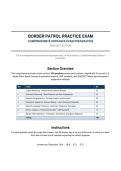
BORDER PATROL PRACTICE EXAM
COMPREHENSIVE ENTRANCE EXAM PREPARATION
2026/2027 EDITION
This is an independent practice exam for educational study; it is not an official U.S. Border Patrol Agent Entrance
Examination.
Section Overview
This comprehensive practice exam contains 150 questions across seven sections, aligned with the current U.S.
Border Patrol Agent Entrance Examination blueprint, CBP standards, and 2026/2027 federal law enforcement
preparation materials.
Sec Topic Qs
1 Logical Reasoning - Deductive and Inductive Analysis 35
2 Arithmetic Reasoning - Word Problems and Data Interpretation 25
3 Reading Comprehension - Passage Analysis and Inference 20
4 Situational Judgment & Decision-Making - Law Enforcement Scenarios 20
5 Spanish Language Proficiency - Grammar, Vocabulary, Translation 20
6 Ethics, Integrity, & Professional Conduct - CBP Standards 15
7 Border Patrol Operations - Procedures, Surveillance, Emergency Response 15
TOTAL 150
Instructions
For each question, select the single best answer. Use the answer key at the end of the exam to check your work.
Each item includes a brief rationale explaining the correct response.
Answer Key Distribution: 38 A · 38 B · 37 C · 37 D
, Section 1: Logical Reasoning - Deductive and Inductive Analysis
Q1: All Border Patrol stations in Sector X are staffed 24 hours. Station Y is in Sector X. Which conclusion logically
follows?
A. Station Y is staffed only at night
B. Station Y has no staff
C. Station Y is staffed 24 hours [CORRECT]
D. Station Y is closed on weekends
Correct Answer: C
Rationale: If all stations in Sector X are staffed 24 hours, and Station Y is in Sector X, then Station Y is staffed 24 hours. This is a
valid deductive conclusion from the stated premises.
Q2: Most migrants who cross at point A do so at night. It is currently daytime at point A. Which statement is most
supported?
A. No one has ever crossed at point A
B. Point A is always unguarded
C. All crossings occur at night
D. A crossing at point A during the day is possible but less typical [CORRECT]
Correct Answer: D
Rationale: Because most crossings at point A occur at night, a daytime crossing is possible but less typical. The conclusion must
not overstate to 'all' or 'no one,' which the premises do not support.
Q3: If a sensor activates and a Border Patrol agent observes a group heading north, which is the most logical next
action?
A. Ignore the sensor
B. Wait until the group crosses the border
C. Respond and assess the situation while coordinating with other units [CORRECT]
D. Assume it is a false alarm without checking
Correct Answer: C
Rationale: A sensor activation combined with a visual observation justifies a response to assess the situation. Ignoring it, waiting,
or assuming false alarm without verification is not logical.
Q4: A report states: 'Every agent in the unit passed the annual physical.' If Agent Lopez is in the unit, which
conclusion follows?
A. Agent Lopez failed the physical
B. Agent Lopez did not take the physical
C. Agent Lopez passed the annual physical [CORRECT]
D. Agent Lopez is not in the unit
Correct Answer: C
Rationale: If every agent in the unit passed the physical and Agent Lopez is in the unit, then Lopez passed. The other conclusions
contradict or are unsupported by the premise.
Q5: Which of the following is an example of an assumption a person might make when concluding that a cleared area
means no one recently crossed?
A. That the area is permanently closed
B. That all agents are on leave
C. That a lack of visible tracks means no crossing occurred [CORRECT]
D. That weather never affects tracks
Correct Answer: C
Rationale: Concluding that no crossing occurred from a cleared area assumes that a lack of visible tracks indicates no crossing.
This assumption may be false if tracks were obscured. The other options are not the underlying assumption.
Q6: A policy requires agents to log all stops. Agent M stopped a vehicle but did not log it. Which conclusion is most
directly supported?
Border Patrol Practice Exam - 2026/2027 Page 2
, A. Agent M never stops vehicles
B. The policy does not exist
C. Agent M failed to comply with the logging policy [CORRECT]
D. Agent M logged it elsewhere
Correct Answer: C
Rationale: If the policy requires logging all stops and Agent M did not log a stop, then Agent M failed to comply. The other
conclusions are not directly supported.
Q7: If it rains, the ground is wet. The ground is wet. Which conclusion is most logical?
A. It must have rained
B. The ground could be wet for reasons other than rain, so rain is not certain [CORRECT]
C. It never rains
D. The ground is always dry
Correct Answer: B
Rationale: A wet ground does not necessarily prove rain, as it could be wet from other causes (sprinklers, spills). This illustrates
that the converse of a conditional is not valid.
Q8: A supervisor states: 'All qualified agents can operate the radio.' If an agent cannot operate the radio, what
follows?
A. The agent is not qualified [CORRECT]
B. The agent is qualified
C. The radio is broken
D. Training is complete
Correct Answer: A
Rationale: If all qualified agents can operate the radio, an agent who cannot operate it is not qualified. This is the valid
contrapositive of the conditional statement.
Q9: Three agents are assigned to patrols. Agent A patrols Sector 1, Agent B patrols Sector 2. Which statement is
most logical?
A. Agent C patrols Sector 3
B. Agent C patrols Sector 1
C. Agent C's assignment cannot be determined from the given information [CORRECT]
D. Agent C has no assignment
Correct Answer: C
Rationale: From the information given, Agent C's patrol assignment is unknown. Any specific assignment is unsupported without
further facts.
Q10: Inductive reasoning is best described as:
A. Drawing a specific conclusion from a general rule
B. Reaching conclusions without evidence
C. Drawing a general conclusion from specific observations [CORRECT]
D. Memorizing facts
Correct Answer: C
Rationale: Inductive reasoning moves from specific observations to general conclusions. Deductive reasoning moves from
general premises to a specific conclusion.
Q11: Which of the following best represents deductive reasoning?
A. This agent wears a vest, so all agents wear vests
B. Most agents are fit
C. All agents must wear vests; this agent is an agent, so this agent must wear a vest [CORRECT]
D. Agents sometimes patrol
Correct Answer: C
Rationale: Deduction applies a general rule to a specific case: all agents must wear vests, this agent is an agent, therefore this
agent wears a vest. The other options describe induction or weak generalizations.
Border Patrol Practice Exam - 2026/2027 Page 3
COMPREHENSIVE ENTRANCE EXAM PREPARATION
2026/2027 EDITION
This is an independent practice exam for educational study; it is not an official U.S. Border Patrol Agent Entrance
Examination.
Section Overview
This comprehensive practice exam contains 150 questions across seven sections, aligned with the current U.S.
Border Patrol Agent Entrance Examination blueprint, CBP standards, and 2026/2027 federal law enforcement
preparation materials.
Sec Topic Qs
1 Logical Reasoning - Deductive and Inductive Analysis 35
2 Arithmetic Reasoning - Word Problems and Data Interpretation 25
3 Reading Comprehension - Passage Analysis and Inference 20
4 Situational Judgment & Decision-Making - Law Enforcement Scenarios 20
5 Spanish Language Proficiency - Grammar, Vocabulary, Translation 20
6 Ethics, Integrity, & Professional Conduct - CBP Standards 15
7 Border Patrol Operations - Procedures, Surveillance, Emergency Response 15
TOTAL 150
Instructions
For each question, select the single best answer. Use the answer key at the end of the exam to check your work.
Each item includes a brief rationale explaining the correct response.
Answer Key Distribution: 38 A · 38 B · 37 C · 37 D
, Section 1: Logical Reasoning - Deductive and Inductive Analysis
Q1: All Border Patrol stations in Sector X are staffed 24 hours. Station Y is in Sector X. Which conclusion logically
follows?
A. Station Y is staffed only at night
B. Station Y has no staff
C. Station Y is staffed 24 hours [CORRECT]
D. Station Y is closed on weekends
Correct Answer: C
Rationale: If all stations in Sector X are staffed 24 hours, and Station Y is in Sector X, then Station Y is staffed 24 hours. This is a
valid deductive conclusion from the stated premises.
Q2: Most migrants who cross at point A do so at night. It is currently daytime at point A. Which statement is most
supported?
A. No one has ever crossed at point A
B. Point A is always unguarded
C. All crossings occur at night
D. A crossing at point A during the day is possible but less typical [CORRECT]
Correct Answer: D
Rationale: Because most crossings at point A occur at night, a daytime crossing is possible but less typical. The conclusion must
not overstate to 'all' or 'no one,' which the premises do not support.
Q3: If a sensor activates and a Border Patrol agent observes a group heading north, which is the most logical next
action?
A. Ignore the sensor
B. Wait until the group crosses the border
C. Respond and assess the situation while coordinating with other units [CORRECT]
D. Assume it is a false alarm without checking
Correct Answer: C
Rationale: A sensor activation combined with a visual observation justifies a response to assess the situation. Ignoring it, waiting,
or assuming false alarm without verification is not logical.
Q4: A report states: 'Every agent in the unit passed the annual physical.' If Agent Lopez is in the unit, which
conclusion follows?
A. Agent Lopez failed the physical
B. Agent Lopez did not take the physical
C. Agent Lopez passed the annual physical [CORRECT]
D. Agent Lopez is not in the unit
Correct Answer: C
Rationale: If every agent in the unit passed the physical and Agent Lopez is in the unit, then Lopez passed. The other conclusions
contradict or are unsupported by the premise.
Q5: Which of the following is an example of an assumption a person might make when concluding that a cleared area
means no one recently crossed?
A. That the area is permanently closed
B. That all agents are on leave
C. That a lack of visible tracks means no crossing occurred [CORRECT]
D. That weather never affects tracks
Correct Answer: C
Rationale: Concluding that no crossing occurred from a cleared area assumes that a lack of visible tracks indicates no crossing.
This assumption may be false if tracks were obscured. The other options are not the underlying assumption.
Q6: A policy requires agents to log all stops. Agent M stopped a vehicle but did not log it. Which conclusion is most
directly supported?
Border Patrol Practice Exam - 2026/2027 Page 2
, A. Agent M never stops vehicles
B. The policy does not exist
C. Agent M failed to comply with the logging policy [CORRECT]
D. Agent M logged it elsewhere
Correct Answer: C
Rationale: If the policy requires logging all stops and Agent M did not log a stop, then Agent M failed to comply. The other
conclusions are not directly supported.
Q7: If it rains, the ground is wet. The ground is wet. Which conclusion is most logical?
A. It must have rained
B. The ground could be wet for reasons other than rain, so rain is not certain [CORRECT]
C. It never rains
D. The ground is always dry
Correct Answer: B
Rationale: A wet ground does not necessarily prove rain, as it could be wet from other causes (sprinklers, spills). This illustrates
that the converse of a conditional is not valid.
Q8: A supervisor states: 'All qualified agents can operate the radio.' If an agent cannot operate the radio, what
follows?
A. The agent is not qualified [CORRECT]
B. The agent is qualified
C. The radio is broken
D. Training is complete
Correct Answer: A
Rationale: If all qualified agents can operate the radio, an agent who cannot operate it is not qualified. This is the valid
contrapositive of the conditional statement.
Q9: Three agents are assigned to patrols. Agent A patrols Sector 1, Agent B patrols Sector 2. Which statement is
most logical?
A. Agent C patrols Sector 3
B. Agent C patrols Sector 1
C. Agent C's assignment cannot be determined from the given information [CORRECT]
D. Agent C has no assignment
Correct Answer: C
Rationale: From the information given, Agent C's patrol assignment is unknown. Any specific assignment is unsupported without
further facts.
Q10: Inductive reasoning is best described as:
A. Drawing a specific conclusion from a general rule
B. Reaching conclusions without evidence
C. Drawing a general conclusion from specific observations [CORRECT]
D. Memorizing facts
Correct Answer: C
Rationale: Inductive reasoning moves from specific observations to general conclusions. Deductive reasoning moves from
general premises to a specific conclusion.
Q11: Which of the following best represents deductive reasoning?
A. This agent wears a vest, so all agents wear vests
B. Most agents are fit
C. All agents must wear vests; this agent is an agent, so this agent must wear a vest [CORRECT]
D. Agents sometimes patrol
Correct Answer: C
Rationale: Deduction applies a general rule to a specific case: all agents must wear vests, this agent is an agent, therefore this
agent wears a vest. The other options describe induction or weak generalizations.
Border Patrol Practice Exam - 2026/2027 Page 3


