
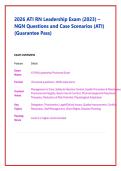
2026 ATI RN Leadership Exam (2023) –
NGN Questions and Case Scenarios (ATI)
(Guarantee Pass)
EXAM OVERVIEW
Feature Detail
Exam
ATI RN Leadership Proctored Exam
Name
Format 70 scored questions + NGN-style items
Management of Care, Safety & Infection Control, Health Promotion & Maintenance
Content
Psychosocial Integrity, Basic Care & Comfort, Pharmacological & Parenteral
Areas
Therapies, Reduction of Risk Potential, Physiological Adaptation
Key Delegation, Prioritization, Legal/Ethical Issues, Quality Improvement, Conflict
Topics Resolution, Staff Management, Client Rights, Disaster Planning
Passing
Level 2 or higher recommended
Score
,SECTION 1: DELEGATION & ASSIGNMENT
(Questions 1–30)
1. A charge nurse is delegating tasks to an assistive personnel (AP). Which of
the following tasks is appropriate to delegate?
A) Administering oral medications
B) Assessing a patient's skin condition
C) Providing a patient with a bed bath
D) Creating a plan of care for a patient
,,,,answer,,,,: C) Providing a patient with a bed bath
Rationale: The RN can delegate tasks that do not require nursing judgment or
assessment. Hygiene and bathing are within the scope of practice for an AP.
Medication administration, assessment, and care planning require the knowledge
and judgment of an RN.
,2. A nurse is making shift assignments in a hospital. Which of the following
tasks is appropriate to assign to a licensed practical nurse (LPN)?
A) Administering IV push medications
B) Administering a nasogastric tube feeding
C) Performing an initial admission assessment
D) Creating a discharge plan
,,,,answer,,,,: B) Administering a nasogastric tube feeding
Rationale: LPNs can perform stable, predictable tasks such as administering NG
tube feedings. IV push medications, initial assessments, and discharge planning
require RN-level education and judgment.
3. A nurse who is caring for a group of clients delegates collection of vital signs
to an assistive personnel (AP). Which of the following actions should the nurse
take to evaluate the delegated task?
A) Assume the AP performed the task correctly
B) Recheck vital signs that are outside the expected reference range
C) Document the delegation in the patient's chart
D) Observe the AP performing the task on all patients
,,,,answer,,,,: B) Recheck vital signs that are outside the expected reference
range
Rationale: Evaluation of delegated tasks includes rechecking any findings outside
the expected range to ensure accuracy and patient safety. The RN retains
accountability for delegated tasks.
, 4. A nurse is supervising a newly licensed nurse who is performing surgical
asepsis. After donning a sterile gown and gloves, which of the following actions
by the newly licensed nurse demonstrates correct aseptic technique?
A) The nurse holds her hands below her waist
B) The nurse holds her hands above her waist
C) The nurse places her hands on her hips
D) The nurse folds her arms across her chest
,,,,answer,,,,: B) The nurse holds her hands above her waist
Rationale: After donning sterile gloves and a gown, the nurse must keep hands
above the waist and within the sterile field to maintain sterility. Hands below the
waist are considered contaminated.
5. A nurse is caring for a group of clients and can delegate care to an LPN and
an AP. Which of the following tasks should the nurse assign to the LPN?
A) Feeding a client who has difficulty swallowing
B) Ambulating a client who is postoperative
C) Reinforcing teaching with a client who is learning to self-administer insulin
D) Bathing a client who is on bed rest
,,,,answer,,,,: C) Reinforcing teaching with a client who is learning to self-
administer insulin
Rationale: LPNs can reinforce teaching provided by the RN. Tasks that require
assessment, initial teaching, or complex judgment should be performed by the RN.
NGN Questions and Case Scenarios (ATI)
(Guarantee Pass)
EXAM OVERVIEW
Feature Detail
Exam
ATI RN Leadership Proctored Exam
Name
Format 70 scored questions + NGN-style items
Management of Care, Safety & Infection Control, Health Promotion & Maintenance
Content
Psychosocial Integrity, Basic Care & Comfort, Pharmacological & Parenteral
Areas
Therapies, Reduction of Risk Potential, Physiological Adaptation
Key Delegation, Prioritization, Legal/Ethical Issues, Quality Improvement, Conflict
Topics Resolution, Staff Management, Client Rights, Disaster Planning
Passing
Level 2 or higher recommended
Score
,SECTION 1: DELEGATION & ASSIGNMENT
(Questions 1–30)
1. A charge nurse is delegating tasks to an assistive personnel (AP). Which of
the following tasks is appropriate to delegate?
A) Administering oral medications
B) Assessing a patient's skin condition
C) Providing a patient with a bed bath
D) Creating a plan of care for a patient
,,,,answer,,,,: C) Providing a patient with a bed bath
Rationale: The RN can delegate tasks that do not require nursing judgment or
assessment. Hygiene and bathing are within the scope of practice for an AP.
Medication administration, assessment, and care planning require the knowledge
and judgment of an RN.
,2. A nurse is making shift assignments in a hospital. Which of the following
tasks is appropriate to assign to a licensed practical nurse (LPN)?
A) Administering IV push medications
B) Administering a nasogastric tube feeding
C) Performing an initial admission assessment
D) Creating a discharge plan
,,,,answer,,,,: B) Administering a nasogastric tube feeding
Rationale: LPNs can perform stable, predictable tasks such as administering NG
tube feedings. IV push medications, initial assessments, and discharge planning
require RN-level education and judgment.
3. A nurse who is caring for a group of clients delegates collection of vital signs
to an assistive personnel (AP). Which of the following actions should the nurse
take to evaluate the delegated task?
A) Assume the AP performed the task correctly
B) Recheck vital signs that are outside the expected reference range
C) Document the delegation in the patient's chart
D) Observe the AP performing the task on all patients
,,,,answer,,,,: B) Recheck vital signs that are outside the expected reference
range
Rationale: Evaluation of delegated tasks includes rechecking any findings outside
the expected range to ensure accuracy and patient safety. The RN retains
accountability for delegated tasks.
, 4. A nurse is supervising a newly licensed nurse who is performing surgical
asepsis. After donning a sterile gown and gloves, which of the following actions
by the newly licensed nurse demonstrates correct aseptic technique?
A) The nurse holds her hands below her waist
B) The nurse holds her hands above her waist
C) The nurse places her hands on her hips
D) The nurse folds her arms across her chest
,,,,answer,,,,: B) The nurse holds her hands above her waist
Rationale: After donning sterile gloves and a gown, the nurse must keep hands
above the waist and within the sterile field to maintain sterility. Hands below the
waist are considered contaminated.
5. A nurse is caring for a group of clients and can delegate care to an LPN and
an AP. Which of the following tasks should the nurse assign to the LPN?
A) Feeding a client who has difficulty swallowing
B) Ambulating a client who is postoperative
C) Reinforcing teaching with a client who is learning to self-administer insulin
D) Bathing a client who is on bed rest
,,,,answer,,,,: C) Reinforcing teaching with a client who is learning to self-
administer insulin
Rationale: LPNs can reinforce teaching provided by the RN. Tasks that require
assessment, initial teaching, or complex judgment should be performed by the RN.


