

US History Regents Exam Questions and
Answers with Verified Solutions | Latest
Updated 2026
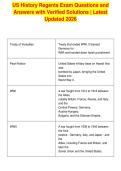
Treaty of Versailles Treaty that ended WWI. It blamed
Germany for
WWI and handed down harsh punishment.
Pearl Harbor United States military base on Hawaii that
was
bombed by Japan, bringing the United
States into
World War II.
WWI A war fought from 1914 to 1918 between
the Allies,
notably Britain, France, Russia, and Italy;
and the
Central Powers: Germany,
Austria-Hungary,
Bulgaria, and the Ottoman Empire.
WWII A war fought from 1939 to 1945 between
the Axis
powers - Germany, Italy, and Japan - and
the
Allies, including France and Britain, and
later the
Soviet Union and the United States.
,Japanese Internment Camps The forcible relocation of Japanese
Americans to
housing facilities called "War Relocation
Camps", in
the wake of Imperial Japan's attack on
Pearl Harbor.
Civilian Conservation Corps (CCC) Gave jobs to young men who worked on
conservation projects like planting trees,
building
parks, and preventing soil erosion.
Works Progress Administration Employed millions of Americans to build
(WPA) roads,
schools, bridges, and public buildings. It
also
supported artists, writers, and musicians.
Federal Deposit Insurance Protected people's money by insuring
Corporation (FDIC) bank
deposits, helping restore trust in the
banking
system.
Social Security Act (1935) Created a system of monthly payments for
retired
people, the unemployed, and those with
disabilities, pro
, Cold War A period of political tension and rivalry
between
the U.S. and Soviet Union after World War
II. It
included an arms race, space race, and
proxy wars,
but no direct fighting.
Cuban Missile Crisis 13-day standoff in 1962 between the U.S.
and the
Soviet Union over nuclear missiles in
Cuba.
Bay of Pigs Invasion A failed U.S.-backed attempt by Cuban
exiles to
overthrow Fidel Castro in 1961. It
embarrassed the
U.S. and made Castro's regime stronger.
Fidel Castro A revolutionary leader who ruled Cuba as
a
communist. He was a key figure during the
Cold
War and often clashed with the U.S.
East Berlin The capital of communist East Germany
during the
Cold War. It was controlled by the Soviet
Union
and separated from West Berlin by the
Berlin Wall.
Answers with Verified Solutions | Latest
Updated 2026
Treaty of Versailles Treaty that ended WWI. It blamed
Germany for
WWI and handed down harsh punishment.
Pearl Harbor United States military base on Hawaii that
was
bombed by Japan, bringing the United
States into
World War II.
WWI A war fought from 1914 to 1918 between
the Allies,
notably Britain, France, Russia, and Italy;
and the
Central Powers: Germany,
Austria-Hungary,
Bulgaria, and the Ottoman Empire.
WWII A war fought from 1939 to 1945 between
the Axis
powers - Germany, Italy, and Japan - and
the
Allies, including France and Britain, and
later the
Soviet Union and the United States.
,Japanese Internment Camps The forcible relocation of Japanese
Americans to
housing facilities called "War Relocation
Camps", in
the wake of Imperial Japan's attack on
Pearl Harbor.
Civilian Conservation Corps (CCC) Gave jobs to young men who worked on
conservation projects like planting trees,
building
parks, and preventing soil erosion.
Works Progress Administration Employed millions of Americans to build
(WPA) roads,
schools, bridges, and public buildings. It
also
supported artists, writers, and musicians.
Federal Deposit Insurance Protected people's money by insuring
Corporation (FDIC) bank
deposits, helping restore trust in the
banking
system.
Social Security Act (1935) Created a system of monthly payments for
retired
people, the unemployed, and those with
disabilities, pro
, Cold War A period of political tension and rivalry
between
the U.S. and Soviet Union after World War
II. It
included an arms race, space race, and
proxy wars,
but no direct fighting.
Cuban Missile Crisis 13-day standoff in 1962 between the U.S.
and the
Soviet Union over nuclear missiles in
Cuba.
Bay of Pigs Invasion A failed U.S.-backed attempt by Cuban
exiles to
overthrow Fidel Castro in 1961. It
embarrassed the
U.S. and made Castro's regime stronger.
Fidel Castro A revolutionary leader who ruled Cuba as
a
communist. He was a key figure during the
Cold
War and often clashed with the U.S.
East Berlin The capital of communist East Germany
during the
Cold War. It was controlled by the Soviet
Union
and separated from West Berlin by the
Berlin Wall.


