

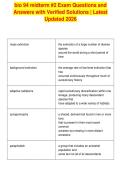
bio 94 midterm #2 Exam Questions and
Answers with Verified Solutions | Latest
Updated 2026
mass extinction the extinction of a large number of diverse
species
around the world during a short period of
time
background extinction the average rate of low-level extinction that
has
occurred continuously throughout much of
evolutionary history
adaptive radiations rapid evolutionary diversification within one
lineage, producing many descendant
species that
have adapted to a wide variety of habitats
synapomorphy a shared, derived trait found in two or more
taxa
that is present in their most recent
common
ancestor but missing in more distant
ancestors
paraphyletic a group that includes an ancestral
population and
some but not all of its descendants
, polyphyletic species grouped together, not based on
common
ancestry
monophyletic an evolutionary unit that includes an
ancestral
population and all of its descendants but
no others
the main parts of a phylogenetic - root
tree - node
- branch
- tip
- outgroup
branch lengths in phylogenetic same/leveled: means arbitrary and
trees relationship
longer branches: more mutations
short branches: extinctions
molecular clock as time progresses, number of mutations
increase
homology similarity among organisms due to shared
ancestry
homoplasy similarity among organisms of different
species due
to reasons other than common ancestry
Answers with Verified Solutions | Latest
Updated 2026
mass extinction the extinction of a large number of diverse
species
around the world during a short period of
time
background extinction the average rate of low-level extinction that
has
occurred continuously throughout much of
evolutionary history
adaptive radiations rapid evolutionary diversification within one
lineage, producing many descendant
species that
have adapted to a wide variety of habitats
synapomorphy a shared, derived trait found in two or more
taxa
that is present in their most recent
common
ancestor but missing in more distant
ancestors
paraphyletic a group that includes an ancestral
population and
some but not all of its descendants
, polyphyletic species grouped together, not based on
common
ancestry
monophyletic an evolutionary unit that includes an
ancestral
population and all of its descendants but
no others
the main parts of a phylogenetic - root
tree - node
- branch
- tip
- outgroup
branch lengths in phylogenetic same/leveled: means arbitrary and
trees relationship
longer branches: more mutations
short branches: extinctions
molecular clock as time progresses, number of mutations
increase
homology similarity among organisms due to shared
ancestry
homoplasy similarity among organisms of different
species due
to reasons other than common ancestry


