

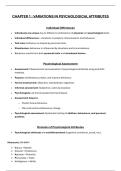
CHAPTER 1 : VARIATIONS IN PSYCHOLOGICAL ATTRIBUTES
Individual Differences
• Individuals are unique due to different combinations of physical and psychological traits.
• Individual differences = variations in people's characteristics and behaviour.
• Trait view: behaviour is shaped by personal traits.
• Situationism: behaviour is influenced by situations and circumstances.
• Behaviour results from both personal traits and situational factors.
Psychological Assessment
• Assessment: Measurement and evaluation of psychological attributes using scientific
methods.
• Purpose: Understand, predict, and improve behaviour.
• Formal assessment: Objective, standardized, organized.
• Informal assessment: Subjective, varies by assessor.
• Psychologists use formal assessment techniques.
• Assessment helps to:
o Predict future behaviour.
o Plan interventions/behaviour change.
• Psychological assessment: Systematic testing of abilities, behaviours, and personal
qualities.
Domains of Psychological Attributes
• Psychological attributes are multidimensional (cognitive, emotional, social, etc.).
Mnemonic: V-I-A-P-I
➢ Values → Beliefs
➢ Interest → Preference
➢ Aptitude → Potential
➢ Personality → Traits
➢ Intelligence → Ability
,Domain Meaning Assessment/Purpose
Ability to understand, think rationally, Measures general cognitive ability; predicts
Intelligence
solve problems academic performance
Aptitude Potential to acquire skills Predicts future performance after training
Helps choose suitable subjects, careers, and
Interest Preference for certain activities
jobs
Enduring traits that make a person
Personality Explains and predicts behaviour
unique
Identifies dominant values (social, political,
Values Enduring beliefs guiding behaviour
religious, economic)
Assessment Methods
Method Meaning Main Use Limitation
Objective & standardized Measures intelligence, aptitude,
Psychological Limited to what test
test of mental/behavioural personality; diagnosis,
Test measures
traits guidance, selection, training
One-to-one information Counselling, employee May be
Interview
gathering selection, surveys biased/subjective
In-depth study of an Clinical assessment, Time-consuming;
Case Study
individual understanding behaviour limited generalization
Systematic recording of Little control;
Observation Studies real-life behaviour
behaviour in natural settings observer bias
Person reports own facts, Questionnaires, interviews, May be dishonest or
Self-Report
opinions, beliefs diaries inaccurate
Mnemonic: P-I-C-O-S
➢ P – Psychological Test
➢ I – Interview
➢ C – Case Study
➢ O – Observation
➢ S – Self-Report
, Intelligence
• Intelligence: Ability to learn, understand, reason, think, and adapt.
• Explains individual differences and adaptation to the environment.
• Common traits: Mental alertness, quick learning, ready wit, understanding relationships.
Definitions
• Oxford Dictionary: Power to perceive, learn, understand, and know. (P-L-U-K)
• Alfred Binet: Ability to judge, understand, and reason well. (J-U-R)
• David Wechsler: Global ability to think rationally, act purposefully, and adapt effectively.
(A-T-A)
• Gardner & Sternberg: Intelligence includes adapting to and shaping the environment.
APPROACHES TO INTELLIGENCE
Psychometric / Structural Approach Information-Processing Approach
Intelligence = thinking & problem-solving
Intelligence = aggregate of abilities
processes
Focuses on structure of intelligence Focuses on how intelligence works
Measures intelligence with a single cognitive Studies cognitive processes behind intelligent
score (IQ) behaviour
Emphasises how a person thinks and solves
Emphasises what abilities a person has
problems
Memory Trick
• Psychometric = "What you have" (abilities, IQ)
• Information Processing = "How you think" (mental processes)
Individual Differences
• Individuals are unique due to different combinations of physical and psychological traits.
• Individual differences = variations in people's characteristics and behaviour.
• Trait view: behaviour is shaped by personal traits.
• Situationism: behaviour is influenced by situations and circumstances.
• Behaviour results from both personal traits and situational factors.
Psychological Assessment
• Assessment: Measurement and evaluation of psychological attributes using scientific
methods.
• Purpose: Understand, predict, and improve behaviour.
• Formal assessment: Objective, standardized, organized.
• Informal assessment: Subjective, varies by assessor.
• Psychologists use formal assessment techniques.
• Assessment helps to:
o Predict future behaviour.
o Plan interventions/behaviour change.
• Psychological assessment: Systematic testing of abilities, behaviours, and personal
qualities.
Domains of Psychological Attributes
• Psychological attributes are multidimensional (cognitive, emotional, social, etc.).
Mnemonic: V-I-A-P-I
➢ Values → Beliefs
➢ Interest → Preference
➢ Aptitude → Potential
➢ Personality → Traits
➢ Intelligence → Ability
,Domain Meaning Assessment/Purpose
Ability to understand, think rationally, Measures general cognitive ability; predicts
Intelligence
solve problems academic performance
Aptitude Potential to acquire skills Predicts future performance after training
Helps choose suitable subjects, careers, and
Interest Preference for certain activities
jobs
Enduring traits that make a person
Personality Explains and predicts behaviour
unique
Identifies dominant values (social, political,
Values Enduring beliefs guiding behaviour
religious, economic)
Assessment Methods
Method Meaning Main Use Limitation
Objective & standardized Measures intelligence, aptitude,
Psychological Limited to what test
test of mental/behavioural personality; diagnosis,
Test measures
traits guidance, selection, training
One-to-one information Counselling, employee May be
Interview
gathering selection, surveys biased/subjective
In-depth study of an Clinical assessment, Time-consuming;
Case Study
individual understanding behaviour limited generalization
Systematic recording of Little control;
Observation Studies real-life behaviour
behaviour in natural settings observer bias
Person reports own facts, Questionnaires, interviews, May be dishonest or
Self-Report
opinions, beliefs diaries inaccurate
Mnemonic: P-I-C-O-S
➢ P – Psychological Test
➢ I – Interview
➢ C – Case Study
➢ O – Observation
➢ S – Self-Report
, Intelligence
• Intelligence: Ability to learn, understand, reason, think, and adapt.
• Explains individual differences and adaptation to the environment.
• Common traits: Mental alertness, quick learning, ready wit, understanding relationships.
Definitions
• Oxford Dictionary: Power to perceive, learn, understand, and know. (P-L-U-K)
• Alfred Binet: Ability to judge, understand, and reason well. (J-U-R)
• David Wechsler: Global ability to think rationally, act purposefully, and adapt effectively.
(A-T-A)
• Gardner & Sternberg: Intelligence includes adapting to and shaping the environment.
APPROACHES TO INTELLIGENCE
Psychometric / Structural Approach Information-Processing Approach
Intelligence = thinking & problem-solving
Intelligence = aggregate of abilities
processes
Focuses on structure of intelligence Focuses on how intelligence works
Measures intelligence with a single cognitive Studies cognitive processes behind intelligent
score (IQ) behaviour
Emphasises how a person thinks and solves
Emphasises what abilities a person has
problems
Memory Trick
• Psychometric = "What you have" (abilities, IQ)
• Information Processing = "How you think" (mental processes)


