
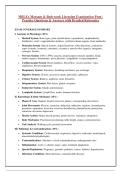
EXAM COVERAGE SUMMARY
I. Anatomy & Physiology (30%)
Skeletal System: Bone types, joint classifications (synarthrotic, amphiarthrotic,
diarthrotic), axial vs appendicular skeleton, vertebral column regions, bone landmarks
Muscular System: Muscle actions, origins/insertions, fiber directions, contraction
types (isotonic, isometric, concentric, eccentric), muscle roles (agonist, antagonist,
synergist, fixator)
Nervous System: CNS vs PNS, neurons, proprioceptors (muscle spindles, Golgi
tendon organs), dermatomes, nerve plexuses, sympathetic vs parasympathetic
Cardiovascular System: Heart chambers, blood flow, vessels (arteries, veins,
capillaries), blood components
Respiratory System: Structures, breathing mechanics, gas exchange
Digestive System: GI tract, accessory organs, peristalsis, sphincters
Urinary System: Kidneys, nephrons, urine formation
Integumentary System: Skin layers, glands, receptors
Endocrine System: Glands and hormones
Lymphatic System: Lymph flow, nodes, immune function
II. Kinesiology & Body Mechanics (15%)
Planes & Axes: Sagittal, frontal, transverse planes; corresponding movements
Joint Movements: Flexion, extension, abduction, adduction, rotation, circumduction,
pronation, supination, inversion, eversion, dorsiflexion, plantarflexion, protraction,
retraction, elevation, depression
Muscle Actions: Major muscle groups, prime movers, synergists, antagonists
Body Mechanics: Practitioner positioning, table height, stances, joint protection
Gait Analysis: Walking cycle, postural assessment
III. Pathology & Contraindications (15%)
Systemic Conditions: Cardiovascular, respiratory, digestive, endocrine, neurological,
musculoskeletal pathologies
Contraindications: Absolute vs local contraindications, endangerment sites
Inflammation: Acute vs chronic stages, signs, treatment adaptations
Special Populations: Pregnancy, geriatric, pediatric, cancer, diabetes, hypertension
Infectious Conditions: Skin infections, communicable diseases
,IV. Massage Techniques & Application (15%)
Swedish Techniques: Effleurage, petrissage, friction, tapotement, vibration
Deep Tissue: Myofascial release, trigger point therapy, cross-fiber friction
Hydrotherapy: Heat vs cold applications, indications, contraindications
Stretching: Active, passive, PNF, active isolated, muscle energy techniques
Other Modalities: Sports massage, prenatal massage, lymphatic drainage,
reflexology, shiatsu, Thai massage, craniosacral therapy
V. Client Assessment & Treatment Planning (10%)
Assessment Types: Postural, gait, ROM (active, passive, resistive), palpation
SOAP Notes: Subjective, Objective, Assessment, Plan documentation
Informed Consent: Process, components, disclosure
Treatment Plans: Goal setting, session frequency, home care recommendations
VI. Professional Standards & Ethics (10%)
Professional Boundaries: Transference, counter-transference, power differential
Ethics: Confidentiality, HIPAA, scope of practice, professional conduct
Legal Issues: Informed consent, documentation, liability, malpractice
Business Practices: Record keeping, taxes, insurance, marketing
VII. Business Practices (5%)
Business Structures: Sole proprietorship, partnership, corporation
Financial Management: Taxes, expenses, accounts payable/receivable
Insurance: General liability, professional liability, malpractice
Marketing: Advertising, publicity, networking
,QUESTION 1
A client reports experiencing numbness and tingling in the thumb, index finger, and middle
finger of the right hand that worsens at night. Which of the following conditions is most
likely indicated by these symptoms?
A. Thoracic outlet syndrome
B. Ulnar nerve entrapment
C. Carpal tunnel syndrome
D. Radial nerve palsy
Answer: C
Carpal tunnel syndrome typically presents with paresthesia in the distribution of the median
nerve, which innervates the thumb, index finger, middle finger, and lateral half of the ring
finger. Symptoms often worsen at night due to wrist positioning during sleep.
QUESTION 2
Which of the following joints is classified as a synarthrotic joint, allowing little to no
movement?
A. Symphysis pubis
B. Glenohumeral joint
C. Gomphosis
D. Atlantoaxial joint
Answer: C
A gomphosis is a synarthrotic joint found between the teeth and their bony sockets, allowing
no movement. Symphysis pubis is amphiarthrotic, while glenohumeral and atlantoaxial joints
are diarthrotic, freely movable joints.
QUESTION 3
, A practitioner notices that a client's foot is excessively everted during a postural assessment.
Which muscle would most likely need to be lengthened to address this condition?
A. Tibialis anterior
B. Tibialis posterior
C. Peroneus longus
D. Extensor digitorum longus
Answer: C
Peroneus longus is a primary evertor of the foot. When hypertonic or shortened, it can
contribute to excessive eversion. Lengthening this muscle would help address the postural
deviation.
QUESTION 4
What is the primary function of the Golgi tendon organ?
A. Detecting muscle length changes
B. Monitoring tension within tendons
C. Sensing light touch on the skin
D. Detecting joint angle position
Answer: B
Golgi tendon organs are proprioceptors located at the musculotendinous junction that detect
tension within tendons. They provide inhibitory feedback to protect muscles from excessive
force generation, unlike muscle spindles which detect stretch.
QUESTION 5
A client presents with redness, heat, swelling, and pain in the lower leg following a recent
injury. These signs indicate which stage of inflammation?
A. Chronic inflammation
B. Subacute inflammation
C. Acute inflammation
D. Resolution phase
I. Anatomy & Physiology (30%)
Skeletal System: Bone types, joint classifications (synarthrotic, amphiarthrotic,
diarthrotic), axial vs appendicular skeleton, vertebral column regions, bone landmarks
Muscular System: Muscle actions, origins/insertions, fiber directions, contraction
types (isotonic, isometric, concentric, eccentric), muscle roles (agonist, antagonist,
synergist, fixator)
Nervous System: CNS vs PNS, neurons, proprioceptors (muscle spindles, Golgi
tendon organs), dermatomes, nerve plexuses, sympathetic vs parasympathetic
Cardiovascular System: Heart chambers, blood flow, vessels (arteries, veins,
capillaries), blood components
Respiratory System: Structures, breathing mechanics, gas exchange
Digestive System: GI tract, accessory organs, peristalsis, sphincters
Urinary System: Kidneys, nephrons, urine formation
Integumentary System: Skin layers, glands, receptors
Endocrine System: Glands and hormones
Lymphatic System: Lymph flow, nodes, immune function
II. Kinesiology & Body Mechanics (15%)
Planes & Axes: Sagittal, frontal, transverse planes; corresponding movements
Joint Movements: Flexion, extension, abduction, adduction, rotation, circumduction,
pronation, supination, inversion, eversion, dorsiflexion, plantarflexion, protraction,
retraction, elevation, depression
Muscle Actions: Major muscle groups, prime movers, synergists, antagonists
Body Mechanics: Practitioner positioning, table height, stances, joint protection
Gait Analysis: Walking cycle, postural assessment
III. Pathology & Contraindications (15%)
Systemic Conditions: Cardiovascular, respiratory, digestive, endocrine, neurological,
musculoskeletal pathologies
Contraindications: Absolute vs local contraindications, endangerment sites
Inflammation: Acute vs chronic stages, signs, treatment adaptations
Special Populations: Pregnancy, geriatric, pediatric, cancer, diabetes, hypertension
Infectious Conditions: Skin infections, communicable diseases
,IV. Massage Techniques & Application (15%)
Swedish Techniques: Effleurage, petrissage, friction, tapotement, vibration
Deep Tissue: Myofascial release, trigger point therapy, cross-fiber friction
Hydrotherapy: Heat vs cold applications, indications, contraindications
Stretching: Active, passive, PNF, active isolated, muscle energy techniques
Other Modalities: Sports massage, prenatal massage, lymphatic drainage,
reflexology, shiatsu, Thai massage, craniosacral therapy
V. Client Assessment & Treatment Planning (10%)
Assessment Types: Postural, gait, ROM (active, passive, resistive), palpation
SOAP Notes: Subjective, Objective, Assessment, Plan documentation
Informed Consent: Process, components, disclosure
Treatment Plans: Goal setting, session frequency, home care recommendations
VI. Professional Standards & Ethics (10%)
Professional Boundaries: Transference, counter-transference, power differential
Ethics: Confidentiality, HIPAA, scope of practice, professional conduct
Legal Issues: Informed consent, documentation, liability, malpractice
Business Practices: Record keeping, taxes, insurance, marketing
VII. Business Practices (5%)
Business Structures: Sole proprietorship, partnership, corporation
Financial Management: Taxes, expenses, accounts payable/receivable
Insurance: General liability, professional liability, malpractice
Marketing: Advertising, publicity, networking
,QUESTION 1
A client reports experiencing numbness and tingling in the thumb, index finger, and middle
finger of the right hand that worsens at night. Which of the following conditions is most
likely indicated by these symptoms?
A. Thoracic outlet syndrome
B. Ulnar nerve entrapment
C. Carpal tunnel syndrome
D. Radial nerve palsy
Answer: C
Carpal tunnel syndrome typically presents with paresthesia in the distribution of the median
nerve, which innervates the thumb, index finger, middle finger, and lateral half of the ring
finger. Symptoms often worsen at night due to wrist positioning during sleep.
QUESTION 2
Which of the following joints is classified as a synarthrotic joint, allowing little to no
movement?
A. Symphysis pubis
B. Glenohumeral joint
C. Gomphosis
D. Atlantoaxial joint
Answer: C
A gomphosis is a synarthrotic joint found between the teeth and their bony sockets, allowing
no movement. Symphysis pubis is amphiarthrotic, while glenohumeral and atlantoaxial joints
are diarthrotic, freely movable joints.
QUESTION 3
, A practitioner notices that a client's foot is excessively everted during a postural assessment.
Which muscle would most likely need to be lengthened to address this condition?
A. Tibialis anterior
B. Tibialis posterior
C. Peroneus longus
D. Extensor digitorum longus
Answer: C
Peroneus longus is a primary evertor of the foot. When hypertonic or shortened, it can
contribute to excessive eversion. Lengthening this muscle would help address the postural
deviation.
QUESTION 4
What is the primary function of the Golgi tendon organ?
A. Detecting muscle length changes
B. Monitoring tension within tendons
C. Sensing light touch on the skin
D. Detecting joint angle position
Answer: B
Golgi tendon organs are proprioceptors located at the musculotendinous junction that detect
tension within tendons. They provide inhibitory feedback to protect muscles from excessive
force generation, unlike muscle spindles which detect stretch.
QUESTION 5
A client presents with redness, heat, swelling, and pain in the lower leg following a recent
injury. These signs indicate which stage of inflammation?
A. Chronic inflammation
B. Subacute inflammation
C. Acute inflammation
D. Resolution phase


