
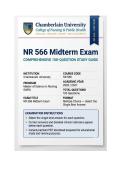
,NR 566 Midterm Exam – Advanced Pharmacology –
Q&A (2026) PDF | Chamberlain
1. The nurse practitioner prescribes trimethoprim-sulfamethoxazole for a 26-year-old woman
with an uncomplicated UTI. Which pathogen is the most common cause of this infection?
A) Proteus mirabilis
B) Enterococcus faecalis
C) Escherichia coli
D) Klebsiella pneumoniae
Correct Answer: C) Escherichia coli
Rationale: E. coli accounts for approximately 80% of uncomplicated community-acquired
UTIs. Nitrofurantoin and TMP-SMX are first-line because they achieve high urinary
concentrations. Other organisms are less frequent and typically associated with complicated
infections.
2. The nurse practitioner is treating a patient with a severe penicillin allergy. Which antibiotic
class should be avoided due to potential cross-reactivity?
A) Macrolides
B) Tetracyclines
C) Cephalosporins
D) Fluoroquinolones
Correct Answer: C) Cephalosporins
Rationale: Cephalosporins share a beta-lactam ring with penicillins; cross-reactivity can occur,
especially in patients with anaphylactic reactions to penicillin. Macrolides, tetracyclines, and
fluoroquinolones are structurally unrelated and safe alternatives.
,3. A patient is prescribed an azole antifungal for vulvovaginal candidiasis. The nurse
practitioner advises that azoles should be avoided in pregnancy due to:
A) Hepatotoxicity
B) Nephrotoxicity
C) Teratogenicity
D) Cardiotoxicity
Correct Answer: C) Teratogenicity
Rationale: Systemic azoles can cause fetal malformations; topical clotrimazole or miconazole
is preferred during pregnancy. Azoles inhibit CYP450, increasing drug interactions, but
teratogenicity is the primary pregnancy concern.
4. The nurse practitioner is initiating lorcaserin for weight management. What baseline
assessment is required before starting therapy?
A) Complete blood count
B) Liver function tests
C) Thyroid function tests
D) Assessment to rule out valvular disorders and pulmonary hypertension
Correct Answer: D) Assessment to rule out valvular disorders and pulmonary hypertension
Rationale: Lorcaserin, a 5-HT2C receptor agonist, is associated with valvular heart disease and
pulmonary hypertension risk. Baseline echocardiography and clinical assessment are
necessary. CBC monitoring is also recommended for blood dyscrasias.
5. A patient with moderate-to-severe allergic rhinitis has nasal congestion as the dominant
complaint. Which first-line intranasal therapy should the nurse practitioner prescribe?
A) Oral antihistamine
, B) Intranasal glucocorticoid
C) Decongestant spray
D) Leukotriene receptor antagonist
Correct Answer: B) Intranasal glucocorticoid
Rationale: Intranasal corticosteroids are the most effective for treating nasal congestion and
overall allergic rhinitis symptoms. Antihistamines primarily address sneezing and itching.
Decongestants are for short-term use, and leukotriene antagonists are second-line.
6. The nurse practitioner is counseling a patient starting Contrave (naltrexone/bupropion) for
weight loss. The black box warning for this medication relates to:
A) Hepatotoxicity
B) Suicidality in children, adolescents, and young adults
C) Valvular heart disease
D) Pulmonary hypertension
Correct Answer: B) Suicidality in children, adolescents, and young adults
Rationale: The bupropion component carries a black box warning for increased risk of suicidal
thoughts and behaviors in pediatric and young adult patients. The combination is
contraindicated in patients with seizure disorders or eating disorders.
7. A patient with cytomegalovirus retinitis is prescribed ganciclovir. The nurse practitioner
monitors for which serious adverse effect?
A) Nephrotoxicity
B) Granulocytopenia
C) Hepatotoxicity
D) Ototoxicity
Q&A (2026) PDF | Chamberlain
1. The nurse practitioner prescribes trimethoprim-sulfamethoxazole for a 26-year-old woman
with an uncomplicated UTI. Which pathogen is the most common cause of this infection?
A) Proteus mirabilis
B) Enterococcus faecalis
C) Escherichia coli
D) Klebsiella pneumoniae
Correct Answer: C) Escherichia coli
Rationale: E. coli accounts for approximately 80% of uncomplicated community-acquired
UTIs. Nitrofurantoin and TMP-SMX are first-line because they achieve high urinary
concentrations. Other organisms are less frequent and typically associated with complicated
infections.
2. The nurse practitioner is treating a patient with a severe penicillin allergy. Which antibiotic
class should be avoided due to potential cross-reactivity?
A) Macrolides
B) Tetracyclines
C) Cephalosporins
D) Fluoroquinolones
Correct Answer: C) Cephalosporins
Rationale: Cephalosporins share a beta-lactam ring with penicillins; cross-reactivity can occur,
especially in patients with anaphylactic reactions to penicillin. Macrolides, tetracyclines, and
fluoroquinolones are structurally unrelated and safe alternatives.
,3. A patient is prescribed an azole antifungal for vulvovaginal candidiasis. The nurse
practitioner advises that azoles should be avoided in pregnancy due to:
A) Hepatotoxicity
B) Nephrotoxicity
C) Teratogenicity
D) Cardiotoxicity
Correct Answer: C) Teratogenicity
Rationale: Systemic azoles can cause fetal malformations; topical clotrimazole or miconazole
is preferred during pregnancy. Azoles inhibit CYP450, increasing drug interactions, but
teratogenicity is the primary pregnancy concern.
4. The nurse practitioner is initiating lorcaserin for weight management. What baseline
assessment is required before starting therapy?
A) Complete blood count
B) Liver function tests
C) Thyroid function tests
D) Assessment to rule out valvular disorders and pulmonary hypertension
Correct Answer: D) Assessment to rule out valvular disorders and pulmonary hypertension
Rationale: Lorcaserin, a 5-HT2C receptor agonist, is associated with valvular heart disease and
pulmonary hypertension risk. Baseline echocardiography and clinical assessment are
necessary. CBC monitoring is also recommended for blood dyscrasias.
5. A patient with moderate-to-severe allergic rhinitis has nasal congestion as the dominant
complaint. Which first-line intranasal therapy should the nurse practitioner prescribe?
A) Oral antihistamine
, B) Intranasal glucocorticoid
C) Decongestant spray
D) Leukotriene receptor antagonist
Correct Answer: B) Intranasal glucocorticoid
Rationale: Intranasal corticosteroids are the most effective for treating nasal congestion and
overall allergic rhinitis symptoms. Antihistamines primarily address sneezing and itching.
Decongestants are for short-term use, and leukotriene antagonists are second-line.
6. The nurse practitioner is counseling a patient starting Contrave (naltrexone/bupropion) for
weight loss. The black box warning for this medication relates to:
A) Hepatotoxicity
B) Suicidality in children, adolescents, and young adults
C) Valvular heart disease
D) Pulmonary hypertension
Correct Answer: B) Suicidality in children, adolescents, and young adults
Rationale: The bupropion component carries a black box warning for increased risk of suicidal
thoughts and behaviors in pediatric and young adult patients. The combination is
contraindicated in patients with seizure disorders or eating disorders.
7. A patient with cytomegalovirus retinitis is prescribed ganciclovir. The nurse practitioner
monitors for which serious adverse effect?
A) Nephrotoxicity
B) Granulocytopenia
C) Hepatotoxicity
D) Ototoxicity


