
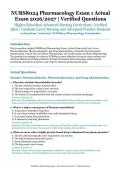
NURS8024 Pharmacology Exam 1 Actual
Exam 2026/2027 | Verified Questions
Higher Education Advanced Nursing Curriculum | Verified
Q&A | Graduate-Level Nursing and Advanced Practice Students
50 Questions | 2026/2027 NURS8024 Pharmacology Examination
Introduction
This 50-question original NURS8024 Pharmacology Exam 1 Actual Exam 2026/2027 covers
Pharmacokinetics, Pharmacodynamics, and Drug Administration, Autonomic Nervous System
Pharmacology, Central Nervous System Pharmacology, and Cardiovascular and Renal Pharmacology.
The questions are designed to reinforce NURS8024 course objectives for actual exam readiness and
advanced clinical prescribing proficiency through mechanism-based reasoning, patient-specific
monitoring, interaction awareness, and evidence-informed medication decisions.
Actual Questions
Domain: Pharmacokinetics, Pharmacodynamics, and Drug Administration
1. What does absolute bioavailability describe?
A. The dose needed to produce maximal effect.
B. The time required for a drug to leave the body.
C. The percentage of a drug bound to a receptor.
D. The fraction of an administered dose that reaches systemic circulation unchanged.
Correct Answer: D
Rationale: Bioavailability reflects the amount of administered drug reaching systemic circulation. Oral
drugs can have reduced bioavailability because of partial absorption and first-pass metabolism.
2. What is a major consequence of first-pass metabolism?
A. It guarantees immediate drug effect.
B. It can reduce systemic availability of an orally administered drug.
C. It prevents hepatic drug interactions.
D. It eliminates renal drug elimination.
Correct Answer: B
Rationale: First-pass metabolism occurs in the gut wall and liver before systemic circulation after oral
administration. It can lower the amount of active drug reaching the circulation.
3. What can occur when a highly protein-bound drug is displaced from plasma proteins?
A. The free, pharmacologically active drug fraction can increase.
B. The drug becomes permanently inactive.
C. Renal elimination stops entirely.
D. The drug cannot enter tissues.
Correct Answer: A
Rationale: Only unbound drug is generally available for receptor interaction, distribution, and
elimination. Changes in protein binding can increase active free concentration.
NURS8024 Pharmacology Exam 1 Actual Exam 2026/2027 | Verified Questions
, 4. What does a large apparent volume of distribution generally suggest?
A. The drug has no tissue binding.
B. The drug cannot cross any membrane.
C. The drug distributes extensively into tissues relative to plasma.
D. The drug remains only in the bloodstream.
Correct Answer: C
Rationale: A large apparent volume of distribution suggests extensive tissue distribution or binding. It is a
theoretical volume that helps describe drug distribution.
5. What is the practical meaning of a drug half-life?
A. The time required for receptor binding to begin.
B. The time required for the drug concentration to decline by one-half during elimination.
C. The time a prescription remains valid.
D. The time before the first dose can be given.
Correct Answer: B
Rationale: Half-life helps predict dosing intervals, time to steady state, and washout. It can change with
organ dysfunction or altered clearance.
6. For most drugs given repeatedly at a constant interval, when is approximate steady
state reached?
A. Immediately after the first dose.
B. After one-half of a half-life.
C. Only after a drug is discontinued.
D. After about four to five elimination half-lives.
Correct Answer: D
Rationale: Steady state is reached when drug input and elimination balance. For many drugs, this occurs
after several half-lives, assuming stable kinetics.
7. Why can renal impairment require dose adjustment for a renally eliminated drug?
A. Renal impairment always increases absorption.
B. Reduced clearance can increase drug exposure and toxicity risk.
C. The drug becomes inactive in the liver.
D. Protein binding becomes irrelevant.
Correct Answer: B
Rationale: Reduced renal function can slow elimination of renally cleared drugs or metabolites. Dose,
interval, and monitoring should follow patient-specific guidance.
8. What is the purpose of a loading dose?
A. To reduce a drug’s half-life.
B. To eliminate the need for maintenance dosing.
C. To prevent all adverse effects.
D. To reach a desired therapeutic concentration more rapidly when clinically indicated.
Correct Answer: D
Rationale: A loading dose is calculated to rapidly establish a target concentration, often for drugs with
long half-lives. Ongoing maintenance dosing is still needed.
NURS8024 Pharmacology Exam 1 Actual Exam 2026/2027 | Verified Questions
Exam 2026/2027 | Verified Questions
Higher Education Advanced Nursing Curriculum | Verified
Q&A | Graduate-Level Nursing and Advanced Practice Students
50 Questions | 2026/2027 NURS8024 Pharmacology Examination
Introduction
This 50-question original NURS8024 Pharmacology Exam 1 Actual Exam 2026/2027 covers
Pharmacokinetics, Pharmacodynamics, and Drug Administration, Autonomic Nervous System
Pharmacology, Central Nervous System Pharmacology, and Cardiovascular and Renal Pharmacology.
The questions are designed to reinforce NURS8024 course objectives for actual exam readiness and
advanced clinical prescribing proficiency through mechanism-based reasoning, patient-specific
monitoring, interaction awareness, and evidence-informed medication decisions.
Actual Questions
Domain: Pharmacokinetics, Pharmacodynamics, and Drug Administration
1. What does absolute bioavailability describe?
A. The dose needed to produce maximal effect.
B. The time required for a drug to leave the body.
C. The percentage of a drug bound to a receptor.
D. The fraction of an administered dose that reaches systemic circulation unchanged.
Correct Answer: D
Rationale: Bioavailability reflects the amount of administered drug reaching systemic circulation. Oral
drugs can have reduced bioavailability because of partial absorption and first-pass metabolism.
2. What is a major consequence of first-pass metabolism?
A. It guarantees immediate drug effect.
B. It can reduce systemic availability of an orally administered drug.
C. It prevents hepatic drug interactions.
D. It eliminates renal drug elimination.
Correct Answer: B
Rationale: First-pass metabolism occurs in the gut wall and liver before systemic circulation after oral
administration. It can lower the amount of active drug reaching the circulation.
3. What can occur when a highly protein-bound drug is displaced from plasma proteins?
A. The free, pharmacologically active drug fraction can increase.
B. The drug becomes permanently inactive.
C. Renal elimination stops entirely.
D. The drug cannot enter tissues.
Correct Answer: A
Rationale: Only unbound drug is generally available for receptor interaction, distribution, and
elimination. Changes in protein binding can increase active free concentration.
NURS8024 Pharmacology Exam 1 Actual Exam 2026/2027 | Verified Questions
, 4. What does a large apparent volume of distribution generally suggest?
A. The drug has no tissue binding.
B. The drug cannot cross any membrane.
C. The drug distributes extensively into tissues relative to plasma.
D. The drug remains only in the bloodstream.
Correct Answer: C
Rationale: A large apparent volume of distribution suggests extensive tissue distribution or binding. It is a
theoretical volume that helps describe drug distribution.
5. What is the practical meaning of a drug half-life?
A. The time required for receptor binding to begin.
B. The time required for the drug concentration to decline by one-half during elimination.
C. The time a prescription remains valid.
D. The time before the first dose can be given.
Correct Answer: B
Rationale: Half-life helps predict dosing intervals, time to steady state, and washout. It can change with
organ dysfunction or altered clearance.
6. For most drugs given repeatedly at a constant interval, when is approximate steady
state reached?
A. Immediately after the first dose.
B. After one-half of a half-life.
C. Only after a drug is discontinued.
D. After about four to five elimination half-lives.
Correct Answer: D
Rationale: Steady state is reached when drug input and elimination balance. For many drugs, this occurs
after several half-lives, assuming stable kinetics.
7. Why can renal impairment require dose adjustment for a renally eliminated drug?
A. Renal impairment always increases absorption.
B. Reduced clearance can increase drug exposure and toxicity risk.
C. The drug becomes inactive in the liver.
D. Protein binding becomes irrelevant.
Correct Answer: B
Rationale: Reduced renal function can slow elimination of renally cleared drugs or metabolites. Dose,
interval, and monitoring should follow patient-specific guidance.
8. What is the purpose of a loading dose?
A. To reduce a drug’s half-life.
B. To eliminate the need for maintenance dosing.
C. To prevent all adverse effects.
D. To reach a desired therapeutic concentration more rapidly when clinically indicated.
Correct Answer: D
Rationale: A loading dose is calculated to rapidly establish a target concentration, often for drugs with
long half-lives. Ongoing maintenance dosing is still needed.
NURS8024 Pharmacology Exam 1 Actual Exam 2026/2027 | Verified Questions


